
A Heritage Architecture Walk Through Mumbai
A calm, self-guided walk through Mumbai's UNESCO heritage: Victorian Gothic at CSMT and the High Court, and Art Deco along Marine Drive.
'%3E%3Crect%20width%3D'96'%20height%3D'96'%20fill%3D'%23E65100'%2F%3E%3Ccircle%20cx%3D'30'%20cy%3D'24'%20r%3D'44'%20fill%3D'%23fff'%20opacity%3D'.12'%2F%3E%3Ccircle%20cx%3D'60'%20cy%3D'74'%20r%3D'40'%20fill%3D'%23000'%20opacity%3D'.10'%2F%3E%3C%2Fg%3E%3Cg%3E%3Ccircle%20cx%3D'48'%20cy%3D'48'%20r%3D'15'%20fill%3D'none'%20stroke%3D'%23fff'%20stroke-width%3D'3'%2F%3E%3Cpath%20fill%3D'%23fff'%20d%3D'M48%2037%20l3.5%2011%20-3.5%2011%20-3.5%20-11%20z'%2F%3E%3Ccircle%20cx%3D'48'%20cy%3D'48'%20r%3D'2.2'%20fill%3D'%23fff'%2F%3E%3C%2Fg%3E%3C%2Fsvg%3E)
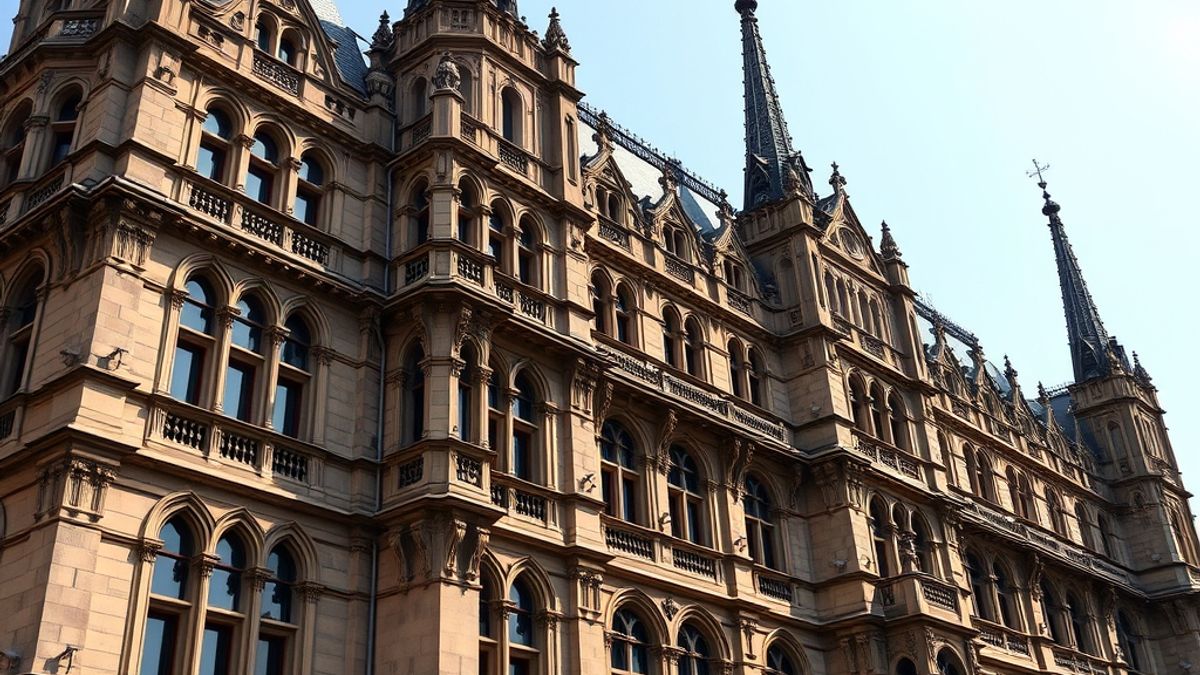
Mumbai keeps one of the world’s great architectural stories out in the open, and you can read it on foot in a single unhurried afternoon. The setting is a cricket ground in the heart of the city called the Oval Maidan, and the two eras that face each other across its grass could hardly be more different. On the eastern edge stand the soaring Victorian Gothic public buildings the British raised as their empire peaked in the nineteenth century. On the western edge, looking towards the sea, runs a long parade of streamlined 1930s Art Deco — the confident, home-grown Bombay of the jazz age. Together they earned the city a UNESCO World Heritage listing in 2018, and reading them side by side is the whole point of this walk.
This is a self-guided route you can do at your own pace, for free, with nothing more than comfortable shoes and a bit of curiosity. Here is how to walk it well.
The walk at a glance
| Stop | Landmark | Style & era | How long to linger |
|---|---|---|---|
| 1 | CSMT & the BMC Building | Victorian Gothic, 1880s–90s | 20–30 min |
| 2 | Flora Fountain & the Fort lanes | High-Victorian commercial | 15–20 min |
| 3 | High Court, University & Rajabai Tower | Victorian Gothic, 1870s | 30–40 min |
| 4 | Kala Ghoda (optional detour) | Mixed heritage & galleries | 30–60 min |
| 5 | Eros, Churchgate & the Deco frontages | Art Deco (“Bombay Deco”), 1930s | 20–30 min |
| 6 | Marine Drive promenade | Art Deco meets the sea | open-ended |
Budget two to three hours for the core loop, or half a day if you take the Kala Ghoda detour and stop to eat. It is almost all flat pavement, so it suits most fitness levels; the only real effort is the heat.
The story in stone
In 2018 UNESCO inscribed the “Victorian Gothic and Art Deco Ensembles of Mumbai” — a group of some 94 protected buildings arranged around the Oval Maidan and the neighbouring Cross Maidan. It is an unusual listing, because it celebrates not one masterpiece but a conversation between two of them. On the east side stand the grand civic buildings of the British Raj at its most ambitious. On the west, facing the reclaimed seafront of Marine Drive, rises one of the largest single collections of Art Deco architecture anywhere in the world — second, by most counts, only to Miami Beach.
What makes the ensemble special is the sightline. Stand in the middle of the maidan and you can turn your head from one century to the next: from the pointed arches and gargoyles of the 1870s to the curved balconies and sunburst grilles of the 1930s, with a cricket match usually going on in between. To understand how the city got here — from a cluster of fishing islands to a fortified colonial port to the commercial capital of India — it helps to know a little of the history of Mumbai; the buildings on this walk are that history written in stone and cement.
The walk, stop by stop
1. Start at CSMT and the BMC Building
Begin at Chhatrapati Shivaji Maharaj Terminus, the former Victoria Terminus and still “VT” to most Mumbaikars. It is a UNESCO World Heritage Site in its own right, listed separately back in 2004, and it is arguably the most spectacular railway station on earth — a dense, hand-carved riot of Gothic turrets, domes, gargoyles, stained glass and stone tracery, completed in the late 1880s to the design of Frederick William Stevens. Give the facade twenty unhurried minutes from across the road before you move on; if you want to go deeper, including the interiors and the famous Star Chamber, our full CSMT guide covers the heritage tour, timings and photo spots.
Directly across the junction stands CSMT’s near-twin, the Municipal Corporation (BMC) Building of 1893, also by Stevens, its equal in Gothic ambition and topped by a soaring gable and dome. The two buildings framing the traffic here are the perfect overture: everything that follows is a variation on this Gothic theme, until the moment you cross the Oval.
2. Flora Fountain and the Fort lanes
Walk south-west towards Flora Fountain, the ornate stone fountain that anchors the Fort business district (the name survives from the walls of the old Bombay Fort, long demolished). The lanes around it — Dadabhai Naoroji Road above all — are a corridor of heritage banks, insurance houses and trading offices, their facades a catalogue of arched windows, cast-iron balconies and carved keystones. Keep an eye out here for an early flash of what is coming: the New India Assurance Building on D.N. Road, from the 1930s, is a fine piece of Art Deco with sculpted figures marching across its front, sitting cheek by jowl with its Victorian neighbours. The Fort and Kala Ghoda quarter rewards a slow wander in its own right.
3. The Gothic east: High Court, University and Rajabai Tower
Reach the eastern edge of the Oval Maidan and you meet the Victorian ensemble at full volume. The Bombay High Court of 1878, a great fortress of Gothic stone, sits beside the University of Mumbai’s Fort campus — the Convocation Hall and the library, and above them the Rajabai Clock Tower, an 85-metre spire designed by Sir George Gilbert Scott in the manner of the great British Gothic clock towers, Big Ben among them. Scott, remarkably, never set foot in India; he drew the tower from England, and it was paid for by the financier Premchand Roychand and named for his mother. Alongside them run the Old Secretariat and the Public Works Department building, completing a near-unbroken wall of nineteenth-century officialdom. This is Victorian Gothic at its most self-assured — and, because these are all working courts and colleges, very much a facades-from-the-street affair.
4. A detour into Kala Ghoda (optional)
Just south of the High Court lies the Kala Ghoda arts precinct, and it is well worth a loop if you have the time. Within a few hundred metres you can take in the honey-coloured David Sassoon Library, the Jehangir Art Gallery, the domed Chhatrapati Shivaji Maharaj Vastu Sangrahalaya (the former Prince of Wales Museum, in the Indo-Saracenic style) and a scatter of galleries, cafés and heritage facades around the black-horse crossing that gives the area its name. If you would rather go in than just look, our guide to Mumbai’s museums and art galleries sets out what is inside; entry to the big museum runs to a few hundred rupees for an Indian adult, a little more with a camera.
5. Crossing the Oval: Art Deco west
Now cross the maidan — cutting past the cricket nets — to the western side, and the mood changes completely. The long residential facades that line the Oval and continue around to Marine Drive form a sweeping Art Deco frontage, a local jazz-age idiom often called “Bombay Deco” or “Indo-Deco.” Look for the signatures of the style: streamlined rounded corners, cantilevered “eyebrow” sunshades over the windows, vertical fins and speed-lines, stylised sunburst and fountain motifs in the grilles, nautical ship’s-railings on the balconies, and bold geometric lettering spelling out building names like Court, Mahal and View. Anchoring the run near Churchgate is the Eros Cinema of the late 1930s, in red sandstone and cream, one of a family of grand Deco picture palaces (the Regal at Colaba, often cited as India’s first air-conditioned cinema, is another). After the heavy stone drama across the green, the effect here is light, optimistic and unmistakably modern.
6. Finish on Marine Drive
End on the Marine Drive promenade, the great curving seafront the city calls the “Queen’s Necklace” for the way its street lamps sweep in a bright arc after dark. With the Arabian Sea on one side and the Deco skyline on the other, this is the natural full stop — and, in the late afternoon, the Deco frontage catches the light beautifully. Our guide to Marine Drive and the city beaches covers the promenade in more detail, and if you time the finish for dusk, the best sunset viewpoints roundup is worth a look.
How to read the two styles
Half the pleasure of this walk is learning to tell the eras apart at a glance, and it is easier than it sounds.
Victorian Gothic (the east side) speaks in stone and verticals. Look for pointed arches, steep gables and spires, flying-buttress muscle, gargoyles and grotesques, rose windows, polychrome banding where different stones are layered for colour, and dense hand-carving of foliage, birds and beasts — much of it done by students of the Sir J.J. School of Art, who were given real freedom to improvise. The mood is heavy, ecclesiastical and imperial.
Art Deco (the west side) speaks in cement and curves. Look for smooth rendered facades in pastel and ochre, horizontal speed-lines, rounded “streamline” corners, projecting eyebrow chhajjas that shade the windows, geometric railings and grilles, frozen-fountain and sunburst ornament, porthole windows, and jaunty typographic building names. The mood is breezy, commercial and forward-looking — the architecture of a city that had stopped imitating London and started designing for itself.
Once you can name these features, every street on the walk becomes legible, and you will start spotting Deco and Gothic details all over the rest of the city.
Timing, season and light
Come in the cool season, October to March, and start in the morning. That is the single most important piece of advice. Mumbai’s heat and glare build fast, and most of this route is unshaded pavement; a 9 or 10 am start gives you soft light and bearable temperatures. The morning sun rakes low across the Gothic stone on the east, throwing all that carving into relief, while the late afternoon flatters the Deco frontage on the west — so the natural direction of the walk (Gothic first, Deco later) also follows the light.
Avoid the monsoon months of June to September for a leisurely walk: the downpours are heavy and the pavements flood, though a heritage stroll under an umbrella has its own moody charm if you are prepared (read our Mumbai monsoon guide before you go). As for the cricket, the maidan is at its liveliest on weekend mornings, when dozens of matches run at once — which is either atmosphere or obstacle depending on your mood. Weekdays are quieter underfoot but busier around the courts.
Getting there and getting around
The route is bookended by two of the city’s busiest stations, so public transport is easy. CSMT is the start; Churchgate sits right by the Marine Drive finish. Both are terminals on the suburban rail network, which is the fastest way in from the suburbs — our local train guide explains the lines, classes and etiquette if you are new to it. Black-and-yellow taxis are plentiful in this part of town and cheap for short hops around the Fort, typically a hundred rupees or two; app cabs work fine too, and the Metro has extended the city’s reach in recent years. For the bigger picture on fares and options, see getting around Mumbai. Because the walk is a rough loop from CSMT to Churchgate, you can start and end at different stations without backtracking.
Where to pause and what to eat
You are walking through the oldest café district in the city, so refreshment is never far. The Fort and Kala Ghoda lanes are dotted with old-world Irani cafés — marble-topped tables, bentwood chairs, and a menu of bun-maska, keema-pav and cutting chai that has barely changed in a century; expect to pay ₹15–30 for tea, ₹40–80 for a bun, and ₹150–300 for a proper sit-down breakfast. Our roundup of Mumbai’s Irani cafés points you to the classics. For a heartier midday break, the Fort lunch trail covers the thali houses and legacy eateries tucked into these streets, while the newer cafés of South Mumbai around Kala Ghoda do the flat-white-and-air-conditioning thing well, with coffees around ₹150–300. Carry a bottle of water regardless; you will get through it.
Make a half-day of it
The walk sits in the middle of the densest cluster of sights in Mumbai, so it is easy to extend. A ten-minute stroll south from Kala Ghoda brings you to the Gateway of India and the harbour — see our Gateway of India guide — with the shopping and street-life of Colaba Causeway right beside it. If the heritage bug has bitten, two very different survivals are within easy reach: the hidden lanes and old cottages of Khotachiwadi near Girgaon, and the ancient stepped water tank of Banganga on Malabar Hill. And if you can plan your visit for early February, the Kala Ghoda Arts Festival takes over the whole precinct for nine days of installations, music and street stalls — the single best time to see this quarter alive. For more ways to fill the day, our things to do in Mumbai list has plenty.
Practical notes
- Time and distance: the core loop is a comfortable two to three hours at an unhurried pace, roughly three to four kilometres, almost all flat.
- Best season and time: October to March, morning start. Skip the leisurely version in the June–September monsoon.
- Mostly exteriors: the High Court, University and government buildings are working institutions with security, so interior access is limited — admire the facades from the street, and don’t photograph inside court complexes.
- CSMT interiors are seen only on the official guided heritage tour, booked in advance; the walking route otherwise stays outdoors and free.
- Comfort: wear proper shoes, carry water and sun cover, and mind the traffic — some of the best angles are from across busy roads and from foot-over-bridges.
- Guided options: several reputable organisations run heritage walks of this quarter, typically from a few hundred to over a thousand rupees per person, if you want the deeper history from an expert; a handful are free or donation-based.
- Bring a camera — the raking morning light on the Gothic stone and the late-afternoon glow on the Deco frontage are both superb, and you will want both.
The bottom line
Mumbai’s UNESCO-listed architecture is best understood on your own two feet, and the Oval Maidan is the perfect place to understand it: the Gothic drama of CSMT, the High Court and the Rajabai Tower on one side, the elegant Deco of Marine Drive on the other, and a cricket match in between. Go in the cool morning, walk it slowly, learn to read the two styles, and let the city tell you its story in stone and cement. It is a free, open-air museum — and one of the finest walks in India.
Frequently Asked Questions
Why is Mumbai's Victorian Gothic and Art Deco ensemble a UNESCO World Heritage Site?
In 2018 UNESCO inscribed the "Victorian Gothic and Art Deco Ensembles of Mumbai," a group of around 94 protected buildings clustered on and around the Oval Maidan. The listing is unusual because it celebrates a conversation between two eras rather than a single monument: grand nineteenth-century Gothic civic buildings on the east side, and one of the world's largest collections of 1930s Art Deco facing the sea on the west. Reading the two styles across the same open ground is what makes the ensemble globally significant.
How long does the Oval Maidan heritage walk take?
The core loop from CSMT round to Marine Drive is a comfortable two to three hours at an unhurried pace, covering roughly three to four kilometres of mostly flat pavement. Add a detour into the Kala Ghoda arts precinct and stops to eat, and it easily fills a half-day. Starting mid-morning in the cool season lets you take it slowly without fighting the heat.
What is the best time of year and day to do the Mumbai heritage architecture walk?
Aim for the cool, dry season between October and March, and start in the morning. The low morning sun rakes across the Gothic stone on the east side and throws the carving into relief, while the late-afternoon light flatters the Art Deco frontage on the west. Avoid a leisurely version during the June-to-September monsoon, when heavy rain and flooded pavements make walking difficult.
Can you go inside CSMT, the High Court and the University buildings on the walk?
This is mainly a facades-from-the-street walk. The High Court, University and government buildings are working institutions with security, so interior access is limited and photography inside court complexes is not allowed. CSMT's interiors — including the famous Star Chamber — can only be seen on an official guided heritage tour booked in advance, while the rest of the route stays outdoors and free.
How do I get to the start of the walk, and is it free?
The route is bookended by CSMT and Churchgate, two major suburban rail terminals, so trains are the easiest way in; black-and-yellow taxis and app cabs are also cheap and plentiful around the Fort. The walk itself is completely free — you only pay if you choose to eat, take a guided tour (typically a few hundred to over a thousand rupees per person) or enter a museum such as the CSMVS. Because it loops from CSMT to Churchgate, you can start and finish at different stations without backtracking.
What is the difference between the Victorian Gothic and Art Deco buildings on the route?
The Victorian Gothic buildings on the east side of the Oval speak in carved stone and verticals — pointed arches, spires, gargoyles, buttresses and dense hand-carving, with a heavy, imperial mood. The Art Deco buildings on the west speak in rendered cement and curves — streamlined corners, eyebrow sunshades, sunburst and nautical motifs, pastel facades and bold geometric lettering. Once you can name these features you can date almost any building in the quarter at a glance.