
Mumbai Local Train Guide: Lines, Tickets and Etiquette
Master Mumbai's local trains: Western, Central and Harbour lines, first vs second class, RailOne tickets, tourist passes, ladies' coaches, rush-hour survival.
'%3E%3Crect%20width%3D'96'%20height%3D'96'%20fill%3D'%23E65100'%2F%3E%3Ccircle%20cx%3D'30'%20cy%3D'24'%20r%3D'44'%20fill%3D'%23fff'%20opacity%3D'.12'%2F%3E%3Ccircle%20cx%3D'60'%20cy%3D'74'%20r%3D'40'%20fill%3D'%23000'%20opacity%3D'.10'%2F%3E%3C%2Fg%3E%3Cg%3E%3Ccircle%20cx%3D'48'%20cy%3D'48'%20r%3D'15'%20fill%3D'none'%20stroke%3D'%23fff'%20stroke-width%3D'3'%2F%3E%3Cpath%20fill%3D'%23fff'%20d%3D'M48%2037%20l3.5%2011%20-3.5%2011%20-3.5%20-11%20z'%2F%3E%3Ccircle%20cx%3D'48'%20cy%3D'48'%20r%3D'2.2'%20fill%3D'%23fff'%2F%3E%3C%2Fg%3E%3C%2Fsvg%3E)
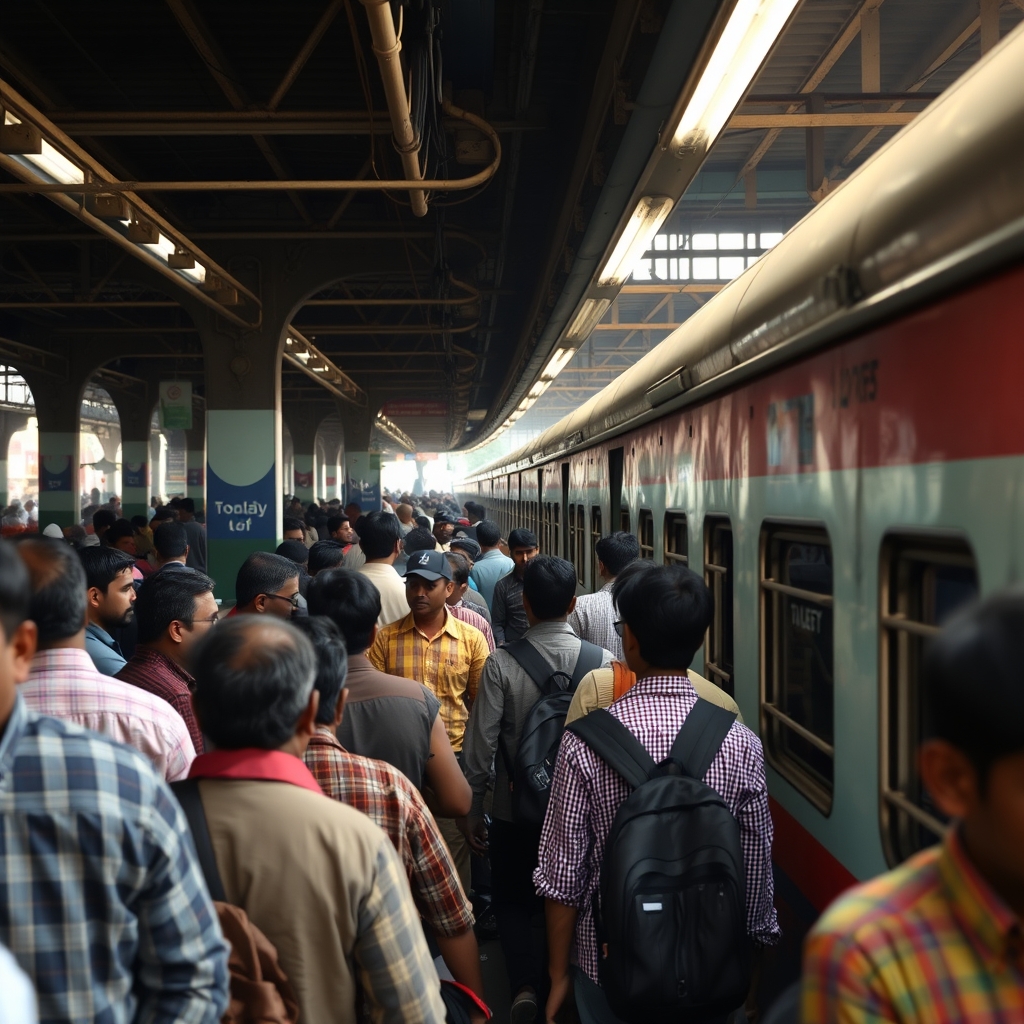
The local train is not a way to see Mumbai — it is Mumbai. More than seven million people ride the suburban network every single day, making it one of the busiest commuter railways on earth and, as every Mumbaikar will tell you without irony, the city’s lifeline. For a first-timer it looks terrifying: a wall of bodies, a train that barely seems to stop, signboards in three scripts, and a private language of “fast”, “slow”, “up” and “down”. It is far more manageable than it looks once you learn the three lines, buy the right ticket, and pick up a handful of unwritten rules.
Mumbai local train quick reference
| Line | Runs between | Best for | Southern terminal | Fast-train halts |
|---|---|---|---|---|
| Western | Churchgate ↔ Virar/Dahanu | Bandra, Andheri, Juhu, airport belt, Borivali | Churchgate | Mumbai Central, Dadar, Bandra, Andheri, Borivali |
| Central | CSMT ↔ Kalyan/Kasara/Karjat | Matunga, Ghatkopar, Thane, eastern city | CSMT | Byculla, Dadar, Kurla, Ghatkopar, Thane |
| Harbour | CSMT ↔ Panvel/Goregaon | Navi Mumbai, Vashi, Bandra–Andheri hop | CSMT | Fewer services; check the board |
| Metro Line 3 | Cuffe Parade ↔ SEEPZ (Aqua) | Airport, BKC, South Mumbai, air-con | Underground | All-stops metro |
Fares below are rough 2026 bands; treat every price as a ballpark, not a quote.
The three lines, and how they fit together
The suburban system is really three railways running roughly north–south, with a fast-growing Metro layered on top. Two pieces of jargon first: locals heading towards South Mumbai — what everyone calls “town” — are going up, and trains heading out into the suburbs are going down. The two great southern terminals are Churchgate (Western) and CSMT, the old Victoria Terminus (Central and Harbour). Get those two straight and half the confusion falls away.
The Western Line
The busiest and, for most visitors, the most useful. It runs from Churchgate up through Marine Lines, Charni Road, Grant Road, Mumbai Central, Dadar, Bandra, Andheri and Borivali, out to Virar and Dahanu Road. This is your line for the western suburbs — Bandra’s cafés, Juhu, the airport hinterland, Borivali for Sanjay Gandhi National Park. Run by Western Railway, its fast trains skip the small stations and halt only at Mumbai Central, Dadar, Bandra, Andheri, Borivali, Bhayander, Vasai Road and Virar. Insider move: going from Churchgate to Bandra or Andheri, wait the extra few minutes for a fast — it can save you twenty.
The Central Line
Central Railway’s main line leaves CSMT and heads north-east through Byculla, Dadar, Kurla, Ghatkopar, Bhandup and Mulund to Thane, then splits at Kalyan towards Kasara and Karjat/Khopoli. This is the line for the central and eastern city — Matunga’s south-Indian belt, Ghatkopar, Thane. Insider move: Central platforms at CSMT and Dadar are a warren; give yourself an extra five minutes and trust the overhead indicator, not the platform number you used yesterday.
The Harbour Line
The quiet third sibling, also starting at CSMT. It runs down through Dockyard Road, Sewri and Wadala, then branches — one arm crosses to Vashi and all of Navi Mumbai down to Panvel, another swings up via Bandra and Andheri to Goregaon. It is the line for Navi Mumbai, Vashi’s malls, and a Bandra–Andheri hop that dodges the Western crush. Insider move: Harbour trains are less frequent, so read the next-train board rather than just turning up. There is also a Trans-Harbour line linking Thane with Vashi and Panvel, but a first-timer rarely needs it.
Fast or slow: read the indicator board
Every local is either slow (marked S), stopping everywhere, or fast (marked F), skipping the minor stations. The fare is identical, so the only question is whether the fast train stops where you are going. The overhead indicator at the platform shows the final destination and the slow/fast status; there is also a small board on the front of the rake. Unsure? Ask a fellow commuter “fast hai?” — people are far friendlier than the crowds suggest.
First class, second class and the AC locals
Every non-AC rake carries both first-class and second-class coaches. The seats and space are much the same; what first class really buys you is a thinner crowd. It costs roughly four to five times the second-class fare, which itself starts at just a few rupees for a short hop, so first class is still cheap by any global standard and worth it in peak hours if the budget allows.
Increasingly there is a third option: air-conditioned locals. Western Railway alone now runs well over a hundred AC services a day and is steadily replacing non-AC rakes with them, and the Harbour Line got its first AC service in early 2026. AC coaches are sealed, quieter, and cost more than second class but far less than a taxi — a genuine relief in the pre-monsoon heat.
Ladies’ coaches: the rules bite
Every train reserves compartments for women, clearly marked on both the platform and the coach, and they are strictly enforced. There is usually a ladies’ second-class section plus a smaller ladies’ first-class one, positioned towards the ends of the rake. Western Railway even runs dedicated Ladies Special trains at peak hours — the first in the world, launched back in 1992 — and Railway Police or home guards ride the ladies’ coaches after dark. Men, take note: from mid-2026 the on-the-spot fine for a man travelling in a ladies’ coach was raised to Rs 2,500, so count the coaches and stay well clear.
Tickets, passes and the RailOne app
Single and return tickets
The simplest option is a paper ticket from the booking window, valid for one journey in your chosen class. State your destination and class, pay, and keep the ticket until you exit — inspectors do check. Travelling without a valid ticket means the single fare plus a Rs 500 penalty, and “I’m a tourist” is not a defence.
The RailOne app
This is the big recent change. For a decade commuters used an app called UTS; as of 1 March 2026 it has been switched off, and unreserved suburban tickets and monthly passes now live inside a single Indian Railways super-app called RailOne. Register with your mobile number, load a wallet, and a QR-code ticket appears on your phone — no queue at all. One quirk to know: like its predecessor, the app will not issue a paperless ticket once you are standing on the platform or beside the tracks, so book before you reach the barrier. There is currently a small discount for booking through the app with a digital payment.
Smart Card and the ATVM
Prefer not to use the app? Buy a physical Smart Card at any station booking office (around Rs 70, including a refundable deposit and a little travel value, with bonus value on top-ups). Tap it at the Automatic Ticket Vending Machines dotted around the stations and print a ticket in seconds — the “one-touch” machines now offer your commonest destinations at a single press. It is the old hand’s way to dodge the queue.
Season passes and the Tourist Ticket
Regular commuters buy season passes (monthly, quarterly and longer), which pay for themselves within days. Visitors have a neater option: the Tourist Ticket, giving unlimited travel across all three lines. Second class is roughly Rs 80 for one day, Rs 125 for three and Rs 150 for five; first class is about Rs 275, Rs 460 and Rs 555 for the same. Ask for it at any city booking window with ID — for a few days of hopping around, it is superb value.
Surviving rush hour
The crush is real but predictable. Peak flow runs roughly 8 to 11am towards town and 5.30 to 8.30pm heading out. If you are still finding your feet, ride between noon and 4pm, when trains are calm enough to actually enjoy. When you must ride the crush, a few habits keep you safe and unhated:
- Let people off first. The scrum wants to board, but the doorway clears faster if you stand aside. A quick “utarna hai?” (“getting off?”) signals your intentions.
- Move to the door one or two stations early. Stops are short and the exit is a gauntlet.
- Wear a backpack on your front and keep your phone and wallet zipped away. Petty theft thrives in a packed coach.
- Never board or alight a moving train. It looks casual when locals do it; it kills people every year.
- Pick the middle coaches. They are usually less jammed than the ends, and you avoid straying into the ladies’ first-class section by mistake.
Where the lines meet: the hubs worth knowing
Dadar is the great interchange, the one station on both Western and Central lines — the place to switch sides of the city, though its footbridges are a genuine test of nerve at 6pm. CSMT and Churchgate are the southern terminals, both walkable into the Fort heritage district and both now within reach of the fully open Metro Line 3 (the underground Aqua Line), which since late 2025 links South Mumbai to the airport and SEEPZ. In the suburbs, Ghatkopar ties the Central Line to Metro Line 1 and Andheri does the same on the Western Line — handy shortcuts when the locals are at their fullest.
Monsoon caveat: the line that floods first
From June to September, remember one thing: the low-lying Central Railway tracks around Matunga, Sion and Kurla, plus Chunabhatti and Wadala on the Harbour line, are the first to go under, and services between CSMT and Thane can halt altogether. On a heavy-rain day, route your journey along the Western line wherever possible, travel ahead of the morning high tide, and check the Central Railway handle for live status before you leave. Never board a train heading into a section that is already waterlogged — being stranded between stations is the worst place to be.
Insider tips to ride like a local
- Keep a RailOne QR or a Tourist Ticket ready before you hit the barrier — fumbling at the gate in a crowd is the rookie giveaway.
- Learn your terminal (Churchgate or CSMT) and your “up/down” direction; it is the fastest way to stop second-guessing platforms.
- Off-peak, second class is perfectly civilised and a fraction of the price. Save first class or an AC local for the rush.
- Carry a small power bank and headphones — a 45-minute Virar run is dead time you can put to use.
- Digital payment works nearly everywhere now, but keep a little cash for a booking window or a share-cab when the rains scramble the network.
Learn your line and its terminal, decide fast or slow from the indicator board, keep a QR or Tourist Ticket on your phone, and ride off-peak until the rhythm makes sense. Do that and the network that first looks like chaos becomes the fastest, cheapest and most honest way to understand this city — one crowded, roaring, strangely companionable carriage at a time.
Frequently Asked Questions
How do I buy a Mumbai local train ticket in 2026?
Download the RailOne app (it replaced UTS on 1 March 2026), register with your mobile number, load the wallet, and generate a QR ticket before you reach the platform. You can also buy a paper ticket at any booking window or tap a Smart Card at an ATVM.
Which line do I take to Mumbai airport?
No suburban line goes directly to the airport terminals. The cleanest link is Metro Line 3 (the underground Aqua Line), which has a station at the airport. From the locals, Andheri (Western) and Vile Parle are the nearest suburban stations.
What is the difference between a fast and a slow local?
A slow local (marked S) stops at every station; a fast local (marked F) skips the minor ones. The fare is identical, so a fast train saves time only if it actually halts where you are going. Read the overhead platform indicator to check.
Is the Mumbai local safe for solo women travellers?
Yes. Every train has reserved ladies' coaches that are strictly enforced and policed after dark, and Western Railway even runs dedicated Ladies Special trains. Off-peak hours and first class are the most comfortable choices.
What is the cheapest way to sightsee Mumbai by train?
The second-class Tourist Ticket gives unlimited travel on all three lines for roughly Rs 80 for a day or Rs 150 for five days. Ask for it at any city booking window with ID; it beats buying a ticket for every ride.