
Fort & Ballard Estate Lunch Trail
Fort & Ballard Estate lunch trail: Britannia berry pulao, Ideal Corner dhansak, Gujarati thalis and canteen plates — with price bands, timing and train tips.
'%3E%3Crect%20width%3D'96'%20height%3D'96'%20fill%3D'%23B3261E'%2F%3E%3Ccircle%20cx%3D'30'%20cy%3D'24'%20r%3D'44'%20fill%3D'%23fff'%20opacity%3D'.12'%2F%3E%3Ccircle%20cx%3D'60'%20cy%3D'74'%20r%3D'40'%20fill%3D'%23000'%20opacity%3D'.10'%2F%3E%3C%2Fg%3E%3Cg%20fill%3D'%23fff'%3E%3Crect%20x%3D'29'%20y%3D'49'%20width%3D'8'%20height%3D'19'%20rx%3D'1'%2F%3E%3Crect%20x%3D'39'%20y%3D'40'%20width%3D'9'%20height%3D'28'%20rx%3D'1'%2F%3E%3Crect%20x%3D'50'%20y%3D'45'%20width%3D'8'%20height%3D'23'%20rx%3D'1'%2F%3E%3Crect%20x%3D'60'%20y%3D'53'%20width%3D'7'%20height%3D'15'%20rx%3D'1'%2F%3E%3Crect%20x%3D'41'%20y%3D'34'%20width%3D'5'%20height%3D'6'%2F%3E%3C%2Fg%3E%3C%2Fsvg%3E)
The Top 11
- 01
Britannia & Co.
Ballard Estate, Fort ₹800–1,200 for two (approx.)Go for: The lunch-trail anchor since 1923 — Parsi Berry (Beri) Pulao with Iranian barberries, Sali Boti, mutton dhansak and fried Bombay duck.
Cash only, lunch-only and shut Sundays — arrive before 3:30 pm as the kitchen winds down early.
- 02
Mahesh Lunch Home
Cawasji Patel Street, Fort ₹1,500–2,500 for two (approx.)Go for: Pioneer of Mangalorean seafood in the city — butter-pepper-garlic crab, tandoori pomfret and fish gassi with neer dosa.
Crab is charged by weight — ask the day's fresh catch and confirm the price before ordering.
- 03
Trishna
Kala Ghoda, Fort ₹2,500–3,500 for two (approx.)Go for: Mumbai's most celebrated seafood room — the Hyderabadi butter-pepper-garlic crab and Koliwada prawns are the signatures.
It's small and packed at lunch — reserve ahead, especially on weekdays.
- 04
Ideal Corner
Gunbow Street, Fort ₹600–900 for two (approx.)Go for: Homely Parsi bol where the office crowd lunches — dhansak, Sali Boti, patra ni machhi and lagan nu custard.
Dhansak and several mains are served only on set days — check the day's menu before you go.
- 05
Cafe Military
Fort (Ali Chambers, Tamarind Lane) ₹500–800 for two (approx.)Go for: Classic Irani-Parsi cafe since 1933 — kheema, bheja fry, chicken-mutton dhansak and caramel custard.
It fills completely at peak lunch — keep a 15–20 minute buffer for a table.
- 06
Apoorva
Noble Chambers, Fort ₹1,200–2,000 for two (approx.)Go for: No-frills coastal seafood favourite — bombil (Bombay duck) fry, bangda, prawn/fish gassi and koliwada.
Pair the fried catch with sol kadhi and neer dosa; the upper floor is quieter for a sit-down lunch.
- 07
Burma Burma
Kala Ghoda, Fort ₹1,200–1,800 for two (approx.)Go for: Pure-vegetarian Burmese flagship — Oh No Khow Suey, samosa soup, tea-leaf salad and Burmese green tea.
Vegetarian and no alcohol — go early for lunch as the small dining room gets a wait quickly.
- 08
Yazdani Bakery
Cawasji Patel Street, Fort ₹150–300 for two (approx.)Go for: Century-old Irani bakery-cafe — bun maska, brun maska, Irani chai and ginger biscuits.
Cash only and closed Sundays — best mid-morning or as a light chai-and-bun stop between bigger meals.
- 09
Pancham Puriwala
Fort (near CST / Perin Nariman Street) ₹200–400 for two (approx.)Go for: One of the city's oldest eateries (1840s) — piping-hot puri-bhaji with aloo and chana.
It's cramped and quick-turnover — grab the puri-bhaji plate and eat fast like the local office crowd.
- 10
A Taste of Kerala
Prospect Chambers, Pitha Street, Fort ₹400–700 for two (approx.)Go for: Great-value Malabar meals — veg and non-veg thalis, fish molee, appam and prawn/crab roast.
Best value at peak lunch when the fish is freshest; ask for the meals (thali) for the fullest spread.
- 11
Kala Ghoda Cafe
Kala Ghoda, Fort ₹800–1,200 for two (approx.)Go for: All-day cafe for a lighter stop — good coffee, coconut vegetable curry with Kerala rice and fresh bakes.
Tiny and busy — good for a coffee-and-plate breather between the heavier Parsi and seafood stops.
Ranked by our Mumbai desk · prices are approximate — confirm before you go.
TL;DR: The best weekday lunch in Fort and Ballard Estate runs from the Parsi institutions — Britannia & Co for berry pulao and Ideal Corner for the daily dhansak — through loaded Gujarati thalis around Kala Ghoda to cheap, filling office-canteen plates near Ballard Estate. Go between noon and 2pm, carry cash, keep your expectations honest about queues, and you can eat your way across four different lunch cultures inside a fifteen-minute walk.
Fort is Mumbai’s original business district: colonial stone bungalows, banks and brokerages, newspaper offices and law chambers, all packed between Flora Fountain, Horniman Circle and the Ballard Estate waterfront. It was laid out for commerce, and for the better part of a century the people who kept that commerce running — clerks, stenographers, lawyers, bank tellers, jobbers from the old stock exchange — needed feeding, fast and cheap, within a short walk of the desk. That daily demand is what built the food. What you get today is not a curated restaurant district but a working lunch economy: old Parsi cafés that have outlived the firms around them, unlimited thali houses that trade on volume, and no-frills canteens engineered to turn a table in twenty minutes. This guide walks that route as a route — the places that genuinely define a Fort workday lunch, in the order a hungry office-goer might actually take them.
The trail at a glance
| Lunch type | Where in Fort | Price per head | Best for |
|---|---|---|---|
| Parsi café mains | Ballard Estate, Gunbow Street | ₹250–500 | Berry pulao, dhansak, a proper sit-down |
| Unlimited thali | Kala Ghoda | ₹300–600 | A big appetite, or skipping dinner |
| Canteen / puri plate | Ballard Estate, Bora Bazaar | ₹150–300 | Fast, filling, genuinely cheap |
| Street sandwich / vada pav | Flora Fountain, GPO lanes | ₹30–120 | A ten-minute desk lunch |
Treat the numbers as bands, not menu prices — they move with the day, the dish and how much meat and dessert you order. The point of the table is the shape of the choice: Fort lets you spend ₹40 or ₹500 on lunch within the same few blocks, and both can be a good decision depending on the clock and the appetite.
Start with the Parsi cafés
The soul of a Fort lunch is Irani-Parsi food, and two names anchor the trail. They are not interchangeable. One is a destination you build an afternoon around; the other is where you eat when you have a 3pm meeting. Knowing which is which is half the skill of eating well here.
Britannia & Co — the pilgrimage
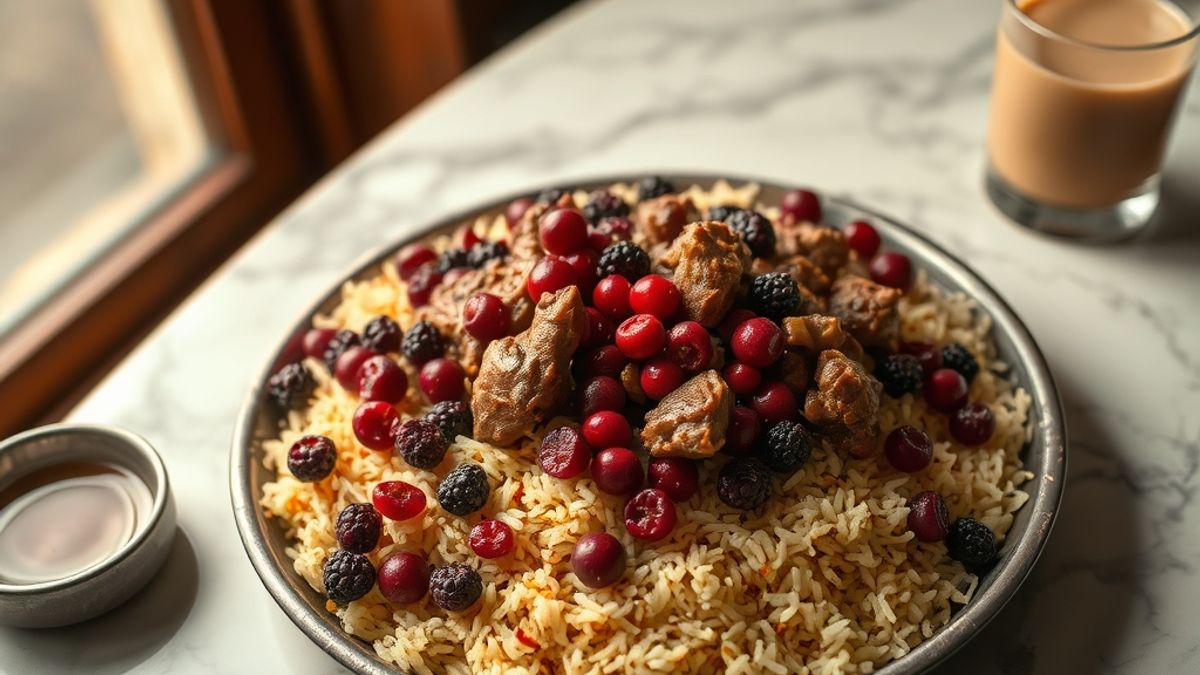
Britannia & Co., in a high-ceilinged colonial hall in Ballard Estate, has been running since 1923 and is the one most people make a pilgrimage for. The room itself is part of the meal: tall windows, worn wooden chairs, marble-topped tables, faded portraits and notices on the wall, the whole thing feeling like a set that was never struck. You come for the berry pulao — fragrant rice and meat (or a vegetable version) studded with tart barberries that cut through the richness — and it is worth understanding why that dish is the signature. The berries are a Persian touch, imported and sharp, and they turn what could be a heavy plate of rice and mutton into something that keeps its balance to the last spoon. Round it out with sali boti, a sweet-and-tangy mutton curry crowned with matchstick potato straws, and finish with the famous caramel custard, which is exactly as wobbly and homemade as it should be.
Two practical truths to plan around. First, Britannia keeps short, lunch-only hours and shuts on Sundays, so it is strictly a weekday-and-Saturday affair — this is not a place you drift into for an early dinner. Second, on busy days there is a wait, and the room does not rush you once you are seated, which is precisely the point but also precisely the risk if you are on a lunch break with a hard stop. The honest advice: come on a day you are not clock-watching. If you have exactly forty minutes, choose the next place instead.
Ideal Corner — the working lunch
A short walk away on Gunbow Street, Ideal Corner is the working person’s Parsi lunch — tighter, faster, and built around a dish of the day. This is the rhythm that regulars live by. Different specials rotate through the week: dhansak on some days, patra ni machhi (fish in green chutney, steamed in banana leaf) or a railway mutton on others, so people come knowing what Tuesday or Wednesday holds and order almost before they sit. The food arrives quickly, the plates are generous without being punishing, and you are back at your desk on time — which is the whole design brief of a Fort lunch, executed in Parsi form.
If you are new to this cuisine, a little orientation helps you order well rather than defaulting to the one name you recognise. Dhansak is the Sunday dish of Parsi homes — mutton slow-cooked with a purée of several lentils and vegetables, mild and deeply savoury, traditionally served with caramelised brown rice; on a café menu it is comfort food that eats like a full meal. Patra ni machhi is lighter and greener, the fish gentle under the chutney. For the fuller story of where all this comes from — the Irani café, the Parsi wedding table, the vocabulary of dhansak and lagan nu custard — read our Parsi food guide before you go, and you will get much more out of both rooms.
The thali houses
When the appetite is bigger than the clock, Fort’s thali houses deliver an unlimited vegetarian spread — rotis, dals, sabzis, rice, farsan and sweets — refilled until you surrender. This is a different philosophy of lunch from the Parsi plate. Instead of ordering one considered dish, you sit down to a metal platter ringed with small bowls, and a rotation of servers keeps circling with buckets and ladles, topping up whatever is running low without being asked. Saying no is on you, and it takes practice.
Chetana and the Kala Ghoda thali
Around Kala Ghoda, Chetana is a long-standing sit-down spot known for its Rajasthani-Gujarati thali in a calmer, more polished setting than the canteens. The distinction matters: a Rajasthani-Gujarati thali leans a touch sweet, with dals and kadhi carrying a gentle sugar note that first-timers from other parts of India sometimes find surprising, alongside a spread of dry and gravy sabzis, farsan like dhokla or khandvi, hot rotis and puris, rice, chaas and something sweet to close. Because it sits among the galleries and cafés of the Kala Ghoda arts precinct, Chetana works well when lunch is also a sit-down catch-up rather than a refuel — you can linger without a queue building behind your chair.
Thalis are the smart order when you want to eat well once and skip an evening meal — but pace yourself, because the servers will keep coming back with the bucket and it is genuinely easy to over-eat. A useful trick: wave off the second round of rice and rotis and save your capacity for the farsan and sweets, which are where a good thali distinguishes itself. For a wider view of this cuisine and how the thali scene plays out across the rest of the city, our Gujarati thali guide maps the broader landscape beyond Fort.
The office-worker canteens
This is where Fort feeds itself day in, day out — the least photogenic and most honest part of the trail. Around the Ballard Estate and Bora Bazaar lanes, the canteens prize speed and value over decor: shared tables, quick turnover, a queue that moves because everyone knows the drill. You do not come here for atmosphere; you come here for a filling plate at a price that lets you do it five days a week.
Pancham Puriwala, near CST, is the old-Bombay stalwart of this category — famous for its puri-based thali and a genuinely filling plate at a modest price, a fixture for the surrounding offices for generations. The formula is simple and unchanged: hot puris, a couple of sabzis, dal, rice, a little pickle, done. Nobody is chasing novelty; the value is that it is the same good, cheap, quick meal it has always been, and the workforce around it treats it accordingly.
The dabbawala backbone
No account of a Fort lunch is complete without the dabba and tiffin culture the district is built on. The citywide dabbawala network delivers tens of thousands of home-cooked lunches to desks every working day, carried in stacked steel tins from suburban kitchens on the morning trains and hand-sorted through the terminals with a coding system that has become a case study in logistics. Stand near CSMT or in the Ballard Estate lanes around midday and you will see the tiffin carriers moving in a hurry, wooden crates of dabbas on their heads and handcarts. Most of Fort’s office lunch does not happen in restaurants at all — it arrives in a tin from home.
For a walk-in eater, the canteens are the closest equivalent to that home-cooked dabba: unfussy, filling, familiar, and cheap. If you want to keep chasing that value further across the city, our budget eats in Mumbai round-up collects the same idea — big flavour, small bill — beyond the Fort lanes.
The quick bites: sandwiches, chaat and street plates
Not every lunch is a full sit-down, and Fort’s pavements and small counters do a brisk trade in fast, cheap food for the days you are eating between meetings.
- The Bombay sandwich — layered boiled potato, cucumber, tomato, onion and beetroot with a slick of green chutney, either grilled with butter or served plain — is the classic desk lunch, sold from carts near Flora Fountain and up and down the office lanes. Ask for it grilled with extra chutney and you have a properly satisfying meal in one hand for around ₹60.
- Vada pav and other fried snacks are everywhere; a well-known stall sits near the GPO opposite CST for a fast bite between meetings. The vada pav is Mumbai’s true fast food — a spiced potato fritter in a soft pav with dry garlic chutney — and it is the correct answer when you have ten minutes and ₹30.
- Chaat and ragda-pattice counters cover the tangy-savoury craving: crisp, cold, hot, sweet and sour all at once, best eaten standing.
These are all best eaten fresh off the griddle or fryer, not carried back to a desk to go soft. Hygiene varies stall to stall, so use the usual street rule — pick the busy cart with high turnover over the quiet one, because a fast-moving stall means fresher food and cleaner oil. For the wider picture of what to eat and where, see our Mumbai street food guide.
What it costs (rough bands)
Prices move by place and by day, so treat these as approximate rather than fixed, and expect the popular Parsi names to sit at the higher end of their band on a weekend:
- Parsi café mains (berry pulao, dhansak plates): roughly ₹250–500 a head, and more if you go big on meat and dessert.
- Unlimited Gujarati/Rajasthani thali: roughly ₹300–600 depending on the house.
- Canteen thali / puri plate: roughly ₹150–300 — the value end of the trail.
- Street sandwiches and vada pav: roughly ₹30–120.
Carry small cash. Many of the older spots prefer it and some of the pavement carts take nothing else, though UPI is increasingly accepted at the sit-down places. A pocketful of ₹10, ₹20 and ₹100 notes will save you the awkward wait for a machine that has lost network at the busiest hour of the day.
Best time and practical tips
The Fort lunch window is tight, and getting the timing right is the difference between a relaxed meal and standing in a queue watching your break evaporate. Aim to sit down between 12 noon and 1pm to get ahead of the office rush, or come after 2pm if you would rather have a calm table and do not mind that some dishes may have sold out. The middle — roughly 1 to 2pm — is peak, when every canteen table and every Parsi bench is full of the same offices emptying at once.
Watch the closing times, because several kitchens wind down by mid-afternoon and are lunch-only — the Parsi cafés especially. This is not a district for a late, leisurely 4pm lunch; if that is your plan, you will find shutters half-down. Most of the old institutions are shut on Sundays, and some also on Mondays, which makes this very much a weekday trail with Saturday as the outer edge. A few quick habits that pay off: keep the marquee sit-down names (Britannia in particular) for a day you are not rushing; slot the canteens and street carts into the days you have a hard stop; and if a place is famous and it is 1:15pm, assume a wait and plan the walk around it rather than against it.
In the monsoon (June to September), the covered colonial halls become a genuine refuge — there are few better places to sit out a downpour than a high-ceilinged Parsi café with a plate of dhansak while the rain hammers the Ballard Estate stone outside. Just carry an umbrella for the walking bits between stops, and know that the pavement carts thin out in heavy rain. Our monsoon in Mumbai guide has more on timing the season and reading the sky.
How to get there
Fort sits between two suburban terminals, which is how most Mumbaikars arrive — on foot from a train, not by car, because parking here is a losing game at lunchtime.
- Churchgate (Western line) — walk east through the office district, past Flora Fountain, into the heart of Fort and on to Kala Ghoda. This is the natural approach for the thali houses and the quick-bite carts around Flora Fountain.
- CSMT / CST (Central and Harbour lines) — the northern edge of the district and closest to Ballard Estate, Bora Bazaar and the canteens, as well as the GPO vada-pav stall right opposite.
Both terminals are a 5–15 minute walk from the trail’s stops, so the whole route is comfortably done on foot in ordinary shoes — no rickshaw needed, and often faster than one in midday traffic. Because the food and the streetscape occupy the same square mile, it is worth pairing the two. Do the eating around the architecture using our Fort & Kala Ghoda guide, or make a morning of the colonial buildings first and time your finish for lunch with the heritage architecture walk. Either way, come hungry, carry cash, mind the clock, and let Fort feed you the way it has fed its offices for a hundred years.
Frequently Asked Questions
Is Britannia & Co in Mumbai open on Sundays?
No. Britannia & Co in Ballard Estate keeps lunch-only hours and is closed on Sundays, so plan a weekday or Saturday visit. Because the room does not rush diners and often has a queue on busy days, go on a day you are not clock-watching rather than on a tight lunch break. If you only have forty minutes, a faster spot like Ideal Corner is the smarter call.
What should I order at a Parsi café in Fort?
At Britannia & Co the signature is berry pulao — fragrant rice and meat studded with tart barberries — best paired with sali boti and finished with caramel custard. At Ideal Corner on Gunbow Street, order the dish of the day, which rotates through the week between dhansak, patra ni machhi and railway mutton. If you are new to the cuisine, dhansak is a safe, comforting place to start.
Where can office workers eat cheaply in Fort, Mumbai?
The canteens and thali houses around Ballard Estate and Bora Bazaar serve filling plates for roughly ₹150–300, with Pancham Puriwala near CST a long-running favourite for its puri thali. For even less, pavement carts near Flora Fountain and the GPO sell Bombay sandwiches and vada pav from about ₹30–120. Carry small cash, as many of these older spots prefer it, though UPI is increasingly accepted.
What time is best for lunch in Fort and Ballard Estate?
Aim to sit down between noon and 1pm to get ahead of the office rush, or come after 2pm for a quieter table. Avoid the 1–2pm peak, when the district's offices empty out at once and every canteen table fills. Remember that the old Parsi cafés are lunch-only and wind down by mid-afternoon, so a late lunch is not the plan here, and most institutions are shut on Sundays.
How do I get to the Fort lunch trail by train?
Churchgate on the Western line drops you on the west side, a short walk east past Flora Fountain into Fort and Kala Ghoda. CSMT/CST on the Central and Harbour lines sits on the northern edge, closest to Ballard Estate, Bora Bazaar and the canteens. Both terminals are a 5–15 minute walk from the trail's stops, so the whole route is comfortably done on foot — often faster than a rickshaw in midday traffic.
Is the Fort lunch trail good for vegetarians?
Yes. The thali houses around Kala Ghoda, such as Chetana, serve unlimited vegetarian Gujarati-Rajasthani spreads, and Britannia's berry pulao comes in a vegetable version. Bombay sandwiches, chaat, ragda-pattice and much of the canteen fare are vegetarian too. The Parsi cafés are still best known for their meat and fish, so meat-eaters and vegetarians can happily share the same trail.