
Banganga Tank, Walkeshwar: Mumbai's Ancient Sacred Tank
A calm local's guide to Banganga Tank, Walkeshwar: Mumbai's 900-year-old spring-fed sacred tank on Malabar Hill — ghats, shrines, the January festival and how to visit.
'%3E%3Crect%20width%3D'96'%20height%3D'96'%20fill%3D'%23E65100'%2F%3E%3Ccircle%20cx%3D'30'%20cy%3D'24'%20r%3D'44'%20fill%3D'%23fff'%20opacity%3D'.12'%2F%3E%3Ccircle%20cx%3D'60'%20cy%3D'74'%20r%3D'40'%20fill%3D'%23000'%20opacity%3D'.10'%2F%3E%3C%2Fg%3E%3Cg%3E%3Ccircle%20cx%3D'48'%20cy%3D'48'%20r%3D'15'%20fill%3D'none'%20stroke%3D'%23fff'%20stroke-width%3D'3'%2F%3E%3Cpath%20fill%3D'%23fff'%20d%3D'M48%2037%20l3.5%2011%20-3.5%2011%20-3.5%20-11%20z'%2F%3E%3Ccircle%20cx%3D'48'%20cy%3D'48'%20r%3D'2.2'%20fill%3D'%23fff'%2F%3E%3C%2Fg%3E%3C%2Fsvg%3E)
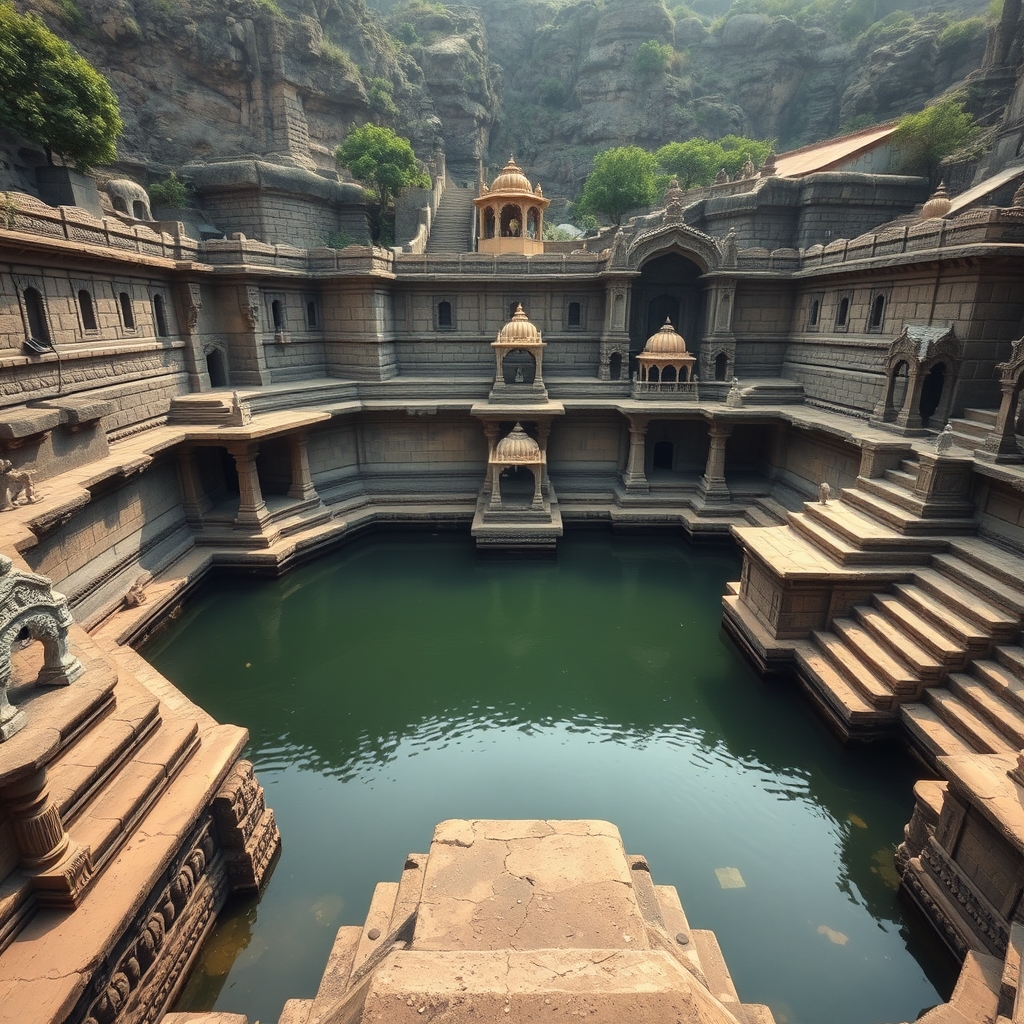
Photo: Oknitop (talk) (Uploads) · CC BY-SA 3.0 · via Wikimedia Commons
Drop down a set of narrow lanes off the moneyed spine of Malabar Hill and the twenty-first century simply stops. There is no ticket window, no queue, no signboard promising an “experience” — only a rectangular pool of grey-green water ringed by worn stone steps, small temples, resthouses and twin lamp-towers, with pigeons wheeling overhead and the sea a few dozen metres off but out of sight. This is Banganga Tank, the oldest surviving Hindu pilgrimage site in Mumbai, and for anyone who likes their history quiet and unpackaged, it is the finest half-hour in the city. It sits at the southern foot of Malabar Hill, in the old settlement of Walkeshwar, and it has been drawing pilgrims for the better part of nine centuries. What follows is what it is, why it matters, and how to visit without fuss — the sort of place that anchors any list of the city’s true hidden gems.
At a glance
| Detail | What to know |
|---|---|
| Where | Walkeshwar, at the southern foot of Malabar Hill, South Mumbai |
| Entry | Free — no ticket. Open-air, effectively dawn until well after dark |
| Best time of day | First light (roughly 6–8 am) or the last hour before dusk |
| Best season | November to February; monsoon is atmospheric but slippery |
| Nearest stations | Charni Road or Grant Road (Western line), then a short taxi |
| Time to allow | 30–60 min for the tank alone; 2–3 hrs with Malabar Hill |
| Don’t miss | The parikrama of the ghats, Walkeshwar temple, the twin deepstambhas |
| Etiquette | Shoes and leather off at shrines; no photos of people mid-bath or prayer |
Read the table as a floor, not a ceiling. Banganga rewards the visitor who slows down, and the difference between a rushed ten minutes and an unhurried hour is the difference between ticking off a sight and actually feeling the place.
The story in the stone
An arrow, a spring, a name
By tradition the tank was dug in AD 1127 by Lakshman Prabhu, a minister in the court of the Silhara (Shilahara) kings who then ruled the Konkan coast. It was cut into the rock as a stepped tank fed by a natural underground spring — which is the small miracle of the place: though the Arabian Sea is only a stone’s throw away, the water in the tank stays sweet, never brackish. It is said to run around ten metres deep at the centre, and locals will tell you the spring has never once run dry, through droughts and building booms alike.
The name carries a legend. As the story goes, Rama halted here on his way south to Lanka and, thirsting, asked his brother Lakshmana for water. Lakshmana loosed an arrow — a baan — into the ground, and a tributary of the Ganga sprang up on the spot: baan-ganga, the Ganga summoned by an arrow. The neighbouring temple takes its name from the same episode. Waiting for an idol that never came, Rama is said to have fashioned a Shiva linga out of the beach sand; hence Walkeshwar, from valuka ishwar, the “lord of sand.” You do not have to take the mythology literally to feel its weight — it is the reason a spring in the middle of the city’s most expensive real estate has been kept, cleaned and worshipped for nine hundred years.
From the Portuguese to Rama Kamath
Both tank and temple were knocked down by the Portuguese in the sixteenth century, when they held these islands. What you see today owes itself to a Bombay businessman and philanthropist, Rama Kamath, who paid for the reconstruction around 1715. That date matters: it means the stone you are walking on is roughly three centuries old, laid down when Bombay was still a cluster of marshy islands being slowly stitched together, long before the reclamations that made the modern city. The whole enclave has since been recognised as a Grade-I heritage precinct, and it is looked after not by the state but by the GSB (Gaud Saraswat Brahmin) Trust, which manages the tank alongside the Walkeshwar temple and a cluster of other shrines around the water. If you enjoy this layering of the old under the new, it pairs beautifully with a heritage architecture walk through the Fort district on another day.
Walking the tank
The pleasure of Banganga is entirely in the walking of it. A parikrama — the slow circuit around the water — takes only a few minutes on paper but rewards dawdling. Come down the steps and the noise of the city drops away almost at once; what you hear instead is the slap of washing, a temple bell, the low murmur of prayer, the occasional splash as someone tips a brass pot over their head. The ghats step down to the water on all four sides, and on them you will find people bathing, feeding the ducks and geese, sitting with a flask of tea, drying saris on the warm stone, or performing last rites and immersing ashes, for the spring-fed water is considered holy.
Reading the ghats
Take the circuit clockwise, keeping the water on your right, as most pilgrims do. Each side of the tank has its own character. One flank is lined with the dharamshalas and resthouses that once put up travelling pilgrims; another is crowded with tiny shrines, their steps slick and their bells worn smooth by generations of hands. Two carved stone deepstambhas (lamp-towers) stand near the entrance, lit on festival nights into pillars of flame — on an ordinary morning they are simply weathered columns, easy to walk past, but they are among the oldest features here. Look, too, at the water itself: the green comes from the resident population of ducks, geese and the odd turtle, and from the sheer age of the tank. It is not a swimming pool, and it is not meant to look like one.
A note on photographs and respect
A word before you raise a camera: this is a living, working place of worship, not a monument. Photograph the architecture and the light all you like, but not people mid-bath or mid-prayer, and never a family performing last rites. Ask, or better, just don’t. The same courtesy applies to the shrines — step back if a ritual is underway, keep your voice low, and switch your phone to silent. Nobody will stop you visiting, and that openness is exactly why it deserves to be handled with care.
Practical tip: go at first light or in the last hour before dusk. The stone glows, the crowds are thin, and in the soft light the tank looks much as it must have for centuries. If you are chasing that golden hour anyway, Malabar Hill has some of the city’s finest sunset viewpoints a short walk uphill.
The temples and shrines around the water
Walkeshwar Temple
The Shri Walkeshwar Mahadev temple, dedicated to Shiva, sits at the head of the tank and is the spiritual anchor of the whole settlement — the reason the neighbourhood exists at all. It is unshowy from outside — a working temple rather than a grand one — but it is the older, quieter counterpart to the city’s busier shrines, the sort of place where you can actually hear yourself think. Stepping in for a moment of darshan is part of the ritual of the place. Leave your shoes at the door, cover up, and keep your voice down. If you have only visited the crowd-heavy giants like Siddhivinayak, this is the gentle antidote.
The maths and the samadhis
Ringing the water are a couple of dozen small temples and two important monasteries of the Gaud Saraswat Brahmin community — the Shri Kashi Math and the Shri Kavale (Kaivalya) Math — whose banks hold the samadhis of their past heads. These are functioning religious institutions, not exhibits; you may find a class of priests chanting, a wedding being blessed, or simply the caretaker sweeping the steps. Pause, look, and move on quietly.
The samadhi shrines of the Advaita masters
For readers of a certain kind, the real draw is quieter still. The small cremation ground beside the tank holds the samadhi shrines of three revered twentieth-century Advaita teachers — Siddharameshwar Maharaj, Nisargadatta Maharaj and Ranjit Maharaj. Anyone who has read Nisargadatta’s I Am That will find it a moving, unmarked sort of pilgrimage: no grand mausoleum, no gift shop, just simple shrines a few steps from where the ashes of ordinary Mumbaikars are still committed to the fire today. It is easy to miss entirely if you don’t know to look — ask a local or one of the trust’s caretakers to point you towards them.
The Jain temple on Ridge Road
If you have the legs for the slope, the Babu Amichand Panalal Adishwarji Jain Temple (1904) up on Ridge Road is the most beautiful interior in the area — marble figures, intricate mirrorwork and a painted dome of the zodiac that is worth the climb on its own. Leave all leather outside (belts, wallets and watch straps included) and step in quietly. Tip: pair it with the walk down to Banganga so you are descending, not climbing, in the heat. Together, the tank and the temple make a neat lesson in how many faiths have quietly shared this one hill.
When to go: seasons, hours and light
Best time of day
The tank is open air and effectively open all day, from dawn until well after dark, and entry is free — this is a place of worship, not a ticketed site. The two windows worth planning around are the first two hours after sunrise and the last hour before dusk. Mornings bring the bathers and the ritual bustle in cool, clear light; evenings bring a softer, emptier calm and, on the right night, the lamp-towers aglow. Midday is the one time to avoid — the stone throws back the heat and the light is flat and unkind to photographs.
Season by season
The best season is November to February, when Mumbai is at its most walkable and the humidity finally breaks. March to May is hot and glary, best tackled at first light with water in your bag. The monsoon (June to September) is atmospheric — the tank brimming, the stone dark and shining, the whole enclave hushed under grey skies — but it is genuinely slippery underfoot, and the steps have no railings. If you come in the rains, wear grippy shoes, take the steps slowly, and treat the wet stone with respect. It helps to have a broader sense of what a Mumbai monsoon actually feels like before you plan around it.
Festivals: Banganga and Dev Diwali
Once a year the steps become a stage. The Banganga Festival, first held in 1992 and run jointly by the Maharashtra Tourism Development Corporation (MTDC) and the Indian Heritage Society, is a two-day open-air classical music event usually staged by the tank in January, with the ghats and lamp-towers as a natural amphitheatre. Over the years its stage has held some of the biggest names in Indian classical music — the likes of Pandit Hariprasad Chaurasia and Ustad Zakir Hussain among them. Dates shift from year to year and editions have occasionally been skipped, so check the MTDC listings closer to the time rather than turning up on spec; seating is usually first-come, and the sound carries best from the middle of the ghats. If you can catch it, it is the finest evening the place offers all year.
The other night to know is Dev Diwali in November, when the tank is ringed with hundreds of oil lamps and the air fills with bhajans. It is less programmed than the January festival — more a community occasion than a ticketed event — and all the lovelier for it.
Getting there and getting around
Banganga sits at the far south-western tip of the island city, and reaching it is half the charm. The nearest suburban stations are Charni Road and Grant Road on the Western line; from either it is a short taxi ride up and over Malabar Hill, usually a modest metered fare. If the local trains are new to you, our guide to getting around Mumbai is worth a read before you set off.
The taxi question
Remember that auto-rickshaws do not run in South Mumbai, so take a black-and-yellow taxi or an app cab. BEST buses (the 108 among them) run to the Walkeshwar stop, five or six minutes’ walk from the tank, and are the cheapest way in if you don’t mind the extra time. Whichever you choose, ask for “Banganga” or “Walkeshwar temple” rather than a street address — every local driver knows it.
The walk down from Malabar Hill
If you would rather arrive on foot, many walkers make a morning of it — starting at the Hanging Gardens and Kamala Nehru Park at the top of the hill and descending through the lanes to the tank, which is the way we would do it. Going downhill spares you the climb in the heat, and the route threads past some of the city’s most handsome old bungalows and apartment blocks. For the fuller picture of the area — where to pause, what else is worth a look — see our Malabar Hill and Walkeshwar guide.
Access and what to carry
Be honest with yourself about the steps: Banganga is a stepped tank, which means the entire experience is stairs, uneven old stone and no ramps or railings. It is not friendly to wheelchairs, prams or unsteady knees, and there are few handholds if the stone is wet. Carry water, wear shoes you can slip off easily at the shrines, and bring a little cash for a small offering or a coconut if you feel moved to — cards are of no use here. There are no proper facilities on site, so plan your stops accordingly.
Where to eat nearby
Walkeshwar is residential, not a dining destination, so eat simply. The reliable local pick is Dakshinayan on Teen Batti Road at the foot of the hill — an unfussy South Indian vegetarian place known for its rava dosas, idlis and filter coffee, with a meal for two landing around Rs 700–800. It is exactly the kind of honest, no-frills meal that suits a morning at the tank: hot, quick and easy on the wallet.
If you round off the walk by heading north to Girgaon Chowpatty, the beach’s evening chaat stalls — bhelpuri, sev puri, ragda pattice and kulfi — are the classic cheap end to the day, eaten with your feet more or less in the sand, with a plate rarely running past Rs 100–150. For more in that vein, the nearby Girgaon khau galli is one of the city’s best old-school street-food lanes, and the whole strip connects up to Marine Drive and Chowpatty for a sunset stroll to finish.
The bottom line
Banganga is not a spectacle and does not try to be one. It is a nine-hundred-year-old spring in the middle of one of the most expensive square miles in India, still doing exactly what it was built to do. Come early, walk the steps slowly, sit for a while, and let the city fall silent around you. For history buffs and quiet-corner seekers alike — the same instinct that draws people to pockets like Khotachiwadi — there are few places in Mumbai so old, so alive, and so easy to miss.
Frequently Asked Questions
Is there an entry fee for Banganga Tank?
No. Banganga is a living pilgrimage site managed by the GSB (Gaud Saraswat Brahmin) Trust, open through the day and free to enter, with no ticket counter. It is a place of worship rather than a ticketed monument, so there are no set hours in the usual sense — it is effectively open from dawn until well after dark. Carry a little cash only if you want to make a small offering.
What is the best time of day to visit Banganga Tank?
Aim for the first couple of hours after sunrise or the last hour before dusk. Mornings bring the ritual bustle of bathers in cool, clear light, while evenings are softer and emptier, with the lamp-towers sometimes lit. Midday is worth avoiding — the open stone throws back the heat and the flat light is unkind to photographs. Across the year, November to February is the most comfortable season to walk the ghats.
How old is Banganga Tank and who built it?
By tradition the tank was dug in AD 1127 by Lakshman Prabhu, a minister of the Silhara (Shilahara) kings who then ruled the Konkan coast. The Portuguese destroyed the earlier structures in the sixteenth century, and what stands today largely dates from a reconstruction paid for by the Bombay philanthropist Rama Kamath around 1715. The whole enclave is now recognised as a Grade-I heritage precinct.
When is the Banganga Festival held?
It is usually staged over two days in January, organised by the Maharashtra Tourism Development Corporation (MTDC) together with the Indian Heritage Society, with the ghats and lamp-towers as a natural open-air amphitheatre. First held in 1992, it has featured major names in Indian classical music over the years. Exact dates shift annually and some editions have been skipped, so confirm with MTDC listings before planning a trip around it.
How do I get to Banganga Tank without an auto-rickshaw?
Auto-rickshaws do not operate in South Mumbai, so take a black-and-yellow taxi or an app cab from Charni Road or Grant Road station on the Western line — it is a short ride up and over Malabar Hill. Alternatively, BEST buses (including the 108) run to the Walkeshwar stop, about five or six minutes' walk from the tank. Ask for 'Banganga' or 'Walkeshwar temple' rather than a street address, as every local driver knows it.
Can I take photographs at Banganga Tank?
Photographs of the architecture, the ghats and the light are fine and often lovely, especially in early-morning or dusk light. What is not fine is photographing people mid-bath, at prayer, or families performing last rites — this is a working place of worship first, and privacy matters. When in doubt, ask permission or simply refrain, and keep your phone on silent near the shrines.