
Khotachiwadi: Walking Girgaon's Hidden 200-Year-Old Heritage Village
Walk Khotachiwadi, Girgaon's 200-year-old wooden-bungalow heritage village: its lanes, red cross, the 47-A gallery, nearby cafés, and how to visit with real care.
'%3E%3Crect%20width%3D'96'%20height%3D'96'%20fill%3D'%23E65100'%2F%3E%3Ccircle%20cx%3D'30'%20cy%3D'24'%20r%3D'44'%20fill%3D'%23fff'%20opacity%3D'.12'%2F%3E%3Ccircle%20cx%3D'60'%20cy%3D'74'%20r%3D'40'%20fill%3D'%23000'%20opacity%3D'.10'%2F%3E%3C%2Fg%3E%3Cg%3E%3Ccircle%20cx%3D'48'%20cy%3D'48'%20r%3D'15'%20fill%3D'none'%20stroke%3D'%23fff'%20stroke-width%3D'3'%2F%3E%3Cpath%20fill%3D'%23fff'%20d%3D'M48%2037%20l3.5%2011%20-3.5%2011%20-3.5%20-11%20z'%2F%3E%3Ccircle%20cx%3D'48'%20cy%3D'48'%20r%3D'2.2'%20fill%3D'%23fff'%2F%3E%3C%2Fg%3E%3C%2Fsvg%3E)
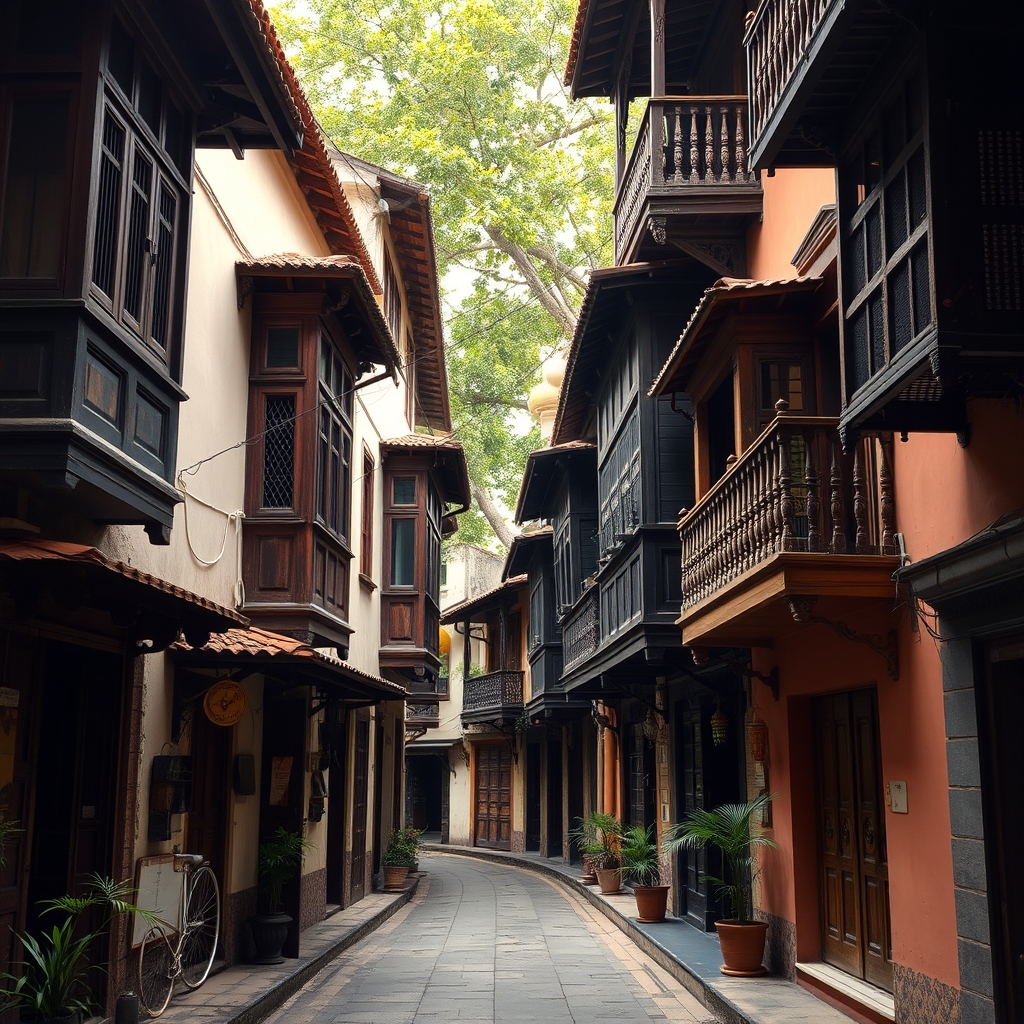
Step off the roar of Jagannath Shankar Seth Road, duck into a lane barely wide enough for two people to pass, and Mumbai simply stops. The horns fade, the light softens, and you are standing among low wooden bungalows painted buttercup yellow and pistachio green, their carved balconies sagging with age, a small red cross keeping watch over the corner. This is Khotachiwadi: a two-hundred-year-old East Indian Christian hamlet folded into the heart of Girgaon, one of the last places in the island city where you can still feel what old Bombay looked like at street level. It is a living neighbourhood, not a museum — which is exactly why it rewards a slow, respectful wander.
You don’t “do” the wadi the way you tick off the Gateway of India. There is no entrance, nothing to queue for, nothing to buy. What it offers instead is texture — a fifteen-minute pocket of the nineteenth century you earn by paying attention. This guide covers what you are looking at, how to find it, when to come, where to eat afterwards, and how to be a guest the residents are glad to see rather than one more lens in the lane.
At a glance
| Detail | What to know |
|---|---|
| What it is | ~200-year-old East Indian Christian heritage village of wooden bungalows |
| Where | Behind St Teresa’s Church, Girgaon, South Mumbai |
| Nearest station | Charni Road (Western line), ~10–15 min walk |
| Nearest Metro | Girgaon, Line 3 (Aqua Line), under 1 km |
| Entry fee | None — it is a residential lane, no ticket |
| Time needed | 20–30 min to stroll; 1–2 hrs with a gallery stop or guided walk |
| Best time | Weekday mornings or late afternoons; Christmas–New Year for the lights |
| Don’t miss | The red village cross, the 47-A gallery, the carved teak balconies |
| Rough spend | Free to wander; ~₹150–300 for two at Panshikar; guided walks ~₹500–1,500 |
| Etiquette | Quiet voices, no peering into homes, always ask before shooting people |
Budget more time than money here. The wander is free, snacks rarely top a few hundred rupees, and only a guided walk means real spending. The lanes are short, but the point is to linger.
What Khotachiwadi actually is
The wadi takes its name from Dadoba Waman Khot, a Pathare Prabhu landowner who, in the late 1700s and early 1800s, leased and sold plots of what was then a quiet grove to families of the East Indian community — the Marathi-speaking Catholics of the Konkan coast. At its peak the quarter held roughly 65 timber bungalows in a loose Portuguese-Goan idiom: sloping tiled roofs, open verandahs, latticed teak staircases, stained-glass fanlights and internal courtyards.
The word wadi — a hamlet, an enclosed cluster of houses — is the key to reading the place. Girgaon was once a mosaic of them, the leafy edge of native Bombay; most have since been swallowed by shops and towers, and Khotachiwadi is the one where enough of the original fabric held together to still feel like one. The wider story of how Mumbai grew from seven islands is written into these lanes: reclaimed land, mill money and railways pushed the city outward, and the wadis that survived did so almost by accident.
The community explains the crosses, the Marathi carols and the Catholic-and-Konkan feel of the place. The East Indians are an old, largely Marathi-speaking Catholic community native to the Bombay-Salsette region — distinct from the Goans and Mangaloreans who arrived later, the name marking them as the area’s original Christians, not anything to do with eastern India. If you have climbed to the Mount Mary basilica during the September fair, you have met their world at its most public; Khotachiwadi is the same culture at its quietest.
Today only about 28 of those original houses survive; the rest have been lost to redevelopment, and the lanes are now a patchwork of heritage cottages, later chawls and the odd apartment block. In 1995 the precinct was granted heritage protection, which is part of why anything remains — though the arithmetic runs one way, from timber to concrete. What you are looking at is not a preserved set-piece but a slow, contested holdout, which is why the wadi asks visitors to tread gently.
How do I find Khotachiwadi?
The most useful thing to know is that Khotachiwadi does not announce itself: no gate, no arch, no signboard from the main road, just lanes that open between shopfronts, so first-timers routinely walk straight past. Anchor on two fixed landmarks and you will not get lost.
The first is St Teresa’s Church on Raja Ram Mohan Roy Road — a large parish church you cannot miss. The second is the din of Jagannath Shankar Seth Road (JSS Road), the busy artery the wadi hides behind. Aim for the church, and the lane entrances are tucked in the blocks around and behind it. Once you slip in, the quarter is tiny — two main lanes running roughly parallel — so you cannot get lost for long. It pairs naturally with a wider heritage architecture walk through Fort and Kala Ghoda: where those precincts are grand and civic, Khotachiwadi is small, wooden and lived-in.
Walking the lanes
There is no set route and the whole quarter takes barely fifteen minutes to cross, so the trick is to slow right down. Wander the two main lanes and the capillaries off them, and let your eye do the work: hand-painted house numbers, bougainvillea over a first-floor rail, a Madonna in a niche, murals added over the years. Double back and walk the same lane twice — the light changes what you notice.
Do pause at the small village cross and chapel, painted a warm red, with a crucified Christ and a much-loved mural of Mary seated on a lotus cradling the infant Jesus — a quiet blend of Catholic and Indian imagery. Local accounts hold it was raised in the late nineteenth century in thanksgiving for the wadi being spared the worst of the 1890s plague. It is still the community’s focal point, never more so than at Christmas.
A loose route, if you want one: enter from the St Teresa’s side, walk the first lane end to end, pause at the cross midway, carry on to 47-A at the far end, then loop back down the parallel lane. Thirty unhurried minutes covers it. Keep your voice down and stay in the lanes — almost every door is someone’s home, and peering through windows is not on, however photogenic the interior.
The architecture, read slowly
Half of what makes Khotachiwadi special is easy to walk past if nobody points it out. Look up first: many bungalows carry an external wooden staircase, an outdoor flight of teak steps climbing to a first-floor verandah, the signature detail of the wadi and increasingly rare across the city. The balconies rest on turned wooden posts and carved balustrades; the roofs are pitched and tiled rather than flat, a Goan-Portuguese habit that reads oddly and wonderfully against the concrete boxes behind them.
Then look at the surfaces — the shuttered windows and fanlights, the panels of coloured glass, and the way each owner picked their own paint, so the lane runs from lemon to teal to dusty pink. None of this is grand; it is domestic architecture built for families of modest means, which is why so little survives elsewhere. A stone landmark survives because an institution protects it; a timber house survives only because a family chooses, decade after decade, not to sell — the best argument for spending a little in the wadi rather than merely photographing it.
47-A
Area: at the far end of the main lane. The most rewarding single stop is 47-A, a design gallery on the ground floor of a mid-nineteenth-century bungalow that has been in the same family since 1857. Restored and opened to the public in 2022, it is the unmistakable blue-and-yellow building at the end of the lane, with rotating shows of Indian textiles, crafts and contemporary design, all for sale, plus heritage walks and a Christmas market. It is the one place you can legitimately step indoors and see a restored Khotachiwadi bungalow from within while supporting the conservation effort. Practical tip: opening days vary around exhibitions, so message ahead, and go in prepared to buy something small — your custom helps keep the house standing.
The Ferreira House
Area: bungalow 47-G, off the main lane. The wadi’s best-known resident is the veteran fashion designer James Ferreira, who lives and works in his roughly 200-year-old family home and has spent decades campaigning to save the precinct. The ground floor operates as an intimate bed-and-breakfast, all antique curios and beaded lampshades, with the studio upstairs. An overnight here is the deepest way to experience the village — waking up inside the heritage rather than photographing it from the lane. Practical tip: it is a private home, not a walk-in attraction, so enquire and book ahead. If the dates do not work, the city’s wider boutique and heritage hotels scratch a similar itch.
St Teresa’s Church
Area: Raja Ram Mohan Roy Road, off JSS Road. The grand Church of St Teresa of Avila is both your navigation anchor and worth a look in its own right. Step inside quietly if a service is not on; it costs nothing and gives you the community’s religious life at full scale, which the tiny lane shrine only hints at. Sunday mornings and feast days are liveliest, though keep the camera down while worship is on.
Where to eat nearby
Khotachiwadi itself has no cafés to speak of — that is part of its quiet — but Girgaon is old-Bombay eating country, and you can go straight from carved balconies to a plate of misal without getting into a cab.
Panshikar, on Jagannath Shankar Seth Road, is a neighbourhood institution going since the 1920s: misal pav, batata vada, kanda poha and thalipeeth, finished with a glass of piyush, the sweet shrikhand-and-yoghurt drink that is a Girgaon speciality. It is genuine and cheap — a couple of hundred rupees feeds two — and a mid-morning visit gets the freshest batch. If it whets your appetite, the city’s broader Maharashtrian food scene starts in exactly these streets.
A few minutes away, Girgaon opens into one of South Mumbai’s most beloved street-food belts; the full Girgaon khau galli deserves an hour, and busy, high-churn stalls mean fresher food. Round off at Girgaon Chowpatty, ten minutes towards the sea, with bhelpuri and kulfi as the light goes — the Chowpatty and Marine Drive stretch is at its best in the golden hour. Prefer a coffee? A surviving Irani café — bun maska, marble tabletops, no hurry — is the café equivalent of the wadi itself.
Photographing it without intruding
Khotachiwadi has become a favourite of photographers and film crews, and residents are, on the whole, gracious about it — but the goodwill is finite. The distinction is simple: the buildings are a shared inheritance you are welcome to admire; the people are not part of the exhibit.
- Photograph the architecture, the doors, the cross and the street art freely.
- Ask before you photograph any resident, and never point a lens through a window or open door.
- Keep groups small and quiet; this is a residential lane, not a set.
- Don’t move plants, prop open gates or stage shoots without permission — commercial shoots are expected to seek it, and residents can and do turn them away.
- Avoid tripods, drones and reflectors on a casual visit; they turn a stroll into an intrusion and mark you as a crew rather than a guest.
Pre-wedding shoots, influencer reels and film units have all worn on residents’ patience over the years. You do not need to tiptoe — the community welcomes interest — but arrive as a guest, not a location scout, and treat the lane as you would a stranger’s front garden.
Getting there and when to go
The easy way in is Charni Road station on the Western line, a ten-to-fifteen-minute walk: exit near Saifee Hospital, head for St Teresa’s Church, and the lanes are just behind it. The nearest Metro stop, Girgaon on Line 3 (Aqua Line), is well under a kilometre off. Any auto or cab knows St Teresa’s Church, Girgaon — but the lanes are too narrow for a car, so the last few minutes are on foot. If the local network is new to you, the Mumbai local train guide helps.
For light and calm, come mid-morning on a weekday: the lanes are awake but not crowded, the light is soft, and you are far more likely to have the cross to yourself than at a weekend noon. Avoid the early afternoon, when the narrow lanes trap the heat and there is little shade beyond the balconies.
The most atmospheric time is Christmas to New Year, when the bungalows string up fairy lights, doorways fill with cribs, and you may catch Marathi carols in the lane — the one occasion the whole village comes out. If you can only visit once, choose this fortnight, but be ready to share the lanes. Season matters too: November to February is the gentlest, April and May turn close and sticky, and the monsoon has its own moody charm — glistening tiles, dripping bougainvillea — if you pick a gap between downpours and wear something with grip.
Guided walks and going deeper
If you want the stories behind the doors, go with a guide. Khaki Tours runs Girgaon and heritage walks, including a late-night ghost walk that ends inside the wadi. A good guide turns a ten-minute stroll into an hour of real history — the plague shrine, the East Indian community, the fight against redevelopment. Group walks are cheaper and scheduled; a private walk costs more but sets its own pace.
For a self-guided version, chain the wadi to nearby pockets of older, low-rise Bombay: the tank and temples of Banganga at Walkeshwar, the calm of Malabar Hill, or the wider list of hidden gems. A workable full day: Khotachiwadi in the cool morning, lunch in Girgaon, Malabar Hill and Banganga in the afternoon, Chowpatty as the light fails — an unhurried tour of the old town most visitors never see.
Insider tips and the bottom line
- Go early and go quiet. A weekday morning gives you soft light, empty lanes and a community that isn’t being crowded — the wadi at its best.
- Put a little back. Buy something small at 47-A or a plate of misal at Panshikar; spending in the wadi is what keeps these timber houses from becoming towers.
- Photograph the paint, not the people. The peeling walls and the lotus Madonna are yours to shoot; the residents are not, unless they say yes.
- Pair it, don’t rush it. Chain the visit to Girgaon’s food and Malabar Hill or Banganga to turn fifteen minutes of lane-wandering into a proper old-town day.
Khotachiwadi is a small place asking for a small, careful kind of attention. Walk slowly, tread gently, leave the lanes as quiet as you found them, and what you get in return is rare in a city forever knocking itself down and rebuilding: a genuine fragment of nineteenth-century Bombay, still lived in, still loved, and — for now — still standing.
Frequently Asked Questions
Where is Khotachiwadi and how do I get there?
Khotachiwadi is behind St Teresa's Church in Girgaon, South Mumbai. The nearest station is Charni Road on the Western line, a 10 to 15 minute walk, and Girgaon on Metro Line 3 is under a kilometre away.
Is there an entry fee to visit Khotachiwadi?
No. It is a living residential lane with no ticket, gate or booth, so wandering is free. Only a guided heritage walk or a stop at the 47-A gallery costs money, roughly 500 to 1,500 rupees for a walk.
What is the best time to visit Khotachiwadi?
Come mid-morning on a weekday for soft light and quiet lanes, or between Christmas and New Year for the fairy lights and cribs. The cool, dry months of November to February are the most comfortable.
Can I take photographs in Khotachiwadi?
Yes, of the architecture, doors, cross and street art. But always ask before photographing residents, never point a lens through a window, and skip tripods, drones and staged shoots on a casual visit.
What is Khotachiwadi known for?
It is a roughly 200-year-old East Indian Christian heritage village of wooden bungalows with carved external teak staircases. Around 28 original houses survive, and the precinct has been heritage-protected since 1995.