
Girgaon Khau Galli & Chowpatty Street-Food Trail
Walk the Girgaon–Chowpatty street-food trail: Chowpatty bhel puri, ragda pattice, buttery pav bhaji and kulfi, with prices, timings and local tips.
'%3E%3Crect%20width%3D'96'%20height%3D'96'%20fill%3D'%23E65100'%2F%3E%3Ccircle%20cx%3D'30'%20cy%3D'24'%20r%3D'44'%20fill%3D'%23fff'%20opacity%3D'.12'%2F%3E%3Ccircle%20cx%3D'60'%20cy%3D'74'%20r%3D'40'%20fill%3D'%23000'%20opacity%3D'.10'%2F%3E%3C%2Fg%3E%3Cg%3E%3Ccircle%20cx%3D'48'%20cy%3D'48'%20r%3D'15'%20fill%3D'none'%20stroke%3D'%23fff'%20stroke-width%3D'3'%2F%3E%3Cpath%20fill%3D'%23fff'%20d%3D'M48%2037%20l3.5%2011%20-3.5%2011%20-3.5%20-11%20z'%2F%3E%3Ccircle%20cx%3D'48'%20cy%3D'48'%20r%3D'2.2'%20fill%3D'%23fff'%2F%3E%3C%2Fg%3E%3C%2Fsvg%3E)
The Top 10
- 01
Chowpatty Beach Chaat Stalls
Girgaon Chowpatty beach, Charni Road ₹100–250 for two (approx)Go for: The defining Chowpatty experience: bhel puri, sev puri, pani puri and ragda pattice eaten by the sea; often called the birthplace of Mumbai chaat.
Come around sunset when the syrups and sev are freshest, and carry small cash — most stalls are cash-first.
- 02
New Kulfi Centre
Chowpatty Seaface (cnr Sardar V. Patel Rd), opp. the beach ₹150–300 for two (approx)Go for: Girgaon's oldest kulfiwala (since ~1960): thick matka malai and pista kulfi, falooda kulfi with rabdi, and dozens of flavours.
It's a stand-and-eat counter with no seating — grab a kulfi and stroll the seaface.
- 03
Cream Centre
Fulchand Niwas, Chowpatty Seaface, Girgaon ₹600–900 for two (approx, ₹₹)Go for: Vegetarian legend since 1958, famous for giant puffed chole bhature and channa; a true Chowpatty institution.
Queues build on weekends and evenings — go on the earlier side to avoid the wait.
- 04
Bachelorr's
Chowpatty Seaface / Marine Drive, near Charni Road ₹300–600 for two (approx, ₹₹)Go for: Seafront juice-and-shake icon since the 1930s: fresh fruit juices, thick shakes, faluda and sandwiches, open till the early hours.
No seating — order from your parked car or the counter; the late-night seafront vibe is half the fun.
- 05
Sukh Sagar
Charni Road, opposite Girgaon Chowpatty ₹400–700 for two (approx, ₹₹)Go for: Long-running South-Indian-plus-chaat spot loved for buttery pav bhaji and soft idli drowned in coconut chutney.
A reliable late-evening option right across from the beach — the pav bhaji and idli are the picks.
- 06
Vinay Health Home
Thakurdwar, Charni Road (Girgaon) ₹150–350 for two (approx, ₹)Go for: Maharashtrian veg institution since 1940: spicy misal pav, crisp batata vada, thalipeeth with white butter and cool piyush.
Best as an early breakfast — it opens around 7am and fills up fast; try misal with a glass of piyush.
- 07
Panshikar Aahar
Opera House, Girgaon ₹150–350 for two (approx, ₹)Go for: Classic Girgaon Maharashtrian snack house famous for sabudana vada, farali misal, thalipeeth and piyush — strong on upvas/fasting-day fare.
Ideal for a light Girgaon breakfast; pair the sabudana vada with a chilled piyush.
- 08
Gupta's Pav Bhaji
Girgaon Chowpatty beach ₹200–400 for two (approx, ₹)Go for: Popular beachside pav bhaji stall doing butter-loaded, cheese and paneer khada variants.
Ask for extra butter and share a plate — it's rich; pair with a cold drink from the beach.
- 09
Tewari Bros. Mithaiwala
Opera House, Girgaon (near Charni Road) ₹200–500 for two (approx, ₹₹)Go for: Well-known Girgaon sweets-and-farsan house: motichoor laddoo, ghee raj kachori, kachoris and namkeen.
Great for a takeaway box of mithai and farsan; eat the raj kachori fresh at the counter.
- 10
Chowpatty Ice Gola Stalls
Girgaon Chowpatty beach ₹50–150 for two (approx, ₹)Go for: Crushed-ice golas in kaala khatta and mixed-fruit syrups — a nostalgic Chowpatty childhood treat.
Pick a busy stall for fresher syrups; it's a walking snack, not a sit-down.
Ranked by our Mumbai desk · prices are approximate — confirm before you go.
The short version: The Girgaon–Chowpatty stretch is South Mumbai’s most old-school eat-street, where the sunset crowd works through crisp Chowpatty-style bhel puri, ragda pattice, sizzling pav bhaji and cold kulfi right by the sea. Come hungry in the evening, walk down from Charni Road station, and graze slowly — nothing here needs to cost much more than a couple of hundred rupees a head.
Most of Mumbai’s famous food trails are about a single dish. This one is about a mood. You start in the tight, chaotic lanes of Girgaon — one of the oldest Marathi-and-Gujarati neighbourhoods in the city — and you end with sand under your chappals at Girgaon Chowpatty, plate in hand, the lights of Marine Drive curving away to your right. It is chaat, it is nostalgia, and it is the kind of eating you do standing up, elbow to elbow with families, college groups and office workers who have done this walk a thousand times. Here is how to do it properly.
The trail at a glance
Read this as a running order, not a checklist. You will not finish everything in one evening, and you should not try to — pace yourself, share plates, and leave room for the kulfi.
| Stop on the trail | What to order | Rough price | Best for |
|---|---|---|---|
| Girgaon lanes | Misal pav, batata vada, sabudana vada | ₹60–₹120 | A warm, savoury opener |
| Beach bhel carts | Bhel puri, sev puri, dahi puri | ₹60–₹120 | The signature Chowpatty crunch |
| Chaat counters | Ragda pattice, pani puri, dahi batata puri | ₹40–₹130 | Grazing and sharing |
| Sit-down veg spots | Pav bhaji, cheese pav bhaji | ₹120–₹220 | When you want a real meal |
| Kulfi & falooda stalls | Malai/pista kulfi, kulfi falooda | ₹60–₹180 | The sweet, cold finish |
Prices move with the cart, the season and the size of the plate, so treat these as bands rather than menus. Almost everything on this trail is vegetarian, and a lot of it is Jain-friendly if you ask for no onion and no garlic before the cart-hand starts assembling.
Start in Girgaon: the neighbourhood khau galli
Girgaon proper is the residential warren behind Chowpatty — wadis (old housing clusters), temples, sweet shops and the small food lanes that feed the daily crowd. This is not a manicured tourist strip; it is a working neighbourhood that happens to eat very well. Expect handcarts and hole-in-the-wall counters rather than sit-down restaurants, and expect the regulars to know exactly which stall does the best plate. If you want a sense of how old this pocket of the city is, detour two minutes into Khotachiwadi, the tiny Portuguese-era heritage village tucked inside Girgaon — its lanes of wooden-balconied cottages are a reminder that this whole area predates the high-rises by a century or more.
What the lanes do best
What the Girgaon lanes do best is everyday Maharashtrian and Gujarati snacking. This is the food of daily life here, not of special occasions:
- Misal pav — sprouted-bean curry under a slick of fiery rassa, topped with farsan and raw onion, mopped up with soft pav. Ask for extra rassa on the side if you like it hot; it is the heart of the dish. It sits at the centre of the city’s wider Maharashtrian food tradition.
- Batata vada — the spiced potato dumpling in a chickpea-flour jacket, deep-fried to order, best eaten straight from the kadhai with dry garlic chutney. If you love it, the same dumpling in a bun is the vada pav you can chase across the city on the vada pav trail.
- Sabudana vada — crisp tapioca-and-peanut patties, especially good around fasting days when upvas food comes into its own.
- Sweets — Girgaon’s mithai shops turn out modak, pedha and warm halwa, and they are busiest before festivals.
Order a plate of misal with extra rassa and a batata vada on the side, eat it standing, and you have your savoury base laid. Many of the best carts are lunchtime-to-evening operations that feed office and college crowds, so the smart move is to go when they are busy: high turnover means the frying oil is fresh and the farsan is crisp rather than sitting.
Eat to the calendar
If you want to understand the food here, understand the calendar. Girgaon is one of the great Ganesh Chaturthi neighbourhoods, and for those ten days the whole area is thick with festival energy — pandals on every corner, modak flying off the counters, and queues that spill into the road. Navratri, Diwali and the fasting seasons all shift what the carts and sweet shops make. Come during a festival and the eating is electric but chaotic; come on an ordinary weeknight and you get the same food with room to breathe. Neither is wrong — just know which one you are signing up for.
The walk down to the sand
From the Girgaon lanes it is a short, downhill drift toward the water. As the buildings open up you hit Sardar Vallabhbhai Patel Road and then the wide arc of the beach itself. This is the moment the trail changes character: the tight, shaded lanes give way to sea air, the smell of frying pav, and the low roar of the evening crowd. Cross carefully — the road along the beach is busy, and the traffic does not slow for a person carrying bhel — then step onto the sand.
Chowpatty bhel puri: the reason people come
Walk down to the beach and you reach the main event. Girgaon Chowpatty is where Mumbai’s bhel puri grew up. For generations the bhelwallas here have been the reference point against which the rest of the city’s chaat is measured, and it is worth eating a plate on the sand just to taste the original in its home.
Dry versus wet: the Chowpatty style
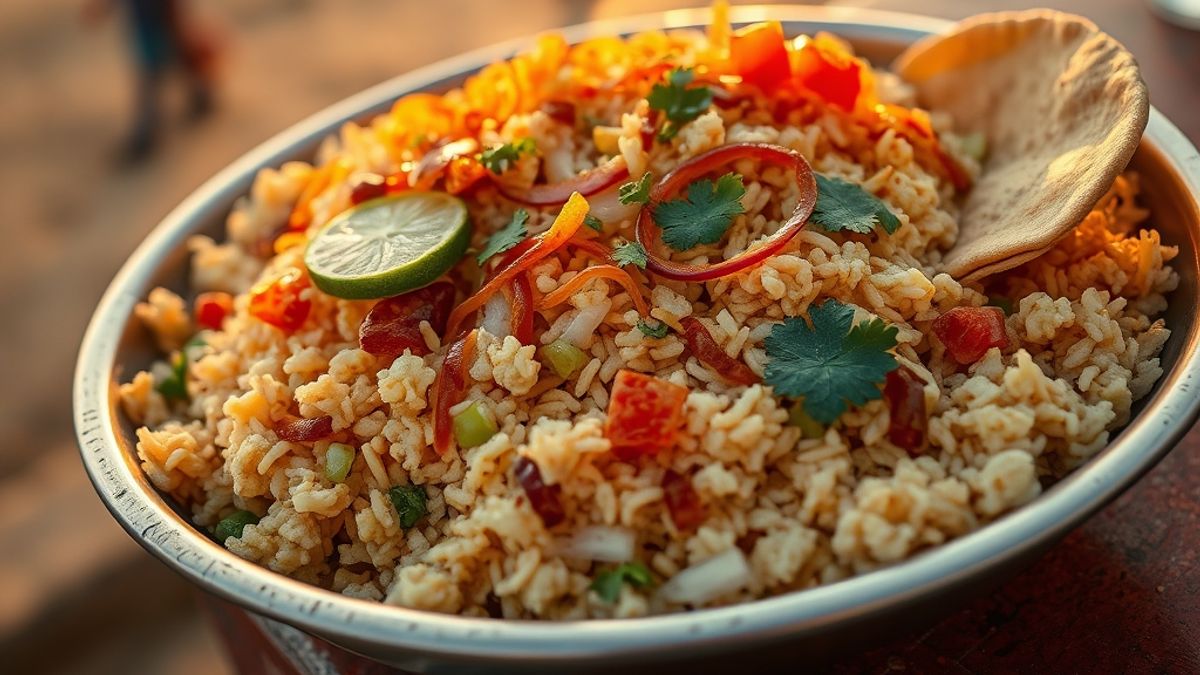
The thing to know is that Chowpatty bhel is famously drier and crunchier than the wetter Juhu version. Puffed rice is tossed with sev, crushed puri, chopped onion and tomato, boiled potato and a squeeze of lime, then lifted by three defining chutneys: sweet tamarind-date, sharp green coriander-mint, and fiery red garlic. A good bhelwalla balances all three so no single note dominates, and serves it fast so the puffed rice stays crisp — bhel that has sat for even a couple of minutes goes soft and sad. If you want to taste the contrast, the Juhu beach chaat scene up north does the wetter, softer style, and comparing the two across a weekend is a genuinely fun way to understand Mumbai chaat.
How to order
The bhelwallas here now largely cluster in a designated hawking zone on the beach rather than roaming loose across the sand. That is a good thing — it keeps the trade in one spot and lets you browse a few carts before you commit.
- Rough price: a plate of bhel or sev puri usually lands somewhere around ₹60–₹120, depending on the cart and the size.
- Order this: bhel puri first, then a plate of sev puri or dahi puri so you taste dry against wet, sharp against cool.
- Say it up front: ask for it teekha (spicy) or kam teekha (mild) before they start mixing — the red garlic chutney is where the heat lives, and it is much easier to leave out than to take back.
Ragda pattice and the chaat middle order
If bhel is the opener, ragda pattice is the substantial middle of the meal. Two shallow-fried potato patties are crushed under a ladle of ragda — a warm, mild white-pea curry — then finished with onion, chutneys, sev and coriander. It is soft, tangy, faintly sweet and completely addictive, and the Chowpatty carts do a reliable, hearty version that eats almost like a small meal.
While you are in chaat territory, the same counters usually turn out the rest of the family: pani puri, the crisp hollow shells filled with spiced teekha water that you eat in one go before they collapse; dahi batata puri, the cooling yoghurt-topped cousin; and ragda samosa, a samosa drowned in the same white-pea gravy. This is grazing food. Order one plate, share it, move to the next cart, and keep the momentum going rather than sitting down to a single large order.
- Rough price: ragda pattice usually runs somewhere around ₹70–₹130 a plate; pani puri is cheaper, often ₹40–₹80 for a round.
- Order this: ragda pattice, then a shot-glass round of pani puri to reset your palate before the pav bhaji.
- Freshness rule: watch the pattice hit the tawa fresh and the shells come from a sealed tin. Skip anything pre-plated and waiting, and if the pani (the spiced water) has been sitting uncovered in the heat, move to a busier cart.
Pav bhaji, the buttery heavyweight
When you want a real meal rather than a snack, this is it. Pav bhaji — a mash of vegetables cooked down with tomato, butter and a punchy masala, served with soft pav toasted in yet more butter — is a Mumbai institution, and the Chowpatty–Girgaon area is one of its spiritual homes. You will see it two ways here: the theatrical beach-cart version, where the cook works a huge flat tawa piled with bhaji and glistening pav under a slab of Amul butter, and the sit-down version at longstanding vegetarian spots around Chowpatty, such as the well-known Sukh Sagar near the beach, which are reliable for a hot, generous plate when you want to sit down and cool off.
- Rough price: roughly ₹120–₹220 a plate at a sit-down spot; often a little less from a cart.
- Order this: classic pav bhaji, or a cheese or masala pav bhaji if you want it richer. Kids and first-timers tend to love the cheese version.
- Good to know: ask for extra pav — the bhaji-to-bread ratio always runs short — and squeeze the lime and pile on the raw onion they give you on the side; both cut the butter beautifully.
If pav bhaji becomes the thing you chase, the city has a whole pav bhaji circuit worth its own evening, and Chowpatty is a fine place to start calibrating your standards.
Kulfi, falooda and the sweet finish
End on something cold. Kulfi — dense, slow-reduced Indian ice cream on a stick or sliced into a bowl — is the classic Chowpatty closer, best in malai, pista and rose. On a warm evening a kulfi falooda, with vermicelli, rose syrup, sweet basil seeds and a scoop of kulfi, is hard to beat. If cold desserts are your weakness, this dovetails neatly with the city’s wider falooda and cold-drink scene, which runs the full range from rose milk to fruit crushes.
- Rough price: kulfi is usually around ₹60–₹150; a full falooda a little more, often up to ₹180.
- Order this: malai or pista kulfi to finish clean, or a kulfi falooda if you are still standing and want the full sensory closer.
Sanjori and the mithai-shop sweets
For something more traditional, look out for sanjori — a Maharashtrian sweet flatbread stuffed with sheera (a rich semolina-and-ghee halwa). It is more a festive and sweet-shop specialty than a beach-cart staple, so you are likelier to find it in Girgaon’s mithai shops and Maharashtrian kitchens than out on the sand, especially around festival season. If you spot it, try it warm with a little ghee. The same shops are your source for modak, pedha and the rest of the city’s mithai and desserts — a good box to carry home so the trail does not end at the beach.
How to walk the trail
The pleasure of this trail is that it is short, linear and downhill toward the water, so you can take it slowly and still cover it all in an evening.
Best time
Go in the evening, from about 5pm onwards, when the sea breeze picks up, the carts fire up and the crowd builds toward sunset. Weeknights are calmer and let you actually talk to the cart-hands; weekends and festival evenings are electric but packed, with queues at the popular stalls. In the monsoon the beach is greyer and the sea rougher, but the fried and hot dishes — misal, vada, pav bhaji — come into their own, and the crowds thin. Carry an umbrella and stick to the covered counters if it is pouring.
Getting there
The nearest railway station is Charni Road on the Western Line — Chowpatty is roughly a five-minute walk from there, and the local train is by far the least stressful way to arrive, given how tight parking is around the beach. Marine Lines (also Western Line) is another easy option, and taxis or autos from Churchgate or CSMT are quick. If you are new to the network, the local train guide is worth a look before you set off; the trains are the fastest way in and out of this part of town by a wide margin.
Walking order
Start in the Girgaon lanes for the savoury openers — misal, vada, a first sweet — then drift down to the beach for bhel puri, ragda pattice and pav bhaji, and finish with kulfi facing the water. Doing it in that order means you build from lighter and drier to richer and heavier, and end cold and sweet with the sea in front of you, which is exactly how it should feel.
Eating smart
A few practical habits keep the evening happy:
- Carry small cash. Many carts prefer it, and while UPI is common now, a stall mid-rush will not always want to fiddle with a phone.
- Keep water handy, ideally sealed bottled water, and pace the spice rather than the quantity.
- If your stomach is delicate, stick to the busiest carts where turnover is highest, skip cut fruit and open uncovered chutneys, and lean toward the freshly fried and freshly griddled items over anything that has been sitting.
- Watch your things in the festival-season crush — it gets shoulder to shoulder, and a hand on your bag is never a bad idea.
Make it a South Mumbai evening
This trail sits neatly alongside the rest of the Mumbai street-food circuit and a slow stroll along Marine Drive and the beaches. String them together — an early plate of chaat at Chowpatty, a walk down the Queen’s Necklace as the lights come on, and a kulfi to close — and in a single unhurried evening you have tasted, walked and seen the soul of South Mumbai the way locals actually live it: on foot, in the open air, one shared plate at a time.
Frequently Asked Questions
What is Girgaon Chowpatty famous for eating?
It is best known for Chowpatty-style bhel puri, which is drier and crunchier than the wetter Juhu version, along with ragda pattice, sev and dahi puri, and buttery pav bhaji. You finish with kulfi or a kulfi falooda by the sea. It is one of the oldest street-food destinations in Mumbai and the place where the city's bhel puri effectively grew up.
What is the nearest station to Girgaon Chowpatty?
Charni Road on the Western Line is closest, roughly a five-minute walk to the beach. Marine Lines station is also nearby and easy to walk from, and taxis or autos from Churchgate and CSMT are quick. Taking the local train is far less stressful than driving, since parking around the beach is very tight in the evenings.
How much does it cost to eat at Girgaon Chowpatty?
Street snacks are cheap: bhel and sev puri run about ₹60–₹120 a plate, ragda pattice around ₹70–₹130, and pani puri roughly ₹40–₹80 a round. A sit-down pav bhaji is usually ₹120–₹220, and kulfi or falooda around ₹60–₹180. A person can graze happily across several dishes for a couple of hundred rupees, though prices vary by cart, season and portion size.
What is the best time to visit Girgaon Chowpatty for street food?
Evenings from about 5pm onwards are ideal, when the sea breeze picks up, the carts fire up and the sunset crowd builds. Weeknights are calmer and better for actually browsing the stalls, while weekends and festival evenings are lively but crowded with queues. During Ganesh Chaturthi the whole Girgaon area is packed and festive, which is exciting but chaotic.
How is Chowpatty bhel puri different from Juhu bhel puri?
Chowpatty bhel is famously drier and crunchier, with the puffed rice, sev and crushed puri staying crisp under the chutneys. The Juhu style tends to be wetter and softer, with more chutney and moisture worked through. Tasting both across a weekend is a common and enjoyable way to understand Mumbai chaat.
Is street food at Girgaon Chowpatty safe to eat?
It is generally fine if you eat smart: stick to the busiest carts where high turnover keeps ingredients fresh, and favour items that are fried or griddled to order. Avoid cut fruit and open, uncovered chutneys, and be cautious with the spiced water in pani puri if it has been sitting in the heat. Carry sealed bottled water, and if your stomach is sensitive, go easy on the spice and quantity.