
Falooda & Cold Drinks: Mumbai's Best Falooda Spots
Mumbai's best falooda: Badshah's Royal, kulfi-falooda at Shalimar & Chowpatty, fruit creams at Bachelorr's — with ₹ price bands, areas and timing tips.
'%3E%3Crect%20width%3D'96'%20height%3D'96'%20fill%3D'%23E65100'%2F%3E%3Ccircle%20cx%3D'30'%20cy%3D'24'%20r%3D'44'%20fill%3D'%23fff'%20opacity%3D'.12'%2F%3E%3Ccircle%20cx%3D'60'%20cy%3D'74'%20r%3D'40'%20fill%3D'%23000'%20opacity%3D'.10'%2F%3E%3C%2Fg%3E%3Cg%3E%3Ccircle%20cx%3D'48'%20cy%3D'48'%20r%3D'15'%20fill%3D'none'%20stroke%3D'%23fff'%20stroke-width%3D'3'%2F%3E%3Cpath%20fill%3D'%23fff'%20d%3D'M48%2037%20l3.5%2011%20-3.5%2011%20-3.5%20-11%20z'%2F%3E%3Ccircle%20cx%3D'48'%20cy%3D'48'%20r%3D'2.2'%20fill%3D'%23fff'%2F%3E%3C%2Fg%3E%3C%2Fsvg%3E)
The Top 12
- 01
Bachelorr's
Girgaon Chowpatty / Marine Drive (opp. Chowpatty Sea Face, near Charni Road stn) ₹150–350 a glassGo for: The seafront's cold-drink institution since the 1930s: thick fresh-cream fruit 'creams' (seasonal sitaphal/custard-apple and strawberry), towering milkshakes, fresh juices and a rich heavy-cream royal/Nawaabi falooda. A roadside stall with car-window service.
Come late (open till ~2am) and order the seasonal sitaphal cream; park along the sea face and waiters take your order at the car.
- 02
Badshah Cold Drink House
Crawford Market (near CSMT / Masjid Bunder) ₹150–250 a glassGo for: The city's most iconic Royal Falooda — cold rose milk, soft vermicelli, sabja seeds and vanilla ice cream — from a strictly pure-veg house running since around 1905.
Fold it into a Crawford Market wander and go in the evening when the milk is coldest and the lanes are buzzing.
- 03
Haji Ali Juice Centre
Mahalaxmi / Haji Ali ₹150–350 a glassGo for: Legendary family-run juice centre by the Haji Ali causeway (since the 1960s), famous for fresh-cream fruit bowls — sitaphal cream is the signature — plus rose, dry-fruit and kulfi faloodas. Open roughly 5am–1am.
Order the custard-apple (sitaphal) cream in season and go before midnight to dodge the peak crush.
- 04
New Kulfi Centre
Girgaon Chowpatty (cnr Chowpatty Seaface & Sardar V. Patel Rd) ₹120–280 a plate/glassGo for: Chowpatty kulfi specialist since 1960 with 36-odd matka-kulfi flavours (malai, kesar-pista, roasted almond, anjeer, seasonal fruit) that can be sliced into a falooda.
Get the kulfi-falooda; there's no seating, so eat it standing or take it down to the sand.
- 05
Sukh Sagar
Girgaon Chowpatty / Marine Drive ₹120–280 a glassGo for: The classic Chowpatty juice-centre address, well known for its dry-fruit falooda and loaded royal falooda alongside fresh juices and shakes.
A dry-fruit falooda here is a meal — split one between two and add a plain rose sherbet.
- 06
Shalimar
Bhendi Bazaar / Mohammed Ali Road ₹120–250 a glassGo for: Serving 'world famous' falooda since 1970, this Mughlai landmark does a rich special falooda crowned with dense malai kulfi — closer to a spoonable dessert than a drink.
Treat it as the cooling full stop to a Mohammed Ali Road kebab crawl; it peaks late and during Ramzan.
- 07
Taj Ice Cream
Bohri Mohalla / Bhendi Bazaar (Khara Tank Rd) ₹80–200 a scoop/plateGo for: One of the city's oldest ice-cream houses (since 1887), still hand-churning small-batch seasonal kulfi and ice cream — fresh mango, sitaphal, anjeer, kesar-pista.
Go for fresh mango or sitaphal in season; it's a tiny cash-only lane shop, so pair it with a Bhendi Bazaar food walk.
- 08
Parsi Dairy Farm
Princess Street / Marine Lines ₹100–250Go for: Century-old dairy (since 1916) revered for thick, slow-set malai kulfi and kulfi-on-a-stick, plus fresh chhaas and mawa sweets.
Take away the malai kulfi and a cold chaas; the newly refreshed Princess Street counter still churns the same rich kulfi.
- 09
Baba Falooda
Mahim (near Mahim Dargah) ₹70–200 a glassGo for: A Mahim favourite for the creamiest faloodas in the neighbourhood — the Royal and Royal Malai Kulfi lead a long list (kaju, butterscotch, black currant, kesar-pista).
Open from ~2pm till 1am — the natural sweet finish after street food around Mahim; go for the Royal Malai Kulfi.
- 10
K. Rustom & Co.
Churchgate (opp. Ambassador Hotel) ₹80–200Go for: A 1953 Parsi institution famous for wafer-pressed ice-cream sandwiches in 50-plus flavours — paan, kesar-pista, sitaphal, walnut crunch, black currant.
Grab a paan or kesar-pista sandwich to eat on the walk to Marine Drive; cash only, no seating.
- 11
Amar Juice Centre
Vile Parle West (beside Cooper Hospital) ₹150–350Go for: The western suburbs' answer to the SoBo juice centres: kulfi-sabja faloodas and rich fresh-cream fruit bowls, with a much-loved sitaphal cream and seasonal mango.
Park at the roadside and let the waiters serve you at the car; the sitaphal cream is the winter must-order.
- 12
Cream Centre
Chowpatty Seaface / Marine Drive ₹200–400Go for: Pure-veg Mumbai landmark since 1958 and the air-conditioned, sit-down option on the seafront — faloodas, sundaes and refreshing mocktails (plus its famous channa bhatura).
The comfortable family alternative to the roadside stalls when you'd rather sit than eat standing; good for a mixed dessert-and-mocktail order.
Ranked by our Mumbai desk · prices are approximate — confirm before you go.
TL;DR: Mumbai’s best falooda is at Badshah Cold Drink House in Crawford Market (the legendary Royal Falooda), with equally serious kulfi-falooda around Mohammed Ali Road (Shalimar) and Girgaon Chowpatty (New Kulfi Centre, Sukh Sagar). Expect to pay roughly ₹120–300 a glass, and go in the evening when the milk is coldest and the crowd is buzzing.
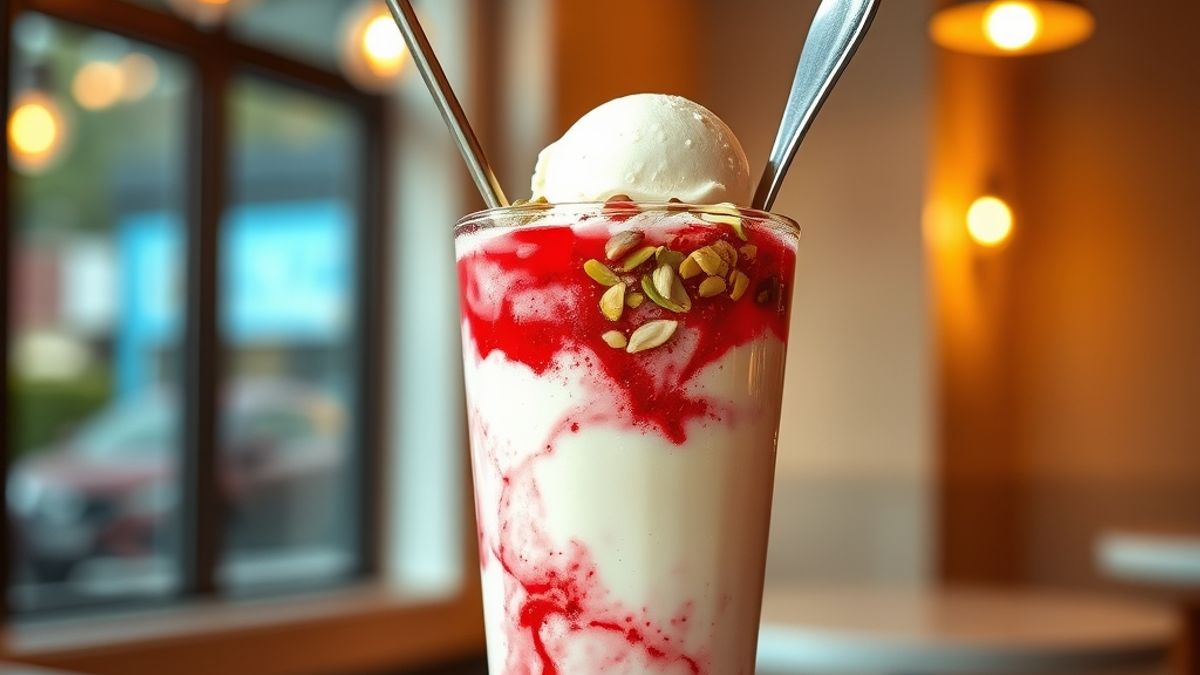
A falooda is less a drink than a whole dessert you sip through a fat straw and finish with a spoon — chilled milk, ribbons of vermicelli, jelly-like sabja (basil) seeds, a slick of rose syrup, and a scoop of ice cream or a wedge of kulfi crowning the glass. In a city that spends eight months of the year sweating, it is Mumbai’s great cooling ritual, and the best versions come from old cold-drink houses that have been layering the same tall glasses for generations. This guide walks you through where to find them, what each style tastes like, what you’ll pay, and how to time a glass so it lands at its best.
Where to go: falooda at a glance
Before the detail, here is the shortlist. Prices are honest ranges, not fixed menus — a plain rose falooda sits at the bottom of each band, a fully loaded royal or dry-fruit version at the top.
| Place | Area / nearest station | Price band | Best for |
|---|---|---|---|
| Badshah Cold Drink House | Crawford Market / CSMT | ₹150–250 | The classic Royal Falooda; pure-veg |
| Shalimar | Bhendi Bazaar / Sandhurst Road | ₹120–250 | Dense malai kulfi-falooda, open very late |
| New Kulfi Centre | Girgaon Chowpatty / Charni Road | ₹120–280 | Kulfi flavours sliced into your glass |
| Sukh Sagar | Girgaon Chowpatty / Charni Road | ₹120–280 | Dry-fruit and royal faloodas by the sea |
| Bachelorr’s | Chowpatty Sea Face / Charni Road | ₹150–300 | Fruit creams and heavy-cream royal falooda, till ~2am |
| Cream Centre | Chowpatty Sea Face / Charni Road | ₹200–350 | Air-conditioned, sit-down faloodas and sundaes |
Read on for what to order at each, and how to build a glass into a proper evening out.
Badshah Cold Drink House, Crawford Market — the original
If you try one falooda in Mumbai, make it the Royal Falooda at Badshah, the pure-vegetarian institution opposite Crawford Market that has been in business since the early 1900s. The Royal is the platonic ideal: cold milk, soft sev-like vermicelli, sabja seeds, a generous pour of red rose syrup and a scoop of vanilla, all built in a tall glass so you get a different ratio in every sip. It is sweet, floral and genuinely refreshing rather than cloying.
What makes it worth the trek is the balance. A lesser falooda drowns everything in rose syrup until it tastes only of sugar; Badshah keeps the milk cold and forward, lets the sabja seeds give that gentle pop, and treats the syrup as a perfume rather than the main event. The vermicelli is soft but still has a little slither to it, and the ice cream melts slowly enough that the last spoonful is as good as the first. Order it, find a spot at the counter, and drink it there rather than carrying it away — a falooda starts losing its chill the moment it leaves the marble.
Make it part of a Crawford Market outing
The area heaves, so treat the falooda as one stop on a bigger loop rather than a destination in itself. Pair it with a wander through the market’s fruit and spice halls, where the light through the old skylights and the smell of the spice lane are half the experience. Go before you shop and you’ll be sticky-fingered for the rest of the trip; go after, and the cold glass is exactly the reward a hot, crowded market earns you.
A Royal Falooda here runs roughly ₹150–250; simpler faloodas and fresh juices are a little less. If you’re two, one royal and one plain sherbet split between you is plenty — these glasses are bigger than they look.
Getting there: Walk from CSMT (Central and Harbour lines) in about ten minutes, or from Masjid Bunder station on the Harbour line. Come on a weekday afternoon if you can; weekend evenings around the market are shoulder-to-shoulder.
Mohammed Ali Road & Bhendi Bazaar — kulfi-falooda country
The lanes around Mohammed Ali Road are famous for kebabs, but they also do a heavier, richer school of falooda built around kulfi rather than soft-serve. This is a different animal from the Crawford Market style: where Badshah’s Royal is light and floral, the Bhendi Bazaar version is dense, milky and almost custardy — a dessert you lean into rather than one that cools you down and gets out of the way.
Shalimar and the late-night crawl
Shalimar, at the Bhendi Bazaar corner, is the reliable name here: order the special falooda or a rose-and-kulfi version and you get dense malai kulfi sinking into rose-scented milk — closer to a spoonable dessert than a drink. The kulfi is the slow-set kind, close-grained and heavy, so it holds its shape in the glass for a good while before it surrenders into the milk. It is open very late, which makes it a natural finish to a Mohammed Ali Road food crawl rather than a stop in the middle of one.
This whole quarter comes alive at night and especially during Ramzan, when the food streets run past midnight and the pavements fill with grills, sweet stalls and the whole city’s appetite. In those weeks the falooda is the cooling counterweight to a lot of rich, spiced food — a glass to reset your palate after the fourth kebab. A kulfi-falooda here is roughly ₹120–250. Come hungry, and treat the falooda as the cooling full stop after the Mughlai kebabs and rolls the area is built on.
A practical note: this is a working food street, not a café district. You’ll mostly eat standing, order and pay at the counter, and share your elbow room with a crowd. That is the charm, not a flaw — but if you want to sit down with a falooda in air-conditioning, this is not the stretch for it.
Girgaon Chowpatty & Marine Drive — falooda by the sea
The stretch opposite Girgaon Chowpatty beach is the single best cluster in the city for a falooda, and the most pleasant place to drink one: sea breeze, chaat stalls, and no rush. It is the natural next move after an evening on the sand or a walk along Marine Drive, when you want something cold and sweet with the water in view.
New Kulfi Centre and Sukh Sagar
New Kulfi Centre, open since around 1960, is the specialist. Its whole trade is kulfi — dozens of flavours, malai and kesar-pista and roasted almond and anjeer, plus seasonal mango when the Alphonsos are in — and you can have any of them sliced into a falooda rather than served plain on a leaf. Ordering the kulfi separately over a bed of vermicelli, rose syrup and sabja is how the regulars do it, because it lets you pick exactly the flavour you want on top. The roasted almond and the anjeer (fig) are the ones worth crossing town for.
A few doors down, Sukh Sagar is the classic juice-centre address, well known for its dry-fruit and royal faloodas. This is the more all-rounder stop — a place to get a loaded glass with slivered nuts and a scoop of ice cream while someone in your group orders a fresh juice or a milkshake instead. Expect roughly ₹120–280 across both, depending on how loaded your glass is.
Bachelorr’s and Cream Centre
The single biggest omission on the Chowpatty seafront is Bachelorr’s, the roadside juice-and-ice-cream institution at 45 Chowpatty Sea Face on Marine Drive — a two-minute walk from Charni Road station — that has been pulling crowds since the 1930s. It is less a falooda specialist than a full-blown cold-drink temple: thick fresh-cream fruit “creams” (the seasonal sitaphal, or custard apple, and the strawberry are what regulars queue for) alongside towering milkshakes, fresh juices and a rich, heavy-cream royal falooda, served until around 2am to cars parked along the sea face, where waiters take your order at the window. The fruit creams are the signature and the falooda is the sturdy backup — order one of each if you’re a group and pass them round.
A few doors along the Seaface, Cream Centre — a pure-veg Mumbai landmark since 1958 — is the air-conditioned, sit-down alternative for faloodas, sundaes and mocktails when you’d rather not eat standing. It is the place to bring someone who wants the falooda experience without the pavement, and it costs a little more for the comfort. Together with New Kulfi Centre and Sukh Sagar, these make the Chowpatty–Marine Drive stretch the single best cluster in the city for a post-beach falooda or fruit cream. Come after sunset, when the sea breeze is up, the chaat stalls are lit and the milk is at its coldest.
Getting there: Charni Road station (Western line) is a short walk; the seafront is a straight line down to the water. If you’re coming off Marine Drive, just keep the sea on your right and walk north toward the sand — the cluster of juice houses is unmissable.
What to order: a falooda glossary
Falooda menus can look interchangeable until you know what the names actually change. Here is what you’re choosing between.
The classic styles
- Royal / Shahi falooda — the fully loaded version: milk, vermicelli, sabja, rose syrup, ice cream, dry fruits and often a layer of malai on top. Order this if it’s your first; it’s the most complete picture of what a falooda can be.
- Kulfi falooda — vermicelli and rose milk with a wedge of dense kulfi instead of (or alongside) ice cream. Richer, less fizzy-sweet, and more of a spoon-and-straw dessert — the style you’ll find around Mohammed Ali Road and Chowpatty.
- Rose / gulab falooda — the simplest classic, leaning on rose syrup and milk. The best test of a place: if the plain rose falooda is good, everything else will be.
- Dry-fruit falooda — laced with slivered almonds, pistachios and cashews; the “special” at many juice centres and the one to get if you want texture in every spoon.
- Kesar-badam — saffron-and-almond milk, warmer in flavour and less floral. A good choice if rose syrup isn’t your thing.
If you’re ordering for a group, get one royal, one kulfi and one kesar-badam and taste across all three — they’re different enough that everyone will have a favourite, and it’s the fastest way to learn the spectrum.
Sherbets and lighter cold drinks
If you don’t want a full falooda, most of these houses also do sherbets and cold milk drinks — rose, khus (vetiver, a startling green), kesar-badam and seasonal fruit — which are lighter, cheaper and faster to drink. Khus is the one to try if you’ve never had it: an almost herbal, cooling green syrup over cold milk that tastes like nothing else and is exactly what you want on a 35-degree afternoon. These are also the smart order when you’ve already eaten and just want something cold in your hand rather than a dessert that doubles as dinner.
Thandai and seasonal cold drinks
Thandai — the spiced, chilled milk drink laced with fennel, cardamom, saffron, pepper and ground nuts — is more seasonal than the year-round falooda. In Mumbai it peaks around Holi in spring, when sweet shops and some restaurants across the city put it on; it is worth seeking out then rather than expecting it on tap in July. It’s a more grown-up, aromatic drink than a falooda — less sweet, more spiced, and closer in spirit to a cold masala milk than a dessert. Year-round, the same cold-drink houses will pour you a khus or rose milk that scratches a similar itch even when thandai is off the board.
Seasonality runs through this whole category, in fact. Mango falooda and mango creams are a summer-only pleasure that arrives with the Alphonsos around April and vanishes by July; sitaphal cream at Bachelorr’s is a cold-season treat that peaks in winter. Ask what’s seasonal before you default to rose — the fruit of the moment is usually the best thing on the board.
How to drink one well
A falooda is cheap and forgiving, but a few habits separate a good glass from a great one.
Timing and season
Go in the evening, roughly 6pm onwards, when the milk has been chilling all day and the areas are at their liveliest. A falooda ordered at 11am from a shop that’s just opened will never be as cold or as settled as one at 8pm. Summer (March–May) is peak falooda season — the hotter the day, the more sense the whole ritual makes — and the seafront cluster at Chowpatty is at its best just after sunset, when the breeze picks up.
Money, crowds and portions
Many of these are counter-service, cash-friendly places with standing room only. Go with the flow: hand your order at the counter, pay, and collect the glass yourself. Keep some cash on you — the smaller stalls may not take cards, and you don’t want to lose your place in a Crawford Market crowd hunting for a working card machine.
On portions, take the sizes seriously. A Royal or dry-fruit falooda is a meal in itself — two people can happily share one and order a plain sherbet on the side. If you’re mid-food-crawl, this matters: one loaded falooda between two will cool you down without ending the evening’s eating.
Dietary notes and the monsoon caveat
A vegetarian note: Badshah and Cream Centre are strictly pure-veg; the Mohammed Ali Road houses serve falooda alongside meat menus, so specify if that matters to you. Faloodas themselves are vegetarian everywhere, but the kitchen around them may not be.
And a seasonal caution: falooda is served cold year-round, but a rainy monsoon evening is not its natural habitat. A cold, sweet, milky drink lands best on a warm night; on a wet July evening it can feel like the wrong thing entirely. Save it for the heat, which — this being Mumbai — is never far away.
Frequently Asked Questions
Which is the most famous falooda in Mumbai?
Badshah Cold Drink House opposite Crawford Market is the city's most iconic address, in business since the early 1900s. Its Royal Falooda — cold milk, soft vermicelli, sabja seeds, rose syrup and a scoop of vanilla — is the falooda most Mumbaikars send visitors to try. It's pure-vegetarian and best drunk at the counter, when the milk is at its coldest.
How much does a good falooda cost in Mumbai?
Roughly ₹120–300 a glass at the well-known cold-drink houses, depending on whether you order a plain rose falooda or a fully loaded royal or kulfi version. A simple sherbet or rose milk is cheaper still, while an air-conditioned sit-down spot like Cream Centre can run a little higher. These are approximate bands, not fixed prices, so expect them to drift with the season and the toppings.
What is the difference between falooda and kulfi-falooda?
A standard falooda is a chilled milk drink with vermicelli, sabja seeds and rose syrup, usually topped with ice cream — light, floral and refreshing. A kulfi-falooda swaps in dense, slow-set kulfi, making it richer and more of a spoon-and-straw dessert. You'll find the ice-cream style at Badshah and the heavier kulfi style around Mohammed Ali Road and Girgaon Chowpatty.
Where can I get falooda near Girgaon Chowpatty and Marine Drive?
The stretch opposite Girgaon Chowpatty beach is the city's best cluster, a short walk from Charni Road station. New Kulfi Centre (open since around 1960) slices dozens of kulfi flavours into your glass, and Sukh Sagar is the classic address for dry-fruit and royal faloodas. Nearby on the sea face, Bachelorr's does heavy-cream royal faloodas and fruit creams until around 2am, while Cream Centre is the air-conditioned sit-down option.
What is the best time of day to have a falooda in Mumbai?
Evenings from about 6pm onwards are ideal, when the milk has been chilling all day and the areas are at their liveliest. Summer, roughly March to May, is peak falooda season — the hotter the day, the more the whole ritual makes sense. A rainy monsoon evening is the one time to skip it; a cold, milky drink lands best on a warm night.
Is Badshah's falooda vegetarian?
Yes — Badshah Cold Drink House is strictly pure-vegetarian, as is Cream Centre near Chowpatty. Faloodas themselves are vegetarian everywhere, but some spots around Mohammed Ali Road serve them alongside meat menus, so mention it if that matters to you. When in doubt, ask at the counter before you order.