
Ganesh Chaturthi in Mumbai: A Visitor's Guide
A practical visitor's guide to Ganesh Chaturthi in Mumbai — Lalbaugcha Raja, GSB Seva Mandal, the Girgaon Chowpatty visarjan, 2026 dates, queues and crowds.
'%3E%3Crect%20width%3D'96'%20height%3D'96'%20fill%3D'%23E65100'%2F%3E%3Ccircle%20cx%3D'30'%20cy%3D'24'%20r%3D'44'%20fill%3D'%23fff'%20opacity%3D'.12'%2F%3E%3Ccircle%20cx%3D'60'%20cy%3D'74'%20r%3D'40'%20fill%3D'%23000'%20opacity%3D'.10'%2F%3E%3C%2Fg%3E%3Cg%3E%3Ccircle%20cx%3D'48'%20cy%3D'48'%20r%3D'15'%20fill%3D'none'%20stroke%3D'%23fff'%20stroke-width%3D'3'%2F%3E%3Cpath%20fill%3D'%23fff'%20d%3D'M48%2037%20l3.5%2011%20-3.5%2011%20-3.5%20-11%20z'%2F%3E%3Ccircle%20cx%3D'48'%20cy%3D'48'%20r%3D'2.2'%20fill%3D'%23fff'%2F%3E%3C%2Fg%3E%3C%2Fsvg%3E)
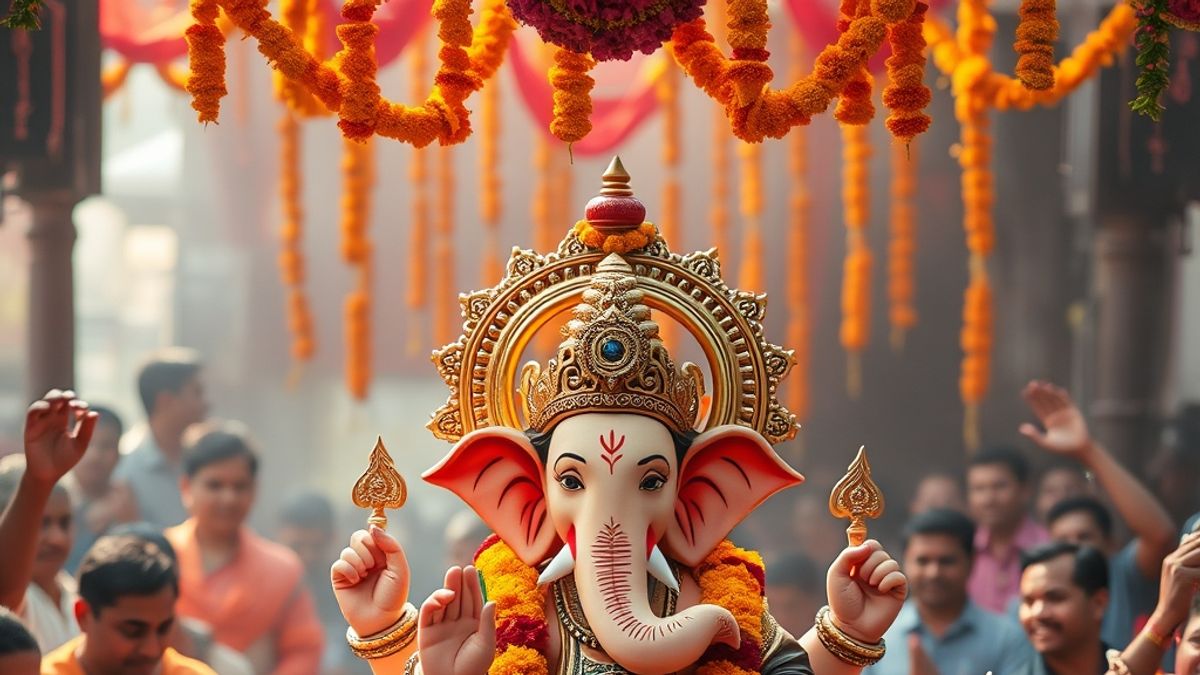
For ten days at the tail end of the monsoon, Mumbai belongs to Ganesha. Ganesh Chaturthi is the city’s biggest, loudest and most openly joyful festival — thousands of clay idols of the elephant-headed god installed in homes and street pandals, days of aarti and dhol-tasha and modak, and finally the great visarjan, when the idols are carried to the sea and immersed. Entire lanes are roofed over with fairy lights, traffic reorganises itself around processions, and for a visitor it is one of the most extraordinary things you can witness anywhere in India. This guide is about how to actually do it — where to go, when to go, how long you’ll queue, and how to keep your feet and your temper through the crowds.
Quick reference
| Landmark | Area | Known for | Typical darshan wait | Best time to go |
|---|---|---|---|---|
| Lalbaugcha Raja | Lalbaug (central) | The city’s most famous idol; the “wish-fulfilling” Ganpati | Hours to a full day (touch-the-feet line) | Weekday pre-dawn or late night |
| GSB Seva Mandal | King’s Circle, Matunga | Richest, most opulent mandal; gold-adorned eco idol | 1–3 hours, well-marshalled | Early weekday morning |
| Ganesh Galli (Mumbaicha Raja) | Lalbaug | Elaborate themed backdrop, tall idol | 1–2 hours | Weekday, off-peak |
| Girgaon Chowpatty | South Mumbai | The headline visarjan beach | N/A — viewing, not queuing | Anant Chaturdashi, from afternoon |
| Juhu / Versova / Dadar | Western & central | Big neighbourhood immersions | N/A | Any immersion day, evening |
Treat the waits as ballpark. They swing wildly with the day of the week, the hour and the weather, and the big mandals publish official schedules each year — always check the current year’s timings before you set out.
What Ganesh Chaturthi actually is
Ganesh Chaturthi marks the birth of Lord Ganesha, the remover of obstacles and the god you turn to before any new beginning. Families and neighbourhood committees install an idol for a fixed span — most commonly one and a half, five, seven or eleven days — worship it daily with flowers, incense and sweets, and then immerse it in water, symbolically sending Ganesha home to Mount Kailash and taking the year’s obstacles with him.
The public, street-corner version of the festival that you see across Mumbai is relatively modern. It was reshaped in the 1890s into a large community celebration, and the city ran with it: the sarvajanik (public) pandal became a fixture of nearly every mohalla. That is why the festival feels less like a single event and more like the whole city celebrating in parallel — Ganesha stands in a marble mansion in Malabar Hill and in a one-lane chawl in Parel on the same evening. If you want to understand Mumbai’s relationship with the deity beyond these ten days, the year-round anchor is the Siddhivinayak temple in Prabhadevi, where the queues never really stop; it sits within the wider constellation of Mumbai’s temples that this festival briefly eclipses in scale.
When it happens in 2026
In 2026, Ganesh Chaturthi begins on Monday 14 September, and the biggest immersion day — Anant Chaturdashi — falls on Friday 25 September, the climax when the largest eleven-day idols make their final journey to the sea. Because the festival follows the lunar calendar and the exact civic date can shift by a day with the tithi timings, confirm against the official calendar if you are booking travel around it.
The timing is worth understanding for practical reasons. The festival lands right at the end of the monsoon, so you can expect warm, sticky air and the occasional heavy shower even in mid-September — the rains have usually eased but not vanished. The intensity also builds across the ten days: the first few are relatively calm, the middle days fill out, and the final two or three — leading into Anant Chaturdashi — are when the city hits full roar. If your window is flexible and crowds worry you, the early days give you the atmosphere at a gentler pitch. If you want the spectacle at its most overwhelming, aim for the last stretch and brace yourself.
The great pandals
Lalbaugcha Raja (Lalbaug)
This is the one everyone means when they say they are “going for darshan.” The Lalbaugcha Raja — the “King of Lalbaug” — is the most famous idol in the city, revered as the Navsacha Ganpati, the Ganesha who grants wishes, and it draws devotees in the millions over the ten days. That reputation is also its challenge: the crowd is genuinely enormous.
There are two queues, and knowing the difference will save your day. The Navasachi line takes you onto the stage to touch the idol’s feet and make your vow — this is the one that can stretch to many hours and, at peak, well over a day, with people queuing overnight in barricaded lanes. The Mukh Darshan line is for a standing, distant glimpse of the idol’s face and moves far faster, often in an hour or two. Unless a personal vow is the point of your visit, the Mukh Darshan line gives you the sight and the atmosphere without surrendering a whole day.
Lalbaug sits in the old mill district of central Mumbai; the surrounding Lalbaug–Parel belt is worth understanding before you arrive, because road access tightens dramatically during the festival and the nearby stations do a lot of the heavy lifting. Go pre-dawn or very late at night on a weekday for the shortest waits, and check the mandal’s published darshan schedule for the year — it lists opening times and the aarti slots when queues pause.
GSB Seva Mandal (King’s Circle, Matunga)
If Lalbaugcha Raja is about scale and devotion, the GSB Seva Mandal at King’s Circle is about craft and order. Run by the Gaud Saraswat Brahmin community, it is reputed to be the richest and most opulent mandal in Mumbai — an eco-friendly clay idol adorned with tens of kilograms of gold and silver, set against fresh flowers and traditional decor. It is usually a shorter, five-day mandal, and it is famously well-organised: covered queues, marshals, drinking water and a darshan that moves at a humane pace, often an hour or two rather than a day.
For many visitors this is the more manageable “flagship” experience — the grandeur is real, the wait is bounded, and the neighbourhood rewards you afterwards. King’s Circle spills into Matunga’s south-Indian food trail, so you can pair darshan with filter coffee and a dosa within a short walk.
Other pandals worth your time
Beyond the two headliners, a handful of names recur every year and are part of the fabric of the festival:
- Ganesh Galli’s Mumbaicha Raja in Lalbaug, known for an elaborate, often architecturally themed pandal that changes each year.
- Andhericha Raja in the western suburbs, a hugely popular working-class mandal near Andheri.
- The Khetwadi lanes in Girgaon, historically famous for exceptionally tall idols and dense, competitive street decoration.
- Chinchpoklicha Chintamani, one of the oldest and most respected mandals, whose arrival and immersion processions are events in themselves.
But the real texture of Ganesh Chaturthi is not on any must-see list. Some of the best moments come from simply wandering a residential stretch — Girgaon, Khetwadi, Parel, Dadar, Chembur — where every second lane has its own Ganesha and its own volunteers competing, quietly and fiercely, to have the finest decoration on the block. If you are already exploring the things to do across the city, this is the season when the ordinary streets outperform the attractions.
Darshan without losing a day
The single biggest mistake visitors make is treating the marquee idols like a museum you can drop into. You cannot. Here is how regulars handle it:
- Pick your line before you arrive. For Lalbaugcha Raja, decide between the fast Mukh Darshan glimpse and the slow feet-touching Navasachi line, and enter the correct queue — they are physically separate and you cannot switch.
- Go at unsociable hours. Pre-dawn (roughly 4–7am) and the small hours after midnight are dramatically quieter than the evening rush. Weekday mornings beat weekends by a wide margin.
- Bank on security. Expect frisking, bag checks and phone-away stretches at the big mandals. Travel light; large bags slow you down and are sometimes turned away.
- Watch the aarti clock. Queues pause during the morning and evening aarti. The schedule is published; timing your entry just after an aarti window can mean a faster move.
- Have a fallback. If a line looks impossible, the neighbourhood pandals nearby ask nothing of you but a few minutes, and the smaller ones often let you stand right in front of the idol.
The visarjan (immersion)
The emotional heart of the festival is the visarjan. Idols are lifted onto trucks and shoulders and paraded to the water with dhol-tasha drumming, dancing, showers of pink gulal and the chant that becomes the soundtrack of the whole city — “Ganpati Bappa Morya, pudhchya varshi lavkar ya” (come again soon next year). The mood is euphoric and, by the end, quietly tearful; you are watching people say goodbye.
Girgaon Chowpatty
The great set-piece is at Girgaon Chowpatty in South Mumbai, the crescent of sand where the Lalbaugcha Raja and many of the other major idols are finally immersed. On Anant Chaturdashi the processions converge here through the afternoon and continue all through the night into the following dawn — cranes lower the largest idols into the sea while lakhs of people watch from the beach and the promenade. It is the same shoreline that runs up to Marine Drive and Chowpatty, and the whole sweep becomes one continuous, sleepless spectacle.
Watching here is genuinely unforgettable, but go in with a plan. Pick your vantage point early in the afternoon, before the crowd solidifies; once the big processions arrive you will not move quickly. Accept that you may be standing for hours, keep a hand on your belongings at all times, and know your exit — the lanes off Chowpatty back towards Charni Road and Girgaon fill completely.
Other immersion points
You do not have to be at Chowpatty to see a moving immersion. The festival’s smaller and mid-sized idols go into the water all over the city, and many of these are easier to reach and gentler to watch:
- Juhu Beach in the western suburbs hosts one of the largest suburban immersions, with a carnival atmosphere and food stalls along the sand.
- Versova, Powai (at the lake) and Dadar’s Shivaji Park beach all take large numbers of idols; the Dadar area is central and well-connected, which makes it a practical choice.
- Countless household idols are immersed at neighbourhood ponds and municipal immersion tanks — increasingly the norm as the city pushes eco-friendly practice.
A neighbourhood immersion, watched from a quiet stretch of a suburban beach, can move you more than the crush at Chowpatty. Consider trading spectacle for intimacy at least once.
Modak and the festival table
You cannot separate Ganesha from food. The signature offering is modak — a soft, pleated dumpling of rice flour filled with jaggery and fresh coconut, steamed (the classic ukdiche modak) or fried, and offered to the god before it is shared as prasad because it is said to be his favourite sweet. During the festival, sweet shops and home kitchens across the city produce them by the thousand; a plate at a good mithai shop typically runs in the ₹200–400 range, and street stalls sell them for less.
Beyond modak, this is peak season for Maharashtrian home cooking — puran poli, varan-bhaat, batata bhaji and the full festive thali — and the mithai counters across Girgaon, Dadar and Matunga are worth a detour on their own. If you find yourself pandal-hopping through the old southern lanes, the Girgaon khau galli keeps you fed between darshans without straying far. Do try the prasad wherever it is offered; accepting it graciously is part of the exchange.
Etiquette
These are religious observances, not a street fair laid on for tourists, and a little care goes a long way:
- Dress modestly. Covered shoulders and knees are the safe standard at pandals; you will feel out of place otherwise.
- Remove footwear where indicated — many pandals require it before you approach the idol.
- Expect security and frisking at the major mandals, and cooperate with the volunteers marshalling the queues; they are managing enormous numbers of people.
- Photograph with consent. Public scenes are generally fine, but ask before pointing a camera at people mid-prayer, and put the phone away where you are asked to.
- Join the chant, follow the lead. If you are near a procession, moving with the crowd and echoing Ganpati Bappa Morya is welcomed, not intruded upon — this is a participatory festival.
Handling the crowds and getting around
Ganesh Chaturthi draws crowds on a scale that can genuinely overwhelm the unprepared, and the logistics are half the battle:
- Use the trains. Roads around Lalbaug, Parel, Girgaon and Marine Drive see heavy diversions and outright closures, especially on immersion days, and taxis simply cannot move through them. The suburban local train is almost always the fastest and most reliable way across the city during the festival — Chinchpokli, Currey Road, Lower Parel and Charni Road stations put you within walking distance of the central action. Read up on getting around Mumbai before you rely on cabs.
- Go early, and go on weekdays. Mornings and weekdays are markedly calmer than evenings and weekends at every pandal.
- Travel light and guard your valuables. In a dense, moving crowd, a small crossbody bag worn in front beats a backpack, and a phone in a zipped pocket beats one in your hand.
- Stay hydrated. The tail-end monsoon air is warm and humid and you will be on your feet for hours; carry water and don’t skip meals.
- Plan around the immersion peak. On Anant Chaturdashi, assume large parts of South and central Mumbai will be effectively impassable by road from the afternoon into the next morning. If you are staying in the thick of it, factor that into where you base yourself.
The quieter, greener side
The festival has been changing. There is a strong and growing push towards eco-friendly celebration — idols of natural, unbaked clay (shadu) that dissolve cleanly, natural colours instead of chemical paints, and immersion at controlled artificial tanks rather than the open sea. Mandals like the GSB Seva Mandal have made a point of their eco idols, and the civic authorities now provide immersion tanks across the city. If the environmental toll of the traditional sea immersion troubles you, seeking out a clay-idol pandal or an artificial-tank immersion is a way to see the festival on its most thoughtful terms.
It is also worth remembering that Ganesh Chaturthi opens a long festive stretch in Mumbai. Within weeks it hands over to the nine nights of Navratri and its garba floors, and the city barely pauses for breath between the two.
The bottom line
Ganesh Chaturthi is Mumbai at its most exuberant — a ten-day outpouring of faith, art and neighbourhood pride that briefly rewires the whole city. Time your visit for mid-to-late September 2026, see the Lalbaugcha Raja (in the fast Mukh Darshan line unless a vow calls for the long one) and the gold-clad GSB Seva Mandal at King’s Circle, wander a couple of ordinary residential lanes for the unstaged version, and — if you can bear the crowds — witness the visarjan at Girgaon Chowpatty, or trade it for the gentler drama of a suburban beach. Go early, dress respectfully, ride the trains, guard your belongings and eat the modak. It is a festival on a scale you really do have to see to believe.
Frequently Asked Questions
When is Ganesh Chaturthi in Mumbai in 2026?
In 2026, Ganesh Chaturthi begins on Monday 14 September, and the biggest immersion day, Anant Chaturdashi, falls on Friday 25 September. The festival runs for about ten days, building in intensity towards the final immersion. Because the dates follow the lunar calendar and can shift by a day with the tithi, check the official calendar if you are booking travel around it.
How long is the wait to see Lalbaugcha Raja?
It depends entirely on which queue you join. The Navasachi (feet-touching) line can run for many hours and, at peak, well over a day, with devotees queuing overnight. The much faster Mukh Darshan line, for a standing glimpse of the idol's face, usually moves in one to two hours. Go pre-dawn or late at night on a weekday for the shortest waits, and check the mandal's published darshan schedule.
Where is the best place to watch the Ganesh visarjan in Mumbai?
The headline immersion is at Girgaon Chowpatty in South Mumbai, where Lalbaugcha Raja and other major idols are immersed on Anant Chaturdashi through the night into the next dawn. It is unforgettable but extremely crowded, so pick your spot in the afternoon before the processions arrive. For a gentler experience, the suburban immersions at Juhu, Versova, Powai lake and Dadar's Shivaji Park beach are easier to reach and less overwhelming.
How do you get around Mumbai during Ganesh Chaturthi?
Use the suburban trains. Roads around Lalbaug, Parel, Girgaon and Marine Drive see heavy diversions and closures, especially on immersion days, and taxis cannot move through them. Stations like Chinchpokli, Currey Road, Lower Parel and Charni Road put you within walking distance of the central pandals. On Anant Chaturdashi, expect large parts of South and central Mumbai to be effectively impassable by road from the afternoon into the following morning.
What should you wear and how should you behave at the pandals?
Dress modestly, with covered shoulders and knees, since these are religious sites and observances. Be ready to remove your footwear where indicated and to pass through security frisking and bag checks at the major mandals. Photography of public scenes is generally fine, but ask before photographing people at prayer and put your phone away where instructed. Accepting prasad such as modak graciously is part of the exchange.
What food should you try during Ganesh Chaturthi?
The signature offering is modak, a soft steamed or fried dumpling of rice flour filled with jaggery and coconut, said to be Ganesha's favourite sweet and shared widely as prasad. A plate at a good mithai shop typically runs around ₹200–400. It is also peak season for Maharashtrian festive cooking like puran poli and varan-bhaat, and the sweet shops of Girgaon, Dadar and Matunga are worth a detour.