
The Best Gujarati & Rajasthani Thali in Mumbai
Where to eat an unlimited Gujarati & Rajasthani thali in Mumbai: Shree Thaker Bhojanalay, Rajdhani, Chetana and value spots, with prices and tips.
'%3E%3Crect%20width%3D'96'%20height%3D'96'%20fill%3D'%23E65100'%2F%3E%3Ccircle%20cx%3D'30'%20cy%3D'24'%20r%3D'44'%20fill%3D'%23fff'%20opacity%3D'.12'%2F%3E%3Ccircle%20cx%3D'60'%20cy%3D'74'%20r%3D'40'%20fill%3D'%23000'%20opacity%3D'.10'%2F%3E%3C%2Fg%3E%3Cg%3E%3Ccircle%20cx%3D'48'%20cy%3D'48'%20r%3D'15'%20fill%3D'none'%20stroke%3D'%23fff'%20stroke-width%3D'3'%2F%3E%3Cpath%20fill%3D'%23fff'%20d%3D'M48%2037%20l3.5%2011%20-3.5%2011%20-3.5%20-11%20z'%2F%3E%3Ccircle%20cx%3D'48'%20cy%3D'48'%20r%3D'2.2'%20fill%3D'%23fff'%2F%3E%3C%2Fg%3E%3C%2Fsvg%3E)
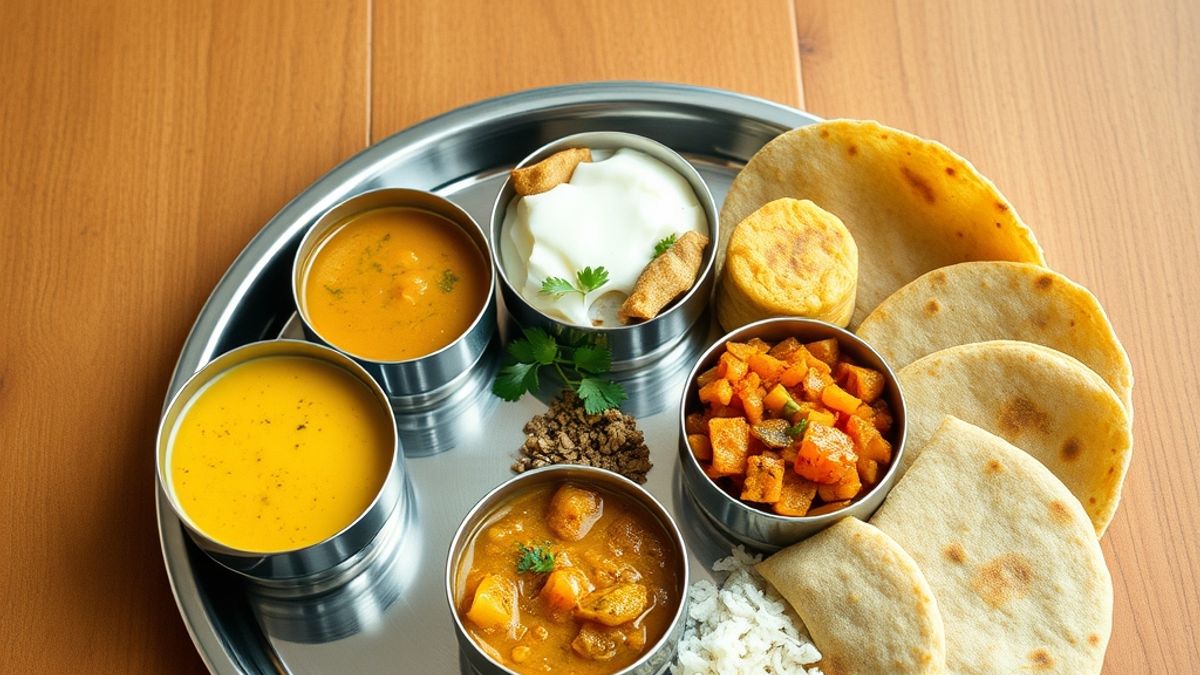
The unlimited Gujarati thali is one of the great meals of India, and Mumbai — with its huge Gujarati and Marwari population — does it better than almost anywhere. Picture a gleaming steel platter ringed with a dozen little bowls: sweet dal, crisp farsan, two or three seasonal vegetables, rotli straight off the griddle, rice, relishes, chutneys and a sweet, all of it topped up endlessly by roving servers until you finally cover your plate and surrender. It is a fixed-price feast, a genuine cultural ritual, and one of the best-value ways to eat superbly in this expensive city. This guide is your map to the best of them — where to go, what to expect, what it costs, and how to eat one without embarrassing yourself.
Quick reference: Mumbai’s thali houses at a glance
Use this as a shortlist. Prices are per person, “comfortably fed,” and shift with the seasons and the price of onions — treat them as bands, not receipts.
| Thali house | Area | Price (₹/head) | Best for |
|---|---|---|---|
| Shree Thaker Bhojanalay | Kalbadevi | 700–900 | The connoisseur’s lunch, gone hungry |
| Rajdhani (Khandani Rajdhani) | Outlets citywide | 600–800+ | A polished, comfortable first thali |
| Chetana | Kala Ghoda | ~400 | Pairing with a Fort and art walk |
| Panchvati Gaurav | Kalbadevi | 200–250 | Old-school value, serving since the 1940s |
| Golden Star Thali | Near Charni Road | Value, unlimited | Unlimited Gujarati-Rajasthani since 1990 |
What a Gujarati thali actually is
A proper Gujarati thali is a parade, not a plate. The joy of it is the range — you are not choosing one dish, you are sampling fifteen, and the kitchen has balanced sweet against salt, soft against crunchy, and rich against cooling so that the whole spread hangs together. Once you understand the components, you can pace yourself intelligently instead of filling up on rotli in the first five minutes.
The savoury run
At the heart of the meal are the wet dishes and the breads, and they arrive first and never really stop.
- Sweet dal and kadhi — the mildly sweet, thin, tempered lentil soup and the gentle yogurt-and-gram-flour kadhi that together define the Gujarati palate. Newcomers are sometimes startled that the dal is faintly sweet; give it a few spoons and it makes sense.
- Shaak — two or three seasonal vegetable preparations, one usually dry and spiced, one in a gravy. This is where the kitchen shows off what is in the market that week.
- Rotli, puri and bhakri — the breads, brushed with ghee, served scorching hot and refreshed the instant you finish one. Bhakri is the thicker, rustic millet or wheat round; rotli is the thin everyday chapati.
- Rice, khichdi and kadhi to close out the savoury stretch, often with a spoon of ghee and a little more kadhi poured over.
Farsan, the supporting cast
Farsan are the fried and steamed snacks that come as sides and, for many people, are the real reason to show up: soft dhokla and khaman, the rolled and layered patra, and steamed muthia, sometimes with a fried item or two alongside. They are meant to be nibbled between mouthfuls of the main run, not treated as a starter to be demolished. If you love Gujarati snacking on its own terms, it overlaps heavily with what you will find on Mumbai’s street food carts, only here it is unlimited and freshly turned out from a proper kitchen.
The sweet finish
Gujarati thalis do not tack dessert on as an afterthought — a sweet is woven into the meal, and often more than one. Expect basundi (thickened, cardamom-scented milk), shrikhand (hung, sweetened yogurt), or a seasonal special, plus jaggery and ghee to eat with the last of your rotli. If the thali leaves you wanting a proper mithai chaser, the city’s mithai and dessert scene is a natural next stop, and a cold falooda or kulfi is the classic way to cool down after all that ghee.
How Rajasthani thalis differ
Most of Mumbai’s thali houses serve a combined Gujarati-Rajasthani spread, and the Rajasthani side is worth understanding because it pulls the meal in a different direction: spicier, drier, and more robust. Look for dal-baati (baked wheat dumplings drowned in ghee and dal), gatta curry (gram-flour dumplings in a yogurt gravy), and ker-sangri, the tangy desert-bean-and-berry dish that is the signature of the cuisine. Everything is pure-vegetarian, and almost all of it can be made Jain — which is exactly why these restaurants are a fixture of Mumbai’s wider pure-veg dining landscape.
The great thali houses of Mumbai
There is no single “best” thali — there is the revered one, the polished one, the convenient one, and the ones that have quietly fed generations for a pittance. Here is how they differ.
Shree Thaker Bhojanalay — Kalbadevi
The connoisseur’s choice. Tucked into a Kalbadevi lane, this is a revered, lunch-focused Gujarati thali famous for the quality and variety of its dal, farsan, bhakri and sweets rather than for any frills. There is no chandelier and no chain-restaurant polish; there is just an extraordinarily well-executed spread served to people who have been coming for years. Expect to pay around ₹700–900 a head, which is at the premium end but reflects the care. Go for lunch, go genuinely hungry, and do not plan anything strenuous for the afternoon.
Rajdhani (Khandani Rajdhani) — citywide
If Shree Thaker is the pilgrimage, Rajdhani is the reliable, comfortable introduction. It is a polished chain that does a lavish, rotating unlimited thali with dozens of items, air-conditioning, attentive servers and a printed daily menu, with outlets across the city so there is usually one near a mall or a station. Reckon on roughly ₹600–800+ a head. This is the one to pick for a first Gujarati thali, for out-of-town relatives, or for anyone who wants the full experience without hunting down a lane in Kalbadevi. It is also a good middle ground if your group is torn between a thali and the city’s vegetarian fine dining.
Chetana — Kala Ghoda
A long-running Gujarati-Rajasthani thali restaurant right in the arts district, Chetana is the smart choice if you are already exploring Fort and Kala Ghoda. It sits in the thick of the galleries and heritage buildings, so a thali here slots neatly into a day of wandering — see the Fort and Kala Ghoda guide for how to build the walk around it. Around ₹400 a head. On the Rajasthani side, make a point of the dahi-gatta and the ker-sangri.
Value that has stood the test of time
Some of the most satisfying thalis in Mumbai are also the cheapest, run for decades on tight margins and loyal regulars.
- Panchvati Gaurav in Kalbadevi has been serving a good-value thali since the 1940s, in the ₹200–250-a-head range. It is proof that an unlimited thali does not have to be a special occasion — it can be a Tuesday lunch.
- Golden Star Thali near Charni Road does an unlimited Gujarati-Rajasthani thali and has been going since 1990, a dependable value option in the same South Mumbai belt.
These are the places to file away for when you want a huge, honest meal without the premium markup — the thali equivalent of the no-fuss Fort lunch trail that office-goers rely on.
Where the thali belts are
Thali culture is not spread evenly across Mumbai; it clusters where the Gujarati and Marwari communities have lived and traded for generations. Knowing the belts helps you find a good one wherever you happen to be.
South Mumbai: Kalbadevi, Charni Road and Fort
This is the historic heartland. Kalbadevi and Charni Road, both in South Mumbai, hold several of the classics — Shree Thaker Bhojanalay, Panchvati Gaurav and Golden Star among them — and they are easily reached from Marine Lines and Charni Road stations on the Western line. The lanes here are dense, old, and full of trading houses and jewellers, so a thali lunch pairs beautifully with a walk through the bazaars. Chetana anchors the Kala Ghoda and Fort end, which is the most walkable, tourist-friendly slice of the belt.
The western suburbs: Vile Parle to Andheri
Running loosely from Vile Parle up through Andheri on the Western line is a stretch with deep vegetarian roots, and it is where a lot of Mumbai families go for their weekend thali. You will find several well-loved unlimited-thali houses here, comfortable and generous, ideal when you are staying in the suburbs and do not want to trek to town. Weekend lunches are the busiest and best-stocked, so it is worth booking ahead.
The eastern and central suburbs: Ghatkopar and beyond
The eastern and central suburbs, particularly around Ghatkopar, are a stronghold of Gujarati and Jain vegetarian eating, and alongside the famous evening street-food scene there are proper sit-down thali houses for when you want to be comprehensively defeated by food. If you are exploring that side of town, the Ghatkopar food trail will point you to the snacking as well as the thalis.
How to eat a thali well
The unlimited thali has its own etiquette, and getting it slightly wrong — filling up too early, or not knowing how to stop the refills — is the difference between a great meal and an uncomfortable one. A few habits make all the difference.
Come hungry and pace yourself
This is the single most important rule. The thali is unlimited, and servers will keep filling your bowls until you signal otherwise, so grazing beforehand is a rookie mistake. Taste a little of everything on the first pass, work out what you love, and then let them refill only those. Go easy on the rice and rotli early — they fill you up fastest and they are the easiest things to top up at the end.
Say “bas” and mean it
Politely declining refills is completely normal and expected. When you have had enough of a particular item, cover that bowl with your hand or say “bas” (enough); to end the meal, cover the plate or wave the servers off. Nobody will be offended — this is the rhythm the whole system runs on. The food only keeps coming because saying no is built into the ritual.
Go at lunch
For the freshest, fullest spread, go at lunch. Many of the best houses — Shree Thaker Bhojanalay chief among them — are lunch-focused, and even at the places that serve dinner, the midday spread is usually broader and the farsan fresher. Weekday lunches in the Fort and Kalbadevi belt buzz with the office crowd, so arrive a touch early or late to dodge the peak; weekend lunches in the suburbs are the fullest of all but need a booking.
Ordering Jain, and other dietary notes
Almost all of these restaurants are pure-vegetarian and cater easily to Jain diners — no onion, no garlic, no root vegetables — but you should say so the moment you sit down, before the first bowls land. Mumbai’s kitchens do this constantly and without fuss; the city’s dedicated Jain food guide goes deeper if you eat this way regularly. It is worth noting that a thali is a heavy, ghee-rich meal, so plan a light dinner if you have gone big at lunch.
Seasons on the thali
One of the quiet pleasures of eating thalis over a year is watching the plate change with the calendar. Winter is the high season: it brings undhiyu, the slow-cooked mixed-vegetable specialty of surti muthia, yam, beans and root vegetables that appears around Uttarayan in January, along with fresh, rich sweets — a very good time to eat Gujarati. Summer delivers aamras, the pulped Alphonso mango that gets ladled over puri until you cannot move. The monsoon shifts the spread toward hot, comforting, fried farsan and warming dals; if the rains have you eating your way through the city, the monsoon food guide is a good companion. Ask what the seasonal special is when you sit — the kitchen is usually proud of it.
What it costs, and why it’s still a bargain
The beauty of the fixed-price thali is that there is no menu stress and no bill anxiety: you pay one rate and eat freely. The range across this guide runs from around ₹200–250 at a value institution like Panchvati Gaurav, through roughly ₹400 at Chetana, up to ₹600–900 at the premium end with Rajdhani and Shree Thaker Bhojanalay. Even at the top of that range, an unlimited, multi-course, endlessly refilled meal is remarkable value by the standards of a city where a single cocktail can cost as much. What you are really paying for at the higher end is refinement and comfort; what you get at the lower end is the same generous spirit, in a plainer room.
Making a day of it
A thali is a big commitment of appetite, so it rewards being built into a proper outing rather than squeezed between errands. If you are in South Mumbai, pair a Kalbadevi lunch with the bazaars, or eat at Chetana and spend the afternoon on the galleries and heritage streets of the Fort and Kala Ghoda precinct. If a thali has you curious about the rest of Mumbai’s vegetarian depth, the South Indian food scene and the home-grown Maharashtrian kitchens are the obvious next chapters. Getting between the belts is easiest by train — every area in this guide sits on the local network, and the local train guide will get you there faster than any cab through Mumbai traffic. And if the whole idea of a leisurely, over-generous midday meal appeals, it is worth knowing the city also does a serious weekend brunch if you want the same spirit in a different register.
The bottom line
An unlimited Gujarati thali is a feast, a bargain and a genuine cultural experience all at once. Head to Shree Thaker Bhojanalay for the revered, connoisseur’s version; Rajdhani for a comfortable, polished introduction; Chetana if you are already in Kala Ghoda; and Panchvati Gaurav or Golden Star when you want the same generosity for a fraction of the price. Arrive hungry, eat at lunch, order Jain if you need to, and do not be shy about the endless refills — that open-handed generosity is the whole point of the meal, and refusing to enjoy it is the only real mistake you can make.
Frequently Asked Questions
Where can I eat the best Gujarati thali in Mumbai?
The connoisseur's choice is Shree Thaker Bhojanalay in a Kalbadevi lane, a revered lunch-focused thali famous for its dal, farsan, bhakri and sweets. For a polished, comfortable introduction, the Khandani Rajdhani chain has outlets across the city, and Chetana in Kala Ghoda is ideal if you are already exploring Fort. For old-school value, Panchvati Gaurav in Kalbadevi has served a good thali since the 1940s.
How much does an unlimited Gujarati thali cost in Mumbai?
It ranges from about ₹200–250 a head at a value institution like Panchvati Gaurav to around ₹400 at Chetana in Kala Ghoda. Premium houses such as Rajdhani and Shree Thaker Bhojanalay run roughly ₹600–900 a head. Because it is a fixed price for an unlimited, multi-course meal, even the top end is excellent value in an expensive city.
What is the difference between a Gujarati and a Rajasthani thali?
A Gujarati thali leans mildly sweet, built around sweet dal, kadhi, farsan like dhokla and khaman, seasonal shaak and ghee-brushed rotli. A Rajasthani thali is spicier and drier, with dishes like dal-baati, gatta curry and the tangy ker-sangri. Most Mumbai thali houses serve a combined Gujarati-Rajasthani spread, and both are entirely pure-vegetarian.
Are Mumbai's Gujarati thalis vegetarian and Jain-friendly?
Yes, these thali restaurants are pure-vegetarian, and almost all of them cater easily to Jain diners without onion, garlic or root vegetables. Just tell the staff you want the Jain version the moment you sit down, before the first bowls arrive. Mumbai kitchens handle this constantly, so it is no trouble at all.
When is the best time to eat a Gujarati thali in Mumbai?
Go at lunch, when the spread is freshest and fullest — many of the best houses are lunch-focused. Winter is the peak season, bringing undhiyu around January and richer sweets, while summer delivers aamras (mango pulp). Arrive genuinely hungry, and book ahead for busy weekend lunches in the suburbs.
How does an unlimited thali work and do I need to book?
You pay one fixed price and servers keep refilling your bowls until you signal to stop by covering a bowl or saying 'bas' (enough); cover the whole plate to end the meal. Declining refills is completely normal and expected. Walk-ins are fine at most value spots, but weekend lunches at popular houses are best booked in advance.