
Chettinad & Tamil Non-Veg Food in Mumbai
Where to eat fiery Chettinad pepper chicken, kari dosa and country-chicken curry in Mumbai — what to order, prices, timings and how to find it.
'%3E%3Crect%20width%3D'96'%20height%3D'96'%20fill%3D'%23E65100'%2F%3E%3Ccircle%20cx%3D'30'%20cy%3D'24'%20r%3D'44'%20fill%3D'%23fff'%20opacity%3D'.12'%2F%3E%3Ccircle%20cx%3D'60'%20cy%3D'74'%20r%3D'40'%20fill%3D'%23000'%20opacity%3D'.10'%2F%3E%3C%2Fg%3E%3Cg%3E%3Ccircle%20cx%3D'48'%20cy%3D'48'%20r%3D'15'%20fill%3D'none'%20stroke%3D'%23fff'%20stroke-width%3D'3'%2F%3E%3Cpath%20fill%3D'%23fff'%20d%3D'M48%2037%20l3.5%2011%20-3.5%2011%20-3.5%20-11%20z'%2F%3E%3Ccircle%20cx%3D'48'%20cy%3D'48'%20r%3D'2.2'%20fill%3D'%23fff'%2F%3E%3C%2Fg%3E%3C%2Fsvg%3E)
The Top 9
- 01
Anjappar Chettinad Restaurant
Andheri West (also Vashi, Navi Mumbai) ₹700–1,000 for two (approx)Go for: The benchmark Chettinad chain in the city — Chettinad chicken masala, pepper chicken, mutton chukka and the chicken/mutton biryani with seeraga samba rice.
Order the Chettinad chicken with parotta; the gravies run genuinely spicy, so ask for a milder version if you're not used to it.
- 02
Dindigul Thalappakatti
Multiple outlets (Andheri / Navi Mumbai area) ₹600–900 for two (approx)Go for: Famous Dindigul-style seeraga samba biryani — the mutton biryani is the signature, plus kari dosa and chicken chukka.
Go for the mutton biryani over the chicken; portions are generous, so one biryani often stretches between two lighter eaters.
- 03
Dakshin, ITC Grand Central
Parel ₹₹₹₹ (roughly ₹3,500–5,000 for two, approx)Go for: Fine-dining South Indian with a proper non-veg (Asaivam) section covering Tamil Nadu / Chettinad — pepper chicken, Chettinad-style meats and seafood, with excellent appam and dosa.
Best for a special occasion; reserve ahead and ask staff to guide you through the regional Tamil Nadu preparations.
- 04
Coconut Grove
Bandra Kurla Complex (BKC) ₹1,500–2,000 for two (approx)Go for: Coastal-plus-Chettinad menu — Chicken Chettinad, ghee roast, seafood and tawa fries, paired with appam or neer dosa.
Pair the Chettinad chicken with appam rather than rice; it's the classic combination here.
- 05
Dakshin Culture Curry
Mahim ₹800–1,200 for two (approx)Go for: Dedicated South Indian non-veg spot spanning Tamil, Andhra and Kerala — spicy roast chicken, Chettinad-style gravies and biryani.
This kitchen leans fiery; the roast chicken is the standout, and a plate of appams helps balance the heat.
- 06
South of Vindhyas, The Orchid Hotel
Vile Parle East ₹1,500–2,200 for two (approx)Go for: Pan-South-Indian restaurant with a strong non-veg range including Chettinad and coastal chicken/mutton and biryani.
Good sit-down option near the airport; ask for the Chettinad and Moplah-style dishes which they do particularly well.
- 07
Madras Diaries
Bandra West (Linking Road) ₹800–1,200 for two (approx)Go for: Modern Madras-themed cafe serving Chettinad chicken, non-veg dosas and chicken 65 alongside Tamil breakfast staples.
Great for a casual meal; try the Chettinad non-veg dosa and finish with a filter kaapi.
- 08
Thangabali
Andheri West ₹1,200–1,800 for two (approx)Go for: Contemporary South Indian restaurant with a solid non-veg spread — Chettinad and coastal chicken, fish preparations and biryani.
Stylish setting for groups; go for the meat curries with Malabar parotta rather than the safer thali options.
- 09
3 States Kitchen
Kharghar, Navi Mumbai ₹700–1,000 for two (approx)Go for: Multi-region South Indian kitchen where the Chicken Chettinad — yoghurt-marinated chicken with curry leaves, pepper and chillies — is the pick.
Best bet if you're in Navi Mumbai; order the Chicken Chettinad and keep rice or parotta on the side to temper the spice.
Ranked by our Mumbai desk · prices are approximate — confirm before you go.
TL;DR: Mumbai’s famous Matunga South Indian belt is largely vegetarian, so the city’s real Tamil non-veg cooking — Chettinad pepper chicken, kari dosa, and peppery country-chicken (nattu kozhi) curry — lives mostly in dedicated Chettinad chain restaurants and small, mess-style kitchens tucked into the city’s older Tamil pockets. Go at lunch, ask for it “Chettinad style,” expect ₹250–500 a head at the chains, and come genuinely hungry, because the heat here is the point.
If you know Mumbai’s South Indian food only through Matunga, you know exactly half the story — the vegetarian half. The Udupi and Tamil-Brahmin institutions around King’s Circle are wonderful and rightly celebrated, but they are pure-veg by design: dosa, idli, rasam, medu vada, filter coffee poured from a great height. The meat-eating side of Tamil Nadu is a different world entirely — dark, pepper-heavy gravies, masalas pounded and roasted the same morning, and the unmistakable slow-cooked funk of country chicken on the bone. That food exists in Mumbai too. You just have to know where to look for it, and this guide is that map.
A quick reference before you go
Use this to decide what to order and where before you set out. Treat the price bands as rough — they move with the outlet and with chicken and mutton rates.
| Dish | Tamil name | What to expect | Best paired with |
|---|---|---|---|
| Pepper chicken | Milagu kozhi | Semi-dry, dark, pepper-forward; the benchmark dish | Malabar parotta, by hand |
| Chicken Chettinad | — | Saucier, richly spiced gravy | Appam, ghee rice, steamed rice |
| Kari dosa | Kari dosai | Meat (and often egg) cooked onto the dosa; Madurai style | On its own, with a rasam |
| Country chicken | Nattu kozhi | Free-range, chewier, deeply flavoured; sells out | Rice, a light rasam |
| Pepper mutton fry | Mutton chukka | Semi-dry, intense; the connoisseur’s order | Parotta or ghee rice |
Rough cost: ₹250–500 for a full non-veg meal for one at the chains; usually less at the small mess-style kitchens. Best time: lunch, 12:30–2 pm, especially weekends. Magic words: “Chettinad style,” said out loud.
Chettinad vs the tiffin scene: know the difference
Chettinad food comes from the Chettiar merchant community of Tamil Nadu’s Karaikudi region, in an arid pocket the locals call Chettinad. It is a cuisine built on freshly roasted, freshly ground spice — black pepper first and foremost, then fennel, star anise, and the smoky, papery lichen called kalpasi, or stone flower. It is aromatic, generously oiled in the good way, and genuinely hot. This is the opposite end of the spectrum from Matunga’s gentle sambar-and-chutney breakfasts, and confusing the two is the single most common mistake visitors make.
So do not walk into a classic Matunga Udupi place expecting pepper chicken. Most of them do not serve meat at all, and the staff will look at you kindly and point you elsewhere. For the real thing you want two kinds of address: dedicated Chettinad restaurants, and the smaller Tamil “military hotel” style kitchens — “military hotel” being the old Tamil name for a non-veg mess, a phrase you will still occasionally see painted on a board. If you also want to explore the vegetarian side properly — and you should, it is one of the great food experiences in the city — our South Indian food guide covers the Matunga institutions in full, and the Matunga food trail walks you lane by lane.
It helps to think of “South Indian” not as one cuisine but as a spread of regional meat traditions, most of them fiercer than their reputation. Chettinad is the Tamil flagbearer, but the peppery Andhra kitchens behind a good Andhra meal and the coastal heat of a Mangalorean fish curry belong to the same broad, spice-forward family. Chettinad’s signature is that it leans on black pepper for its heat as much as red chilli, which is why the burn feels warm and rounded rather than sharp.
What makes it taste like that
If you want to order well, it helps to know what is going into the pan. A Chettinad masala is not a jar of pre-mixed powder. The good kitchens dry-roast whole spices — pepper, fennel, coriander, dried red chilli, a little cinnamon and clove — until fragrant, then grind them fresh with kalpasi, curry leaves, and sometimes a spoon of grated coconut. That roasting is where the depth comes from: the colour turns dark, almost black, and the aroma is toasty rather than raw.
Three things tend to define a plate that has been cooked with care. First, black pepper doing the heavy lifting on heat, so the spice builds and lingers instead of stabbing. Second, the presence of kalpasi, which lends a faint musky, almost mushroomy note you will not find in North Indian gravies. Third, the funk of proper country chicken, if you have ordered it — a slightly gamey, mineral depth that broiler chicken simply cannot fake. When all three land together, you understand why people travel across the city for this.
What to order
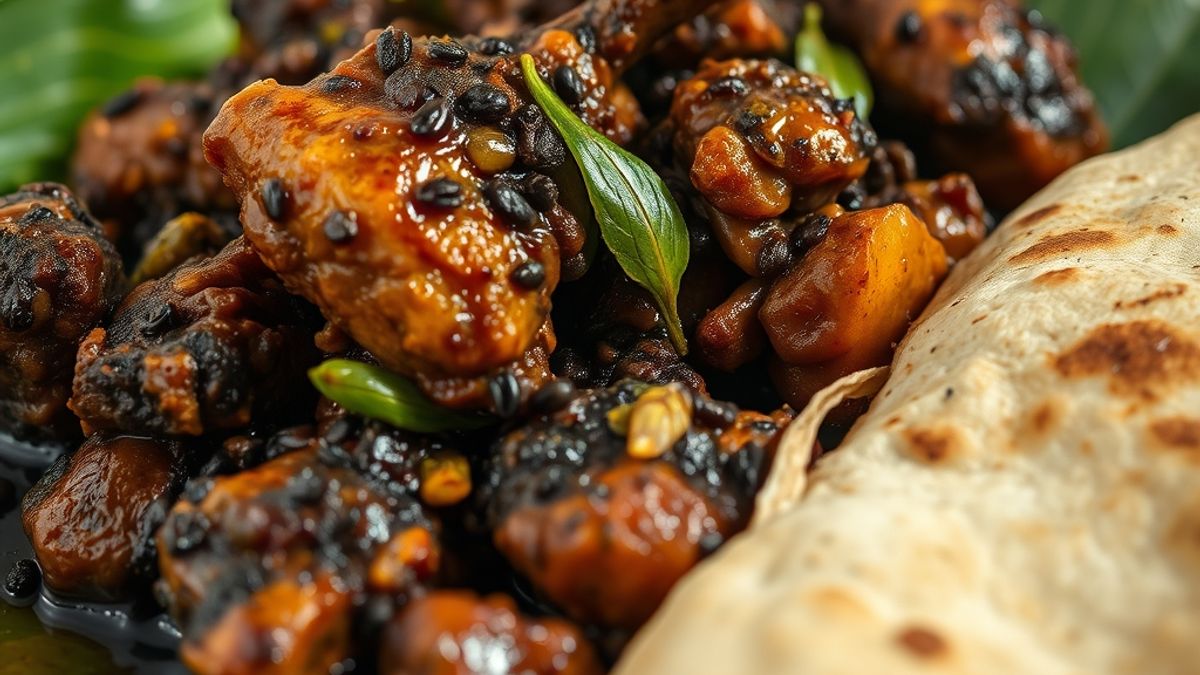
- Chettinad pepper chicken (milagu kozhi): The signature, and the dish to judge any kitchen by. Chicken cooked down with a dark, pepper-forward masala until it is semi-dry and clinging to the meat rather than swimming in gravy. If the pepper chicken is good, trust everything else on the menu.
- Chicken Chettinad (gravy): The saucier cousin — a rich, deeply spiced gravy that goes brilliantly with parotta, appam, or a mound of steamed rice. Order this if you are sharing and want something to spoon over rice for the table.
- Kari dosa: A Madurai speciality that deserves far more fame than it has. Minced or shredded meat, and often a cracked egg, are cooked right onto the dosa on the griddle, so the whole thing turns savoury, layered, and rich. It is genuinely rare in Mumbai, so grab it the moment you see it on a board.
- Nattu kozhi (country chicken) curry or varuval: Free-range, tougher, and far more flavoured than broiler chicken, slow-cooked with roasted masala until the meat gives. More bone, more chew, more reward. Look for “nattu kozhi” written specifically — it is a separate item, and its absence from the menu usually means it is off for the day.
- Mutton chukka / pepper mutton: Semi-dry, intensely spiced mutton fry, and a reliable benchmark of a serious Tamil meat kitchen. If you order one thing beyond the pepper chicken, make it this.
- Sides that carry the meal: Appam, malabar parotta, or a simple ghee rice to soak up the gravies, and a spiced rasam to reset your palate between mouthfuls. A small plate of curd rice at the end cools everything down and is the traditional full stop.
If you are ordering for a group, a smart spread is one semi-dry dish (pepper chicken or mutton chukka), one gravy (chicken Chettinad), a stack of parottas, rice, and a rasam. That covers dry and saucy, hand-food and spoon-food, and gives the heat-sensitive an escape route.
Where to find it in Mumbai
The honest answer is that this scene is scattered, so here is how to actually track it down rather than a list of invented addresses that will be stale by the time you read this.
Chettinad restaurant chains
Well-established Chettinad chains — Anjappar being the best-known nationally — operate in Mumbai and are the most reliable way to eat proper pepper chicken and Chettinad gravies without a hunt. They are consistent, air-conditioned, and squarely aimed at people who want the real, spicy thing rather than a toned-down version. This is where to start if it is your first Chettinad meal or you are bringing along someone sceptical. Check a live listing on Zomato or Swiggy for the branch nearest you before you set out, since outlets open, close, and relocate, and a chain’s map pin is more trustworthy than a half-remembered address.
Tamil migrant pockets
Neighbourhoods with older Tamil and South Indian Muslim communities are where the soul of this food lives. Parts of Sion, Chembur, the edges of Dharavi, and Mira Road further north are dotted with small, no-frills kitchens quietly turning out country-chicken curry and kari dosa for a regular local crowd. These places rarely market themselves — no glossy signage, sometimes barely a menu — so word of mouth and delivery apps are genuinely your best tools. Read the reviews with an eye for people ordering nattu kozhi and kari dosa by name; that is the signal you have found the real thing rather than a generic multi-cuisine spot.
Because these kitchens sit close to some of the city’s best working-class food, it is easy to build a longer eating day around them. Sion and Chembur are within easy reach of the seafood belt if you also want a Mumbai seafood meal, and the same appetite for fiery, meat-heavy cooking that draws you to Chettinad will serve you well at a good Kolhapuri table, Maharashtra’s own answer to pepper-hot mutton.
Matunga, with a caveat
A handful of eateries in and around Matunga do serve non-veg South Indian and Chettinad-style dishes, even though the area’s entire fame rests on vegetarian cooking. It can be done, but confirm before you go, because the restaurant two doors down on the same lane may be strictly pure-veg and will not so much as keep an egg in the kitchen. Never assume; ask on the phone or check the menu photos on a delivery app first.
What to expect and how much
This is not fine dining, and that is exactly the point. Expect functional, busy rooms, quick and unfussy service, banana leaves or steel plates, and food that arrives fast and fierce. A hearty non-veg meal for one — a pepper chicken, a couple of parottas or a plate of rice, a drink — runs roughly ₹250–500 at the chains, and often noticeably less at the smaller mess-style kitchens where the overheads are lower. Country chicken and mutton always sit at the top of that band, since the raw material costs more.
Treat every figure here as a rough band rather than a quote. Prices shift with the outlet, with the day’s chicken and mutton rates, and with whether you are eating a la carte or a set meal, so glance at the menu on the day and order accordingly. If you are counting rupees, the mess-style kitchens give you more flavour per hundred; if you value comfort and certainty, the chains are worth the small premium.
A word on the heat, because it catches people out. Chettinad is meant to be pepper-hot, not chilli-numbing — a warmth that builds and lingers rather than a flash burn — but it is still not shy about it. If you are heat-sensitive, say so clearly when you order and ask them to go easy, and keep curd rice, plain rice, or a glass of buttermilk on the table as a buffer. Bread and rice blunt capsaicin far better than a cold drink does.
Best time to go
Lunch is the sweet spot for Tamil non-veg, and it is not a marginal preference. Many mess-style kitchens cook a fixed quantity of country chicken each day, and the best cuts run out by mid-afternoon, so aim for roughly 12:30 to 2 pm, especially on weekends when families eat out and the good stuff moves fast. Roll in at closing time expecting nattu kozhi and you will be told, gently, that it finished hours ago — that is simply the nature of a dish cooked in one batch from a bird that cannot be rushed.
The Chettinad chains keep longer, more predictable hours and are dependable for dinner, which makes them the sensible choice on a weeknight or when your plans are loose. If your appetite runs late, a few kitchens in the Tamil pockets do serve into the night, though the menu narrows after the lunch rush; for a proper after-midnight plan, our guide to late-night food in Mumbai is the better starting point, since Chettinad is fundamentally a daytime pleasure.
Getting there by train and metro
Mumbai runs on the local train, and most of this food sits near the Central and Harbour lines rather than out west. For the Matunga and Sion pockets, Matunga and King’s Circle stations on the Harbour line, and Sion on the Central line, put you within a short walk or a quick auto ride of everything. Chembur is on the Harbour line and also the Monorail, which makes it one of the easier stops to combine with a longer eating route. For the northern spread toward Mira Road, take the Western line.
For any chain outlets in the western suburbs, the nearest metro or Western-line station plus a short auto is usually the simplest approach. Whichever way you travel, pin the exact branch on your maps app first, because Chettinad restaurants and the smaller kitchens are often tucked into market lanes and side streets rather than sitting on a main road with a big board. If the local network still feels daunting, our Mumbai local train guide explains the lines, tickets, and which end of the platform to stand on so you arrive hungry and unflustered.
How to eat it, and a few local tips
The last mile of a good Chettinad meal is knowing how to order and how to eat, and it genuinely changes the experience.
- Say “Chettinad style” out loud. Some multi-cuisine South Indian places will otherwise default to a milder house gravy, and you will miss the whole point. The phrase tells the kitchen you want the pepper and the roasted masala, not the diplomatic version.
- Country chicken is a separate, pricier item. Nattu kozhi is not the same as regular chicken, costs more, and cooks differently. If you do not see it listed, it is almost certainly not available that day — do not assume the kitchen simply forgot to write it down.
- Eat the pepper chicken with your hands, with a torn piece of parotta. Cutlery genuinely gets in the way of a semi-dry dish clinging to the bone. Tear, pinch, mop, repeat. A finger bowl usually appears without asking.
- Pair a heavy meat meal with rasam or buttermilk, not a sweet soda. The peppery, sour rasam and the cooling buttermilk both cut the oil and reset your palate far better than a fizzy drink, which only masks the spice for a second before it returns.
- Order the dry dish and the gravy together. A semi-dry chukka and a saucy Chettinad gravy at the same table give you two textures and two ways to eat, and stop any single dish from feeling one-note over a full meal.
Eaten this way — at lunch, with your hands, a rasam within reach and the word “Chettinad” said clearly to the person taking your order — this is some of the most rewarding meat cooking in the city, and almost none of it is where a first-time visitor would think to look. That gap between reputation and reality is exactly what makes finding it feel like a small victory.
Frequently Asked Questions
Where can I get authentic Chettinad food in Mumbai?
The most reliable route is a dedicated Chettinad restaurant chain such as Anjappar, which operates across the city and consistently serves proper pepper chicken and Chettinad gravies. For country chicken (nattu kozhi) and kari dosa, hunt down the smaller Tamil mess-style kitchens in older migrant pockets like Sion, Chembur and Mira Road. Always check a delivery app such as Zomato or Swiggy for the current nearest branch before you go, since outlets open, close and move.
Is Matunga good for non-veg South Indian food?
Not really — Matunga's celebrated South Indian scene is overwhelmingly pure-vegetarian Udupi and Tamil-Brahmin cooking built around dosa, idli and rasam. A few eateries in and around the area do serve non-veg and Chettinad-style dishes, but you should confirm on the phone or through menu photos first rather than assume. The restaurant next door on the same lane may be strictly vegetarian and keep no meat at all.
What is the difference between Chettinad chicken and regular chicken curry?
Chettinad chicken uses a masala that is dry-roasted and freshly ground the same day, leaning heavily on black pepper, fennel and the smoky lichen kalpasi (stone flower). This makes it darker in colour, more aromatic and considerably spicier than a standard restaurant chicken curry. The heat comes largely from pepper rather than red chilli alone, so it builds and lingers as a warmth instead of a sharp flash burn.
How spicy is Chettinad food, really?
It is genuinely hot but in a rounded, pepper-driven way rather than a numbing chilli burn, so the spice builds across a meal and lingers pleasantly. If you are heat-sensitive, say so clearly when ordering and ask the kitchen to go easy. Keep curd rice, plain rice or a glass of buttermilk on the table, because those cool and blunt the spice far better than a cold or sweet drink.
What is kari dosa and where can I find it in Mumbai?
Kari dosa is a Madurai speciality where minced or shredded meat, and often a cracked egg, are cooked directly onto the dosa on the griddle so the whole thing turns savoury, layered and rich. It is genuinely rare in Mumbai and mostly turns up in small Tamil mess-style kitchens in areas like Sion, Chembur and Mira Road rather than at mainstream restaurants. Because it is uncommon, order it the moment you spot it on a board, and check reviews on delivery apps for places serving it by name.
What is nattu kozhi and why does it sell out so quickly?
Nattu kozhi is country chicken — a free-range, tougher, more deeply flavoured bird that is slow-cooked with roasted masala until the meat gives. It has more bone and chew but far more flavour than broiler chicken, and it is a separate, pricier menu item. Many kitchens cook only a fixed quantity each day, so the best cuts run out by mid-afternoon; aim for lunch between about 12:30 and 2 pm, especially on weekends, to be sure of getting it.