
Gilbert Hill, Andheri: Mumbai's 66-Million-Year-Old Rock Monolith
Gilbert Hill, Andheri West: a guide to Mumbai's 66-million-year-old basalt monolith — the climb, hilltop temples, sunset view, timings and how to get there.
'%3E%3Crect%20width%3D'96'%20height%3D'96'%20fill%3D'%23E65100'%2F%3E%3Ccircle%20cx%3D'30'%20cy%3D'24'%20r%3D'44'%20fill%3D'%23fff'%20opacity%3D'.12'%2F%3E%3Ccircle%20cx%3D'60'%20cy%3D'74'%20r%3D'40'%20fill%3D'%23000'%20opacity%3D'.10'%2F%3E%3C%2Fg%3E%3Cg%3E%3Ccircle%20cx%3D'48'%20cy%3D'48'%20r%3D'15'%20fill%3D'none'%20stroke%3D'%23fff'%20stroke-width%3D'3'%2F%3E%3Cpath%20fill%3D'%23fff'%20d%3D'M48%2037%20l3.5%2011%20-3.5%2011%20-3.5%20-11%20z'%2F%3E%3Ccircle%20cx%3D'48'%20cy%3D'48'%20r%3D'2.2'%20fill%3D'%23fff'%2F%3E%3C%2Fg%3E%3C%2Fsvg%3E)
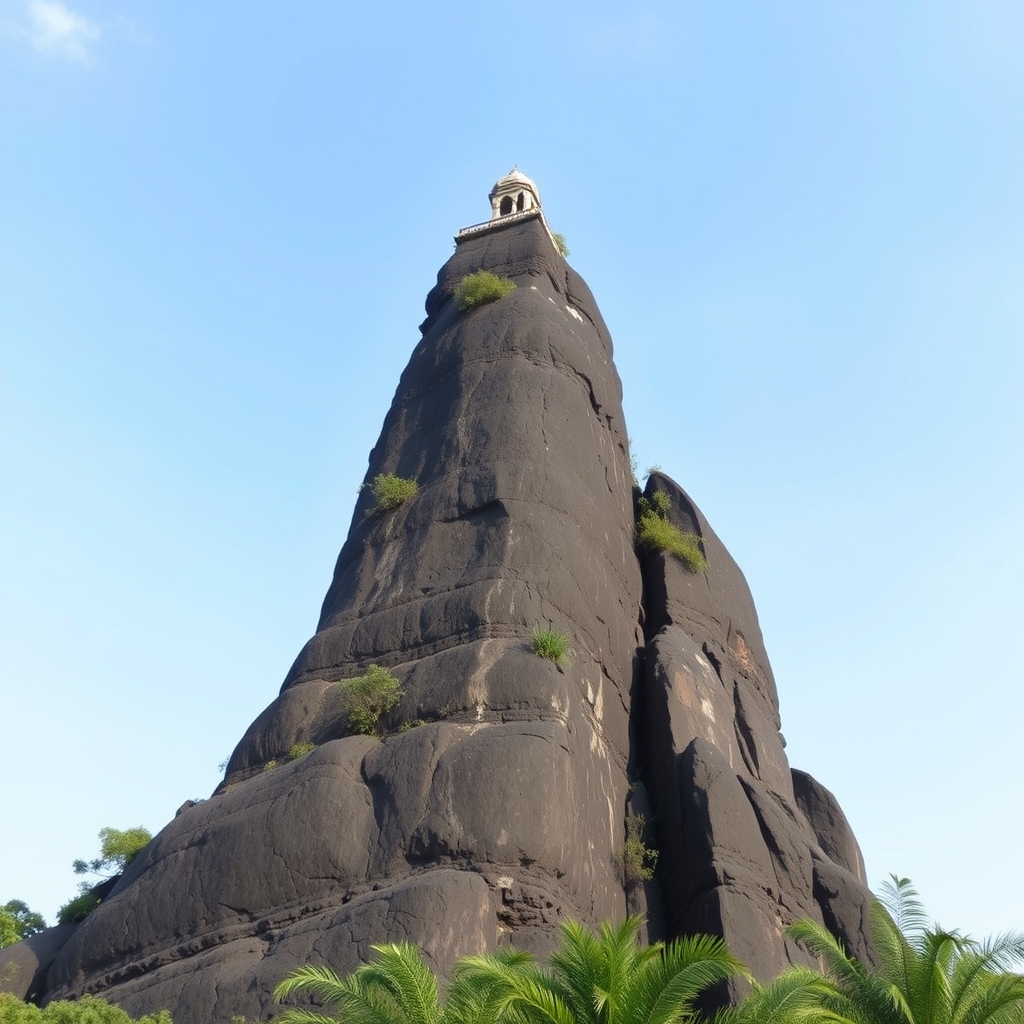
Photo: Oknitop at English Wikipedia · CC BY-SA 3.0 · via Wikimedia Commons
You could walk past it for years and never look up. Hemmed in by apartment towers, a petrol pump and the everyday churn of Andheri West, a sheer black cliff rises almost vertically out of the pavement — a 200-foot column of basalt that was already tens of millions of years old before the first humans walked the earth. This is Gilbert Hill, and it is one of the strangest, most overlooked things in Mumbai: a piece of the planet’s violent volcanic youth, marooned in the middle of a suburb, with two small temples and a garden balanced on its flat top. It asks nothing of you but a short, steep climb — and it rewards that with geology, a quiet shrine and one of the better free views in the city.
Most visitors never make it here, which is part of the appeal. It rarely shows up on a first-timer’s Mumbai list, and even long-time residents of the western suburbs tend to know it only as a shape glimpsed from a rickshaw. If you like your sightseeing a little off the usual grid — the kind of place we round up in our guide to the hidden gems of Mumbai — Gilbert Hill is close to perfect: no queue, no ticket, no gift shop, and a genuinely astonishing backstory hiding behind a row of flats.
Gilbert Hill at a glance
| Detail | What to know |
|---|---|
| What it is | A ~200-foot (61 m) columnar basalt monolith, roughly 66 million years old |
| Where | Off Gilbert Hill Road / Maharashtra Nagar, Andheri West |
| Getting there | 5-min auto or 15–20-min walk from Andheri station (Western Line + Metro Line 1) |
| Entry fee | Free — both the rock and the temples on top |
| The climb | ~150–200 concrete steps with a handrail; 10–15 minutes at an easy pace |
| Temple hours | Roughly 7–11am and 4–6pm; usually shut through the middle of the day |
| Best season | October to February; skip the peak monsoon |
| Best time of day | Late afternoon into sunset |
| Time needed | About 45 minutes to an hour |
| Good for | Geology buffs, photographers, offbeat sightseeing, families (with care near the edges) |
What you’re actually looking at
Gilbert Hill is a monolithic column of solid black basalt, roughly 200 feet (about 61 metres) high, formed around 66 million years ago at the very end of the age of the dinosaurs. Put that number next to the things Mumbai usually shows off — the Gateway of India is a little over a century old, the Victorian-Gothic and Art Deco architecture of the Fort district a century or two at most — and the scale of the thing starts to land. This rock predates the city, the subcontinent’s modern coastline, and very nearly the mammals.
The Deccan Traps, briefly
It is a relic of the Deccan Traps — one of the largest volcanic events in the planet’s history, when molten lava poured out of the earth and spread across an enormous area of present-day Maharashtra, Gujarat and Madhya Pradesh, something like 500,000 square kilometres of it. That single episode of eruptions is the reason the interior of western India is built on layer after layer of black volcanic rock — the same dark basalt you see in the city’s old sea walls and stepped tanks. Most of the Western Ghats, the escarpment that walls Mumbai off from the Deccan plateau, is essentially the eroded edge of this lava pile. Gilbert Hill is a stray, upright fragment of that story, left behind in the suburbs.
Why this one stands up
What makes this particular lump special is the shape. When most of that lava cooled it settled into broad horizontal sheets, which is why the Western Ghats step down in flat layers, and why so many of the rock-cut caves around Mumbai are carved into level bands of stone. Here, geologists believe the molten rock was forced up through a vertical vent and cooled in place as a standing column, cracking into rough vertical facets rather than lying down in beds. The result is a natural tower of columnar basalt — the same phenomenon that produced Devil’s Tower in Wyoming and the Giant’s Causeway in Northern Ireland.
Gilbert Hill is frequently described as one of only a handful of such columnar formations anywhere in the world. That “only three on earth” line gets repeated more confidently than the geology strictly allows — columnar basalt turns up in many places once you go looking — but the rarity is real, and it is genuinely the only thing of its kind standing in an Indian city. When you tilt your head back at the base and read the vertical fracture lines running up the face, you are looking at the frozen plumbing of a 66-million-year-old volcano.
There is a small, humbling detail worth holding on to as you stand there. Identical basalt columns once stood a few kilometres away at Jogeshwari, and they were simply quarried away for building stone within living memory. Gilbert Hill survives largely because temples were built on top of it, and you cannot easily blast a shrine. The suburb grew up around a monument that only just made it — a piece of luck as much as any deliberate act of preservation.
Where the name comes from
Nobody is entirely sure. The most-repeated story credits the American geologist Grove Karl Gilbert, the man who coined the term “laccolith” for exactly this sort of intruded-magma feature. Others say it was named after a British officer once posted in charge of Andheri during colonial times. Both accounts float around; neither is nailed down, and you will see each stated as fact on signboards and websites with equal confidence.
Locals, for what it’s worth, mostly do not call it Gilbert Hill at all. To the families who live at its foot and climb it for prayers, it is Gaondevi — named for the temple on top. If you are asking directions in Marathi or Hindi, “Gaondevi mandir” will get you there faster than the colonial name ever will.
Getting there: the approach through Andheri
Part of the charm, and the mild absurdity, is how ordinary the surroundings are. There is no grand gateway, no ticket counter, no signage doing the monument justice. You turn off a busy lane in Andheri West and suddenly the cliff is just there, wedged between buildings on Maharashtra Nagar. It is worth pairing the trip with a broader wander through the area — our neighbourhood guide to Andheri covers the wider suburb of studios, markets and food streets that Gilbert Hill sits quietly inside.
From Andheri station
The rock sits about a five-minute autorickshaw ride, or a 15–20 minute walk, from Andheri station — one of the busiest junctions in the western suburbs and a stop on both the Western Railway line and the Metro (Line 1). If you are coming from the island city or the eastern suburbs, the fastest run is usually a fast local to Andheri and a rickshaw for the last leg; if you would rather not deal with the crush of the platforms, the wider picture of getting around Mumbai by taxi, auto, bus and Metro is worth a look before you set out.
Any rickshaw driver working the Andheri West side will know “Gilbert Hill” or, more reliably, “Gaondevi mandir”. If you draw a blank, ask for the SRPF / Maharashtra Nagar side of Andheri West and you will be within walking distance. Traffic through this stretch is heavy and slow, so a short hop can still take ten minutes in the evening rush; factor that in if you are chasing the sunset.
The last stretch on foot
Approach on foot for the final stretch if you can. The vertical face is best appreciated from the base, at street level, where you can stand back far enough to take in the whole 200 feet and pick out the columnar cracking in the rock. Look up before you go up: the scale is oddly hard to feel once you are on the staircase, and it is only from the pavement, with the towers of Andheri crowding in on either side, that the incongruity really registers — a Cretaceous volcanic plug behind a row of chawls and mid-rise flats, with almost nobody looking.
The climb and the temples on top
A staircase runs up one flank of the rock — a steep, slightly vertigo-inducing flight of somewhere between 150 and 200 concrete steps, with a metal handrail most of the way. Taken steadily it is a 10–15 minute climb, and while it will get your heart going, it is manageable for most reasonably mobile people. There are landings to pause on, and no shame in using them. Wear proper shoes rather than slippery sandals, go slowly in the heat, and carry water; Mumbai’s humidity turns even a short flight of stairs into real exertion for much of the year.
A quick note on who this suits: the climb is fine for most adults and older children, but it is not step-free, and the stairs are too steep and narrow to be comfortable for anyone with limited mobility, a pushchair, or a serious fear of heights — there is no lift or ramp. If that rules out the summit for your group, the view of the face from the base is still very much worth the trip on its own.
Gaondevi and Durga Mata temples
The flat top is smaller and greener than you expect — a modest garden with two working Hindu shrines, the Gaondevi temple and a Durga Mata temple. This is not a tourist set-piece. It is a genuine neighbourhood place of worship, busiest at aarti times, tended by local devotees who are, quite literally, the reason the hill was never sold off and demolished. The contrast between the ancient rock underfoot and the small, lived-in devotion on top is the quiet heart of the place; it is a very different register from a landmark shrine like the ones on our Mumbai temples trail, and all the more affecting for it.
Time your climb to catch the shrines open. The temples generally keep morning and evening hours — roughly 7–11am and 4–6pm — and close through the middle of the day, so a midday visit gets you the rock and the view but a locked gate at the top. Dress modestly, remove your shoes at the shrine, and be unobtrusive if a puja is under way. Photography of the view is fine; be more careful and more respectful pointing a camera at people mid-prayer.
The view from the top
From the edge of the summit, suburban Mumbai spreads out in every direction — a sea of rooftops and water tanks, the airport with planes stacking up to land, and, on a clear day, a glint of the Arabian Sea beyond. It is not a manicured “view point” with railings and a telescope and a snack counter; it is a rooftop of rock with a low parapet and a garden, which is precisely why it feels like a find rather than an attraction.
Come in the late afternoon and stay for sunset. As the light drops, the city switches on beneath you and the whole thing turns into a soft, glittering carpet — the kind of golden-hour payoff we chase across the city in our roundup of Mumbai’s best sunset points and viewpoints, delivered here for the price of a rickshaw and a staircase. Photographers get the best of it in the hour before dusk, when the low sun rakes across the rooftops and the smog itself turns the light warm; the harsh midday sun flattens everything, and the temples are shut anyway. If you can only make one trip, make it a clear-sky evening in the dry season.
Timings, seasons and practicalities
There is no entry fee, and the rock itself can be reached through the day, though there is little point climbing when the shrines are locked at midday. The short version: aim for early morning, roughly 7–11am, or — better — late afternoon into sunset.
The best months to go
The best window is the cooler, drier stretch from October to February, when the heat is bearable, the air is often clear enough to see the sea, and the steps are dry. March to May is punishingly hot on an exposed rock with no shade; a pre-dawn or just-before-sunset visit is the only sensible way to do it in high summer. Avoid the peak of the Mumbai monsoon, roughly June to September, when the steps run wet and slick, the handrail is your only friend, and the celebrated view collapses into a wall of moving grey. A light monsoon drizzle can actually be atmospheric from the top — but only if the stone is not treacherous underfoot, so judge it on the day.
What to bring, and a caution up top
Carry water, keep valuables zipped away on the climb, and allow around 45 minutes to an hour for the whole visit. It is a friendly, low-key and generally very safe place, but it is also an ordinary working neighbourhood, so use the same street sense you would anywhere in the city. It is family-friendly, and children usually love the novelty of a “volcano” in the middle of the suburb — but keep a firm hand on small ones near the unfenced edges up top, where the parapet is low and the drop is real.
Make a half-day of it
Gilbert Hill is a short visit on its own — an hour, give or take — so it works best folded into a wider afternoon around Andheri West and Versova. A few natural pairings, all within a short ride, are below; for the bigger citywide picture, our roundup of things to do in Mumbai has more.
Mahakali Caves
A short ride across the highway into Andheri East brings you to the Mahakali Caves, a cluster of rock-cut Buddhist caves dating back around two thousand years — quiet, largely tourist-free, and run by the Archaeological Survey of India. They are generally open through the day (around 9am to 5pm) for a nominal entry fee of about Rs 20 for Indian visitors. It makes a neat “old Mumbai” double-bill with Gilbert Hill: two very different kinds of ancient rock within a few kilometres of each other. If the caves whet your appetite, the far grander Kanheri Caves inside Sanjay Gandhi National Park are the full-day version of the same idea, an easy trip further north.
Versova Beach
At the western end of Andheri, Versova Beach is a calmer, less crowded stretch of sand than its famous neighbour — a working fishing village, with the Koli community’s boats drawn up at one end, sits beside a long, quiet shoreline. It is better for atmosphere than for swimming: go for the sunset, the fishing boats and a plate of fresh seafood nearby rather than the water quality. If you would rather trade quiet for chaos, colour and chaat, the busier Juhu beach is a short way south and offers the full seaside-carnival experience instead.
Lokhandwala Market
The Lokhandwala Complex, back in Andheri West, is the suburb’s buzzing shopping-and-eating strip — roadside stalls, high-street clothing, cafes and dessert spots, and a fair chance of spotting a television actor, since much of the industry lives and works around here. Come hungry in the evening; the street food and casual cafes are the point, and it is a fitting, very-modern-Mumbai counterweight to the deep time you have just been standing on. It is also a good jumping-off point for the rest of the entertainment suburb covered in our Andheri neighbourhood guide.
A fragile survivor
Gilbert Hill was declared a national park back in 1952, and in 2007 the Brihanmumbai Municipal Corporation granted it heritage protection, with quarrying formally prohibited. That paperwork matters, because the pressure on the rock has been real. A developer once floated a plan to demolish the hill for construction — a scheme seen off largely by the Gaondevi temple’s devotees, who understood the value of the thing in their care long before any conservation notice was pinned to it. Even now, campaigners worry about erosion, about the vibration and runoff from the construction crowding right up to its base, and about the slow neglect that lets a monument with no ticket revenue quietly decay.
This is one of the oldest things in the whole metropolis — older than the seven islands that were reclaimed into the modern city, older than the Himalayas, a survivor from the last days of the dinosaurs. So visit gently. It is not a climbing wall or a place to blast music: take your rubbish down with you, keep off the rock face itself, and let the shrine be a shrine. It would be a small civic disgrace to lose it now, and the surest protection a monument like this has is simply people who know it is there and treat it with respect.
The bottom line
Gilbert Hill is the sort of place that rearranges how you see your own city. There is no fanfare and no crowd — just a black volcanic tower older than the Himalayas, a modest temple you have to earn with a climb, and a rooftop view of Mumbai going about its evening. Give it an hour, treat the shrine and the rock with a bit of respect, and you will come away having stood on one of the oldest things in the metropolis, hiding in plain sight behind the flats of Andheri.
Frequently Asked Questions
Is Gilbert Hill worth visiting?
Yes, if you enjoy offbeat sights over polished tourist set-pieces. It is a genuinely rare 66-million-year-old columnar-basalt monolith standing in the middle of a suburb, it is free, and the short climb rewards you with two small temples and one of the better free sunset views in the city. It is a 45-minute-to-an-hour stop rather than a half-day attraction, so it works best paired with the rest of Andheri West.
How old is Gilbert Hill and how was it formed?
Gilbert Hill is roughly 66 million years old, dating to the very end of the age of the dinosaurs. It is a relic of the Deccan Traps, one of the largest volcanic events in Earth's history, which buried much of western India under black basalt. Most of that lava cooled into flat horizontal sheets, but here geologists believe the molten rock was forced up through a vertical vent and cooled in place as a standing column, cracking into vertical facets — the same columnar-basalt phenomenon seen at Devil's Tower and the Giant's Causeway.
How many steps is the climb up Gilbert Hill, and how hard is it?
A staircase of somewhere between 150 and 200 concrete steps runs up one flank of the rock, with a metal handrail for most of the way. Taken steadily it is a 10–15 minute climb that will get your heart going but is manageable for most reasonably mobile people. It is steep and not step-free, so it is uncomfortable for anyone with limited mobility, a pushchair or a serious fear of heights; wear grippy shoes and go slowly in the heat.
What are Gilbert Hill's timings, and is there an entry fee?
There is no entry fee for either the rock or the temples on top. The rock can be reached through the day, but the Gaondevi and Durga Mata temples on the summit typically open only in the morning and evening — roughly 7–11am and 4–6pm — and shut through the middle of the day. Aim for a morning or, better, a late-afternoon-into-sunset visit so you find the shrines open and the light at its best.
How do you get to Gilbert Hill from Andheri station?
It is about a five-minute autorickshaw ride, or a 15–20 minute walk, from Andheri station, which is served by both the Western Railway line and Metro Line 1. Ask any rickshaw driver for "Gilbert Hill" or, more reliably, "Gaondevi mandir" in Andheri West. If the name draws a blank, ask for the SRPF or Maharashtra Nagar side of Andheri West and you will be within walking distance.
Is Gilbert Hill really one of only three basalt monoliths in the world?
The popular "only three such columns on earth" claim is a little loose — columnar basalt actually occurs in a number of places once you go looking. What is accurate is that the formation is genuinely rare and that Gilbert Hill is the only feature of its kind standing in an Indian city. The 66-million-year age is well founded, tied to the end-Cretaceous Deccan Traps volcanism.