
Global Vipassana Pagoda, Gorai: Visiting Mumbai's Golden Meditation Dome
Visit Gorai's Global Vipassana Pagoda: the Borivali ferry, free entry and timings, the pillarless golden dome, and a free 10-minute Anapana meditation.
'%3E%3Crect%20width%3D'96'%20height%3D'96'%20fill%3D'%23E65100'%2F%3E%3Ccircle%20cx%3D'30'%20cy%3D'24'%20r%3D'44'%20fill%3D'%23fff'%20opacity%3D'.12'%2F%3E%3Ccircle%20cx%3D'60'%20cy%3D'74'%20r%3D'40'%20fill%3D'%23000'%20opacity%3D'.10'%2F%3E%3C%2Fg%3E%3Cg%3E%3Ccircle%20cx%3D'48'%20cy%3D'48'%20r%3D'15'%20fill%3D'none'%20stroke%3D'%23fff'%20stroke-width%3D'3'%2F%3E%3Cpath%20fill%3D'%23fff'%20d%3D'M48%2037%20l3.5%2011%20-3.5%2011%20-3.5%20-11%20z'%2F%3E%3Ccircle%20cx%3D'48'%20cy%3D'48'%20r%3D'2.2'%20fill%3D'%23fff'%2F%3E%3C%2Fg%3E%3C%2Fsvg%3E)
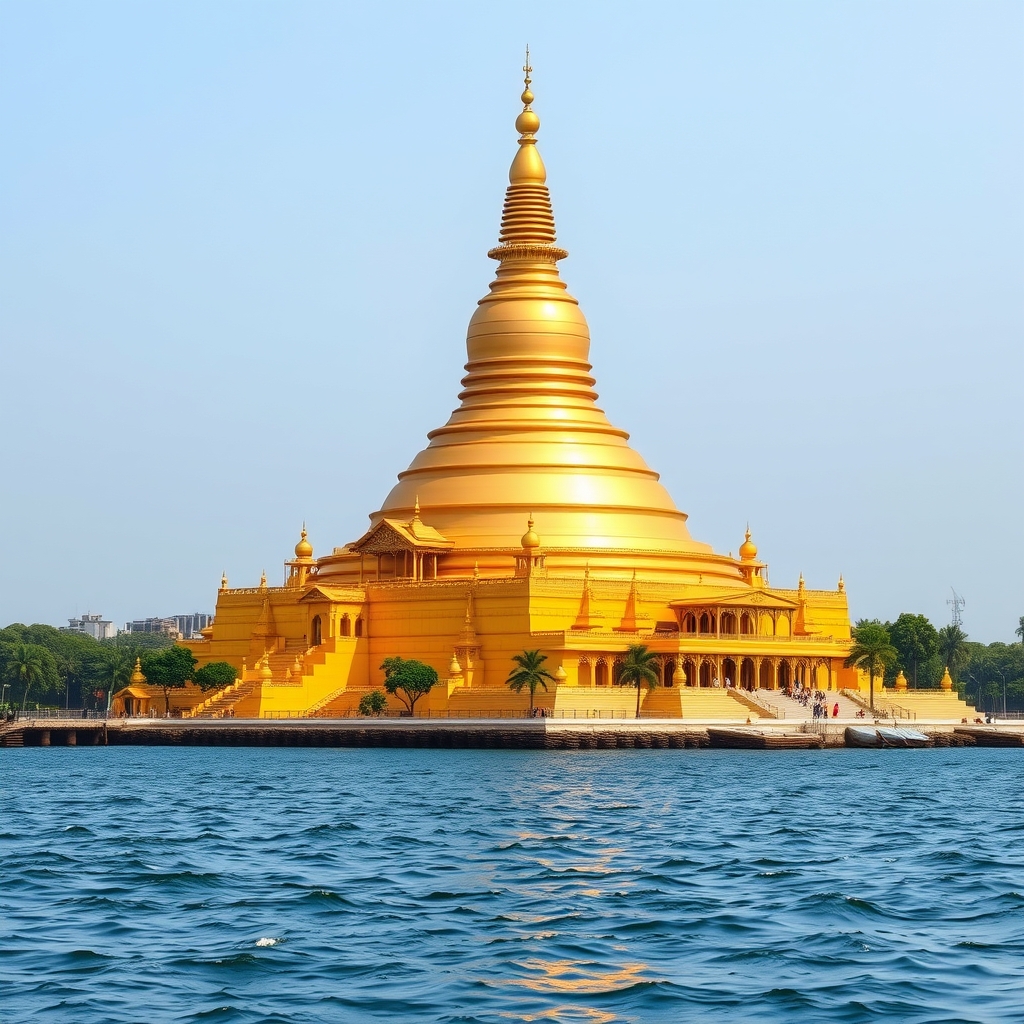
Photo: Pradeep717 · CC BY-SA 3.0 · via Wikimedia Commons
The first time you round the creek at Gorai and see the golden pagoda lift above the trees, it tends to stop you mid-sentence. It is enormous, unmistakably Burmese in shape, and completely at odds with the city you left behind an hour ago. The Global Vipassana Pagoda sits on a spit of land in Mumbai’s far north-west, barely a kilometre from the Arabian Sea, and reaching it involves a short ferry over a tidal creek — which is exactly why it makes such a good half-day escape. You cross water, you walk into a vast domed hall, you sit in silence for a few minutes, and you come back to the traffic feeling oddly reset. This is a full, honest guide to doing it properly: how to get there, what it costs (almost nothing), what you can and cannot do inside, and how to fold it into a calm day out.
Quick reference: how to get there and what to expect
| Route / option | How to do it | Journey time | Rough cost | Best for |
|---|---|---|---|---|
| Ferry via Borivali (classic) | Borivali (W) → auto or BEST bus to Gorai jetty → Esselworld ferry to the pagoda | 30–40 min to the jetty, then a 15–20 min crossing | ₹40–50 ferry return + ₹80–150 auto | First-timers who want the whole experience |
| By road via Mira–Bhayander | Bhayander (W) → MBMT route 4 bus, or drive ~40 km up the Western Express Highway | 45–75 min depending on traffic | Bus nominal (₹20–40); or car fuel + on-site parking | Elderly relatives, monsoon days, your own schedule |
| Sunday BEST shuttle (route 711) | Runs jetty ↔ pagoda through the middle of the day on Sundays | A few minutes | Nominal | Skipping the 10-minute walk from the jetty |
| Free Anapana session | Walk-in meditation taster at the North Pagoda | 10–15 min, runs continuously | Free, no booking | Anyone curious to actually try the practice |
Entry to the pagoda, the gallery and the Anapana sessions is free; you only pay for the ferry and any food. Keep small cash for the boat and an ID if you are a foreign national.
What it actually is
The pagoda is not an old monument, though it looks timeless. It was inaugurated in February 2009 by the then President, Pratibha Patil, and grew out of the work of S.N. Goenka, the teacher who reintroduced Vipassana meditation to India in 1969 after learning it over fourteen years from Sayagyi U Ba Khin in Burma. The building is a gesture of thanks to Myanmar for keeping the technique alive: its form is modelled closely on the Shwedagon Pagoda in Yangon, its crown carries real gold, and the golden paint over the rest was donated by well-wishers in Thailand.
Underneath the gilding is a genuine feat of engineering. The central dome is the world’s largest stone dome built without any supporting pillars — a hollow structure of interlocking Rajasthan sandstone blocks, each weighing several hundred kilograms, held with lime mortar and no steel. It stands about 325 feet (close to 100 metres) tall and is roughly twice the span of the Gol Gumbaz at Bijapur, which held the previous record. In 2013 the Maharashtra Tourism Development Corporation named it one of the “Seven Wonders of Maharashtra,” and for once that is not marketing bluster.
What makes it worth a visit is not just the record-book scale, but the fact that it is a working meditation site rather than a museum. People come here to sit, not to gawk, and once you are inside you feel the difference. It is one of the few genuinely quiet places on Mumbai’s crowded list of temples and places of worship, and unlike most of them it asks nothing of you — no queue, no offering, no ritual you need to understand.
Getting there
Half the pleasure is the journey, so give yourself time and don’t try to rush the last ferry. The site is off in a corner of the map that most Mumbaikars never visit, so treat the trip as part of the outing rather than an obstacle before it.
The ferry from Gorai, via Borivali
The usual approach is from Borivali station on the Western line — an easy, frequent run from town if you know how the local trains work. Come out of the west side, and from Chandavarkar Road take BEST bus 294 or 247 to Gorai Creek — locally called Gorai Khadi — or simply grab an auto for the roughly 4 km ride, which is the quicker option and only costs a little more. At the jetty you buy a ferry ticket: the Esselworld ferry that continues to the pagoda costs around ₹40–50 for a return, while a bare-bones local boat is a few rupees one way. The crossing takes 15–20 minutes over calm creek water, and it is genuinely pleasant — gulls, fishing boats, the dome growing larger ahead of you.
One thing to plan around: the last ferry towards the pagoda leaves Gorai at about 5.25 pm, so an afternoon that drifts too long can leave you stranded on the wrong side. Build in a buffer; boats can be delayed, and you do not want to be watching the clock while you meditate. On the far bank you disembark near the old Esselworld jetty and follow the signs on foot — past the parking area and helipad, then through the Sanchi-style arch onto Global Pagoda Road. It is a short, well-marked walk of about ten minutes, flat and easy. On Sundays a BEST shuttle (route 711) runs between the jetty and the pagoda through the middle of the day if you would rather not walk.
By road, avoiding the boat
If ferries make you nervous or you are travelling with elderly relatives, you can skip the water entirely by coming through Mira–Bhayander. From Bhayander station (west), MBMT route 4 buses run to the pagoda for a nominal fare, roughly from early morning to a quarter to seven in the evening. By car it is about 40-odd kilometres from the domestic airport up the Western Express Highway and around through Mira–Bhayander; there is parking on site. The road route takes longer and is less charming, but it runs to your own schedule and does not care about the last boat. If you are still finding your feet with the city’s transport, our general guide to getting around Mumbai will help you weigh train, bus, auto and cab for a trip this far out.
A note on timing your run
Whichever way you go, the smart move is to arrive by early afternoon. That gives you an unhurried couple of hours inside and a comfortable margin to catch a return ferry in daylight. Weekday mornings are the calmest; Sundays and public holidays bring family crowds, especially around the Food Plaza, though the dome itself stays quiet by design.
Timings, entry and the rules
The pagoda is open every day, 9 am to 7 pm, though no new visitors are let in after 6.30 pm — another reason to arrive by early afternoon at the latest. Entry is free, and so are the volunteer guides, which is worth repeating because so little in Mumbai is. Foreign visitors should carry photo ID, and it is sensible for everyone to keep some form of identification handy.
A few house rules keep the place calm, and they are enforced gently but firmly:
- Photography is not allowed inside the main dome or the visitors’ gallery. You can shoot freely everywhere outside, and the exterior is the more photogenic part anyway — the gold against a clear winter sky is the shot people remember.
- Dress modestly: shoulders and legs covered, nothing tight or flashy. This is a working meditation site, not a monument to pose against. If you have come straight from a beach or a mall, a light scarf or shawl over the shoulders is enough to be respectful.
- You remove your footwear before entering the dome, as at any temple; there is a designated place to leave shoes, so wear something you can slip off easily and don’t stress about the marble underfoot.
- Since March 2024, outside food is no longer permitted inside the campus, so eat before you cross or use the on-site Food Plaza, which serves simple vegetarian meals, snacks and tea at reasonable prices.
- Keep your voice down and your phone on silent. The whole point of the place is quiet, and the hush is contagious once you settle into it.
Carry a bottle of water, especially outside the winter months — the walk and the open plaza can get warm, and there is little shade between the jetty and the dome.
Inside: the dome and the gallery
The great meditation hall
The heart of the visit is stepping under that pillarless dome. The hall is built to seat several thousand people — the figure usually quoted is around 8,000 meditators sitting together — and standing in it, with the ceiling curving away unbroken overhead, is genuinely humbling. The acoustics are extraordinary; a whisper carries, and when a session is under way the collective silence has a weight to it that is hard to describe until you are in it.
There is a practical catch worth knowing in advance: the floor of the hall is reserved for people who have completed a full Vipassana course (“old students”), who come here to meditate. Everyone else views the interior from the visitors’ gallery around the edge. You still get the full sense of the scale and the hush; you simply watch rather than sit in the middle. Do not treat the gallery as a viewing balcony to chatter on — people below are meditating, and the volunteers will remind you kindly if you forget.
Enshrined in the central locking stone of the dome are bone relics of the Buddha, placed there in October 2006. They came from the ancient stupa at Bhattiprolu in Andhra Pradesh, handed over via the Maha Bodhi Society and the Sri Lankan government, which makes this the largest structure in the world built to house relics of the Buddha. You cannot see them directly, but knowing they are set into the stone above the hall changes how the space feels — it is the reason the dome exists, not a decorative afterthought.
The art gallery and the Anapana pagoda
Around the base of the monument is a gallery on the life and teaching of the Buddha — a well-made walk-through of paintings and panels tracing his story and the 2,600-year chain of teachers who preserved the technique. It is unhurried and genuinely informative, and a good place to understand what the whole complex is for before or after your sit. Give it twenty minutes; the panels are captioned clearly in English, and the storytelling is done with care rather than as an afterthought.
If you want to try the meditation itself rather than only look, head to the North Pagoda, opposite the visitors’ gallery, where free introductory Anapana sessions run more or less continuously through the day (roughly 10 am to 6.30 pm). Anapana is simply the observation of natural breath, the first step of Vipassana, and the taster here lasts only 10–15 minutes. You do not need to book, believe anything, or pay. A short recorded instruction in Goenka’s voice guides you; you sit, you breathe, you notice. It is the single most worthwhile ten minutes on the site, and many people come away deciding to look into a proper course. Even if you never take it further, it is a rare thing to be handed a genuine, unhurried moment of quiet in this city and asked for nothing in return.
Dhamma Pattana, for the full course
Sharing the complex is Dhamma Pattana, a residential Vipassana centre — its name means “Harbour of Dhamma” — which has run structured ten-day and short courses since 2007, with a leaning towards professionals and administrators. This is not a drop-in: courses are booked well ahead, run in complete silence (“Noble Silence”), separate men and women, and ask for real commitment — no phones, no reading, no writing, and full days of sitting. But if the day-visit leaves you curious, this is where the serious version happens. Enquire and apply through the centre directly, well in advance, rather than turning up. Everything, including food and accommodation, runs on a donation basis given only after you complete a course, which tells you something about the spirit of the place.
Making a half-day of it
Treat this as its own outing rather than one stop on a packed itinerary. A comfortable plan is to leave south or central Mumbai by mid-morning, cross by lunchtime, spend two or three unhurried hours between the gallery, the dome and an Anapana session, eat something simple at the Food Plaza, and catch a return ferry with time to spare.
Gorai Beach, a quiet grey-sand stretch on the same side of the creek, is an easy add-on if you want to sit by the sea afterwards. It is not one of the city’s postcard beaches — the sand is coarse and there are no cafes to speak of — but it is calm and largely empty on weekdays, which is the whole appeal. Do note that the old EsselWorld and Water Kingdom parks nearby have been shut since 2022–23, so don’t come expecting rides; the pagoda, the boat and the beach are plenty for one calm day.
If you would rather build a bigger loop, the pagoda pairs naturally with other quiet corners of the northern suburbs. The forests, lake and rock-cut Kanheri Caves inside Sanjay Gandhi National Park are on the same broad side of the city and make an obvious companion for anyone chasing green and calm rather than crowds. For a purely spiritual thread, you could set the pagoda against the very different energy of the city’s better-known shrines, from the sea-girt Haji Ali Dargah to the ever-thronged Siddhivinayak temple — three places of worship that could not feel less alike. And if this is part of a wider week of sightseeing, it slots in well among Mumbai’s broader things to do as the one entry on the list that asks you to slow down rather than speed up.
When to go, and a few honest caveats
November to February is the best window, when the weather is kind, the sky is clear enough for the gold to shine, and the walk and the crossing are both comfortable. Mornings and late afternoons are the calmest hours. Avoid the peak of summer, roughly April and May, when the open plaza and the walk from the jetty are punishing, and take the monsoon seriously: from June to September the creek can be choppy, ferries occasionally pause in bad weather, and the approach paths get slick. If you go during the rains, favour the road route via Mira–Bhayander and check that boats are running before you commit. Our seasonal notes on Mumbai in the monsoon are worth a look if you are visiting between June and September.
A word on expectations: this is a place that rewards a certain frame of mind. If you arrive treating it as a photo-op or a box to tick, you will find it a bit austere — there is no spectacle beyond the building itself, no rides, no shopping, no food beyond a plain canteen. If you arrive willing to be quiet for a couple of hours, it is one of the most restorative half-days the city offers. Accessibility is reasonable — the walk is flat and there are ramps in places — but the ferry step and the sheer distance can be tiring for anyone with limited mobility, which is another point in favour of the road route for older visitors.
The bottom line
The Global Vipassana Pagoda rewards a slow, deliberate visit rather than a quick tick. It costs nothing to enter, the ferry ride is half the charm, and the combination of the great silent dome, the art gallery and a genuine ten-minute taste of meditation adds up to one of the calmest half-days Mumbai has to offer. Carry water, keep small cash for the boat, dress simply, leave time to catch the ferry back in daylight, and go for the quiet rather than the photographs — that is the part that stays with you long after you have crossed the creek again.
Frequently Asked Questions
Is the Global Vipassana Pagoda free to visit?
Yes. Entry to the pagoda, the walk-through art gallery on the life of the Buddha, and the introductory Anapana meditation sessions is completely free, as are the volunteer guides. The only things you pay for are the ferry crossing (around ₹40–50 return) and any food you buy at the on-site Food Plaza. There is no ticket counter for the monument itself.
How do I reach the Global Vipassana Pagoda from Borivali?
Take a train to Borivali station on the Western line and exit on the west side. From there, an auto-rickshaw or BEST bus (routes 294 or 247) takes you the roughly 4 km to the Gorai Creek jetty, where you board the Esselworld ferry that runs across to the pagoda in about 15–20 minutes. Keep small cash for the boat, and note that the last ferry towards the pagoda leaves Gorai at roughly 5.25 pm.
Can visitors meditate inside the main dome?
The floor of the great pillarless dome is reserved for people who have completed a full ten-day Vipassana course, known as old students, who come there to meditate in silence. Other visitors view the interior from the surrounding visitors' gallery, which still conveys the full scale and hush of the hall. Anyone can, however, try a free 10–15 minute Anapana breathing session at the separate North Pagoda without any booking or prior experience.
What are the Global Vipassana Pagoda timings?
The pagoda is open every day from 9 am to 7 pm, but no new visitors are admitted after 6.30 pm, so it is best to arrive by early afternoon. Free Anapana meditation sessions run more or less continuously through the day, roughly from 10 am to 6.30 pm. Because the last return ferry leaves in the early evening, plan to cross well before mid-afternoon to avoid being stranded.
Is photography allowed at the Global Vipassana Pagoda?
Photography is not permitted inside the main dome or the visitors' gallery, as these are active meditation spaces. You are free to take photos everywhere outside, and the golden exterior against a clear sky is the most striking shot anyway. Please also keep your phone on silent and your voice low throughout the campus, which is a working meditation centre rather than a tourist monument.
What is the best time of year to visit the pagoda?
November to February is ideal, when the weather is cool and clear, making both the ferry crossing and the walk from the jetty comfortable. Avoid the peak summer heat of April and May, and be cautious during the monsoon (June to September), when the creek can be rough and ferries occasionally pause. If you visit in the rains, consider the road route via Mira–Bhayander and check that boats are running before you set out.