
Home Chefs & Tiffin Services in Mumbai
Home-style tiffin and home chefs in Mumbai: dabbawalas, aunty dabbas, regional kitchens and apps — real ₹ price bands and how to pick a cook you trust.
'%3E%3Crect%20width%3D'96'%20height%3D'96'%20fill%3D'%23E65100'%2F%3E%3Ccircle%20cx%3D'30'%20cy%3D'24'%20r%3D'44'%20fill%3D'%23fff'%20opacity%3D'.12'%2F%3E%3Ccircle%20cx%3D'60'%20cy%3D'74'%20r%3D'40'%20fill%3D'%23000'%20opacity%3D'.10'%2F%3E%3C%2Fg%3E%3Cg%3E%3Ccircle%20cx%3D'48'%20cy%3D'48'%20r%3D'15'%20fill%3D'none'%20stroke%3D'%23fff'%20stroke-width%3D'3'%2F%3E%3Cpath%20fill%3D'%23fff'%20d%3D'M48%2037%20l3.5%2011%20-3.5%2011%20-3.5%20-11%20z'%2F%3E%3Ccircle%20cx%3D'48'%20cy%3D'48'%20r%3D'2.2'%20fill%3D'%23fff'%2F%3E%3C%2Fg%3E%3C%2Fsvg%3E)
The Top 11
- 01
MamaaMiya
Bandra West ₹₹ · approx ₹500+ for twoGo for: Bohri/Memoni home cooking by Sabina Manekia — nani's murgi ka saalan, shahi korma, chicken-cheese kebabs
Weekend-only home kitchen; orders are taken through the week via Instagram, so message early in the week.
- 02
Charoli Foods
Pali Hill, Bandra ₹₹ · from approx ₹270 a dishGo for: Rare Indori (Malwa) home cuisine by Anuradha Joshi Medhora — taaza masale ka maas, kheema banjara, zarda pulao
Pre-order a day or two ahead; portions are generous and best shared.
- 03
Herbivore by Bela Gupta
Matunga West (delivers Dadar, Prabhadevi, Bandra) ₹₹ · approx ₹275 a mealGo for: Gourmet pure-veg tiffin where no dish repeats for 30 days
Subscribe to enjoy the rotating menu; single meals are also available.
- 04
Every Aroma by Reshma Mane
Santacruz East ₹₹ · from approx ₹300Go for: Regional non-veg home chef — mutton roast with idiyappam, smoked Punjabi butter prawns
A non-veg specialist; pre-order for the weekend menu drops.
- 05
SpiceBox
Delivers across Mumbai (online) ₹ · approx ₹110–130 a mealGo for: Affordable North-Indian home-style lunch tiffin with a rotating 'Friday surprise' cuisine
Best value for a daily office lunch; pick veg, non-veg or mixed plans.
- 06
Jagannath's Kitchen
Delivers Bandra, Andheri, Lower Parel, Goregaon, Fort, Churchgate ₹ · from approx ₹80 a mealGo for: Long-running homely tiffin promising 'no dish repeated for 30 days'
Ideal for daily subscriptions along the western line and SoBo offices.
- 07
Yummy Tiffins
Delivers across Mumbai ₹ · from approx ₹75 a mealGo for: Nutritionist-designed (Neha Chandna) customizable meals — diabetic, low-calorie and weight-goal options
Pick this if you want calorie-controlled or diet-specific tiffins.
- 08
Mumbai Dabbawala Association
Citywide (Virar–Churchgate, Ambernath–Dadar) ₹ · approx ₹1,000–2,000 a monthGo for: The iconic 130-year-old lunchbox network delivering wholesome home-style dabbas
Unbeatable for reliable daily lunchbox pickup and delivery; subscribe monthly.
- 09
Ghar ki Yaad
Powai, Andheri, Goregaon, Kandivali, Vile Parle, BKC ₹ · from approx ₹120 a mealGo for: Multi-regional home food spanning North Indian to Bengali
Check the day's menu before ordering — the cuisine rotates.
- 10
Zaiko Tiffin
Delivers across Mumbai ₹ · from approx ₹99 a mealGo for: FSSAI-registered daily tiffin with a handy pause/resume subscription
Use the pause feature on travel days; a solid budget daily-meal option.
- 11
Poonam Kapur's Healthy Tiffins
Delivers across Mumbai ₹ · from approx ₹150 a mealGo for: Diet-conscious, nutrition-focused home tiffin with lighter, cleaner cooking
Ask about diet-plan customization if you have specific health goals.
Ranked by our Mumbai desk · prices are approximate — confirm before you go.
TL;DR: Mumbai’s best everyday food often isn’t in a restaurant at all — it’s the dabba. Between the century-old dabbawala relay, neighbourhood aunties running home kitchens off a single gas stove, and apps that connect you to vetted home chefs, you can get fresh, regional, home-style meals delivered daily for roughly ₹80–₹250 a meal, or ₹2,500–₹4,500 a month for one veg meal a day. This guide shows you how to source it, what it costs, and how not to get it wrong.
Ask any Mumbaikar who’s lived alone what they miss most, and the answer is rarely a fancy dinner. It’s ghar ka khana — plain home food, the kind that arrives warm at 1 pm and tastes like someone actually cared. In a city where a studio flat costs a fortune and the commute eats your evening, the tiffin is not a novelty. It is infrastructure, as much a part of the daily grid as the local train and the auto stand.
What outsiders miss is how layered this world is. There is the famous dabbawala relay that ferries home-cooked lunches across the city; there are thousands of home cooks — often women running kitchens out of a two-burner setup in Ghatkopar or Mira Road — feeding students, bachelors and office staff; and there is a newer wave of apps trying to formalise all of it. Each layer serves a slightly different person at a slightly different price. Here is how to read the whole system and plug yourself into the part that fits.
Your options at a glance
Before the detail, here is the landscape in one view. Treat the prices as honest bands, not quotes — they move with your area, veg versus non-veg, and how premium the kitchen is.
| Option | How you find it | Typical cost | Best for |
|---|---|---|---|
| Neighbourhood “aunty” tiffin | Building/PG WhatsApp groups, hostel boards, word of mouth | ₹2,500–₹4,500/month (1 veg meal/day) | Daily habit, best value, personal touch |
| Regional/community dabba | Ask within the community, local grocery, colleagues | ₹3,000–₹6,000/month | A specific cuisine — Gujarati, South Indian, Bengali |
| Home-chef app | App listings, ratings, single or subscription orders | ₹80–₹250 per meal | Sampling, no commitment, new-to-city |
| Cloud/“home-style” kitchen on Zomato/Swiggy | The big delivery apps | ₹120–₹300 per meal | One-off convenience, late nights |
| Dabbawala relay (delivery only) | Local dabbawala association or your cook’s tie-up | Modest monthly fee on top of food | You already have a cook and work near a station |
The rest of this guide takes each row and tells you what to actually expect.
The dabbawala system: what it really is (and isn’t)
Start with the legend, because it’s real. Mumbai’s dabbawalas have been moving home-cooked lunches since 1890, when the service began with a small band of men delivering tiffins to office workers who wanted their own home food, not canteen fare. The organisation was later formalised — the Nutan Mumbai Tiffin Box Suppliers Trust in 1956, with its commercial arm following in 1968.
Today, by widely cited figures, around 4,500 to 5,000 dabbawalas move roughly 175,000–200,000 lunchboxes a day across the city with famously low error rates — a Harvard Business School study is often quoted for their near-flawless accuracy. The choreography is genuinely remarkable: a box picked up from a flat in Virar can change hands four or five times, ride the Western line in a wooden crate, get sorted on a Churchgate platform by men who largely work from a colour-and-symbol code rather than written addresses, and still reach the right desk in Nariman Point by 1 pm.
Here is the crucial detail newcomers miss: the classic dabbawala doesn’t cook your food. He collects the tiffin your family — or your paid home cook — has packed at home and relays it to your workplace by lunch, then returns the empty box in the afternoon. It is a delivery relay, not a kitchen. The romance is in the logistics, not the recipe.
So the dabbawala only helps if you already have someone cooking at one end. If you live with family, or you’ve hired a cook, or you’ve arranged a home kitchen that will pack into your dabba, the relay is the cheapest, most reliable way to get that food to your office. If you’re a bachelor with no cook, the dabbawala alone solves nothing — you need the rest of this guide first, and the relay second.
When the relay is worth it
The service keys entirely off suburban rail, so it shines when your home and office both sit near stations on the Western, Central or Harbour lines. A kitchen in Malad delivering to Lower Parel, or a home in Dombivli feeding someone in Fort, is exactly what the network was built for. If your office is in a newer cluster — off the metro in the western suburbs, or deep in Navi Mumbai’s business parks — traditional dabbawala coverage thins out, and you’ll lean more on app delivery or a local cook’s own delivery boy.
Home kitchens and the neighbourhood “aunty” tiffin
The unglamorous backbone of Mumbai’s home-food economy is the local home cook. In almost every residential pocket — Andheri, Ghatkopar, Dadar, Vile Parle, Mira Road, Chembur, Navi Mumbai — someone runs a small tiffin operation out of a home kitchen. You will find them through hostel notice boards, building WhatsApp groups, PG (paying-guest) networks, the watchman, the local kirana shop, and plain word of mouth far more than through any app. The best cooks rarely advertise; they’re full because the last three tenants in your building already eat from them.
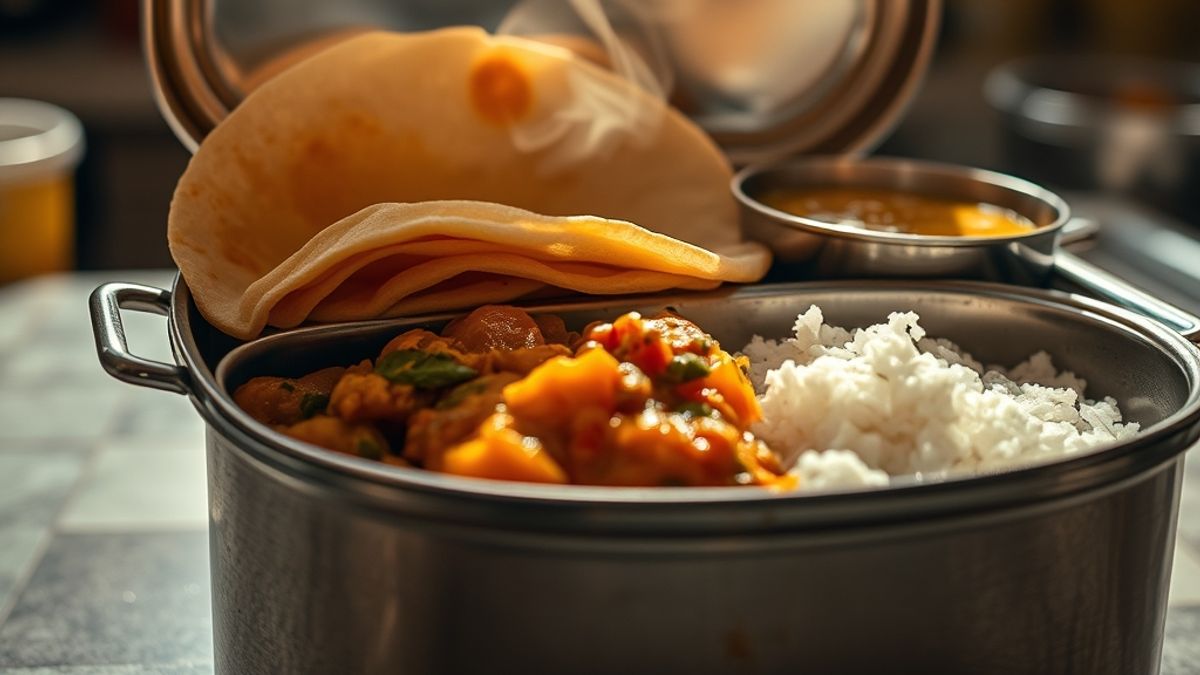
What you get is genuinely home-style: usually two or three rotis or chapatis, a sabzi, a dal or rice item, and sometimes a small sweet, achaar or salad, packed in a steel dabba. Menus rotate by day of the week — Monday’s chana might give way to Thursday’s rajma, with a slightly nicer spread on Friday. Many cooks specialise by community. A Gujarati kitchen will lean sweet-savoury with thepla, dhokla and undhiyu-style dishes; a Maharashtrian one might send pithla-bhakri, varan-bhaat or a batata bhaji; a South Indian cook may do rice, sambar, rasam and a poriyal. This is the real regional-home-food layer, and rupee for rupee it is the best food in the city.
Rough monthly bands run from around ₹2,500–₹4,500 for one veg meal a day, which works out to well under ₹200 a plate — often nearer ₹100 once you average it across the month. That is less than a single mediocre thali at a mall food court, delivered warm, six days a week.
How to vet a home cook
A menu photo tells you almost nothing. What tells you everything is a trial of two or three days before you commit to a month — and any cook confident in their food will happily give you one. During the trial, watch four things:
- Portion and value. Is it enough for a working adult, or a snack pretending to be a meal? Ask whether roti count is fixed or flexible.
- Spice and oil. Say up front if you want it low-oil, less chilli, or a particular regional style. Good home cooks adjust; that flexibility is the whole point of going direct.
- Punctuality. A tiffin that lands at 2:30 pm when you needed it at 1 is useless no matter how good it tastes.
- Diet honesty. Confirm whether it’s strictly pure-veg, includes egg, or does non-veg on certain days — and whether veg and non-veg are cooked in a shared kitchen, which matters to many families.
Also confirm the delivery cut-off and the area they serve. Most home cooks work a tight radius, then either send a local delivery boy or hand off to a dabbawala for the last mile, so being just outside their zone can quietly mean no delivery at all.
Regional and community dabbas
If you want a specific regional home cuisine rather than generic North Indian tiffin, Mumbai’s community concentrations are your map. This is where the city’s diversity pays off, because the cook and the neighbourhood tend to match:
- Gujarati and Jain tiffins are easy to find around Ghatkopar, Kandivali, Borivali, Mulund and the business districts, very often with strict no-onion-no-garlic (Jain) options and that signature touch of sweetness in the dal.
- South Indian home meals cluster where the Tamil, Malayali and Udupi communities live and work — Matunga (the obvious heartland), Chembur, Wadala, Sion and pockets of Navi Mumbai.
- Maharashtrian ghar-ka-khana is strongest in Girgaon, Dadar, Parel, Vile Parle and the central suburbs, where a good kitchen will send you seasonal specials during festivals.
- Bengali, Bihari and UP home food turns up through community networks in the eastern and far-northern suburbs, and around campus and hospital clusters where students and staff from those states congregate.
Because these are informal kitchens, don’t expect a slick website or an app icon. The honest move is to ask within the community — a colleague from that region, a neighbour, the owner of a regional grocery or sweet shop — and to describe the cuisine and the area you want rather than hunting a brand name. Community centres, regional associations and even the neighbourhood temple or gurudwara notice board can point you to a cook feeding a dozen homes already.
Expect to pay a little more than a generic tiffin for genuine regional cooking — roughly ₹3,000–₹6,000 a month — because the ingredients and the skill are more specific. If you’re new to the regional dishes themselves and unsure what to even ask for, our guides to Gujarati thali in Mumbai and Bengali food in Mumbai are a good primer on the dishes, the vocabulary and what a proper spread should include.
The apps: home-chef platforms
A newer layer sits on top of all this: platforms that connect you directly to vetted home chefs and handle the ordering and delivery for you. Several operate in Mumbai — home-cooked-food marketplaces and subscription tiffin apps have grown steadily — and the big delivery apps, Zomato and Swiggy, also list plenty of small “home-style” outfits and cloud kitchens alongside restaurants. Together they’ve made it far easier to eat home-ish food on your first week in the city, before you know a single aunty.
The trade-off is straightforward. Apps give you discovery, ratings, hygiene expectations and no-commitment single orders, which is ideal when you don’t yet have a trusted cook, when you’re only in the city for a few months, or when your schedule is too erratic for a fixed daily subscription. You can read reviews, see photos, order once, and never think about it again.
But apps cost more than a direct neighbourhood arrangement — you’re paying for the platform, the delivery rider and the convenience — and the “home chef” label varies in how literally true it is. Some listings are a genuine home kitchen; some are a small commercial cloud kitchen cooking in bulk and styled as homely. Neither is bad, but they’re not the same thing, and the price gap between an app meal and a direct monthly plan is real: what costs you ₹180 a meal on an app can cost half that, per plate, on a direct subscription.
So a sensible approach is to use the apps as a casting call, not a final home. Order from a few home chefs near you, notice which food actually tastes cooked-with-care and arrives on time, and if one turns out to be a real home kitchen you love, ask whether they’ll take you on a direct monthly plan. Many will, gladly — a guaranteed monthly customer is worth more to them than a stream of one-off app orders, and you both save the platform’s cut.
What it costs, roughly
Treat these as loose bands, not fixed rates — they shift with area, veg versus non-veg, and how premium the kitchen is:
- Single home-style meal (app or one-off): roughly ₹80–₹250 depending on portion and cuisine.
- Monthly veg tiffin (one meal a day): roughly ₹2,500–₹4,500.
- Monthly non-veg or premium/regional tiffin: higher, often ₹4,000–₹7,000 and up, especially if it includes chicken, fish or mutton on set days.
- Two meals a day (lunch and dinner): not simply double — many cooks give a combined rate, so ask.
- Dabbawala delivery (relaying your own tiffin): a modest separate monthly charge on top, since that’s a delivery fee, not food.
A few things that quietly change the number: delivery distance and whether you’re inside the cook’s core radius; how many rotis you want; whether weekends and festival days are included or billed separately; and whether you supply the dabba or they do. Always confirm the exact price, the meal contents, and the holiday schedule — many kitchens skip Sundays and major festivals — before you pay for a month, so a “₹3,000 tiffin” doesn’t turn out to be twenty-two meals rather than twenty-six.
How to get it delivered, and when
Timing is everything, and Mumbai’s tiffin clock is unusually precise. Lunch tiffins are the classic — cooked mid-morning, delivered by around 12:30–1:30 pm to offices and colleges, which is exactly the window the dabbawala relay was built around and tied to the Western, Central and Harbour local-train lines. If your food comes from a suburban home kitchen to an office in Fort, BKC or Lower Parel, it is very likely moving on the same rhythm as the trains, which is why the whole system runs on time despite having no app tracking your box.
Dinner tiffins are common for students and bachelors and usually land around 8–9 pm, cooked in a second batch late afternoon. If you want both meals, a single cook doing lunch and dinner is more convenient and often cheaper than juggling two arrangements — but confirm they can hit both windows reliably before you rely on it.
Where you work shapes which layer serves you best. Near a station on the suburban network, you’re in the sweet spot: pick a home cook in the suburbs and let the rail-keyed relay do the rest. In a newer office cluster off the metro, or across the creek in Navi Mumbai where traditional dabbawala coverage is thinner, lean more on app-based home chefs and on local cooks who run their own delivery rider rather than depending on the classic relay reaching you.
Tips for getting it right
- Always do a trial run. Two or three days tells you about portion size, spice and punctuality far better than any menu photo or five-star rating.
- Be specific about diet. Say up front if you want low-oil, Jain, egg-only, no-onion-no-garlic, or a particular regional style — good home cooks will happily adjust, but only if you tell them early.
- Keep two steel dabbas in rotation so you’re never stuck on the morning the empty one hasn’t come back yet. It happens more than you’d think.
- Confirm the delivery window and off-days before paying monthly, and get the number of the actual delivery person, not just the cook.
- Pay attention to freshness in the rains. During Mumbai’s heavy monsoon months, waterlogged tracks and stalled trains can delay any tiffin, and food cooked hours early in humid heat spoils faster — ask how far in advance the meal is cooked and how it’s kept warm and sealed on the way.
- Build a relationship, not just a transaction. The cook who knows you like less chilli and an extra roti on a long day is worth ten flashy app listings. Pay on time, return the dabba clean, and you’ll be looked after.
The payoff for a little legwork is significant: a warm, familiar, regional meal every single day for a fraction of what eating out costs — the quiet luxury that keeps this enormous, expensive, exhausting city feeling, at 1 pm and again at 9, a little bit like home.
Frequently Asked Questions
Do dabbawalas cook the food they deliver?
No. Mumbai's traditional dabbawalas are a delivery relay, not a kitchen. They collect the tiffin already packed at your home (or by a home cook you've hired) and carry it to your workplace by around 1 pm, then return the empty box in the afternoon. You need a cook at one end; the dabbawala handles only the logistics of getting it there and back.
How much does a monthly tiffin service cost in Mumbai?
As a rough guide, a single veg home-style meal per day runs about ₹2,500–₹4,500 a month, which works out to well under ₹200 a plate. Non-veg or premium regional tiffins are higher, often ₹4,000–₹7,000 or more, especially with chicken, fish or mutton on set days. One-off meals via home-chef apps typically cost ₹80–₹250. Always confirm the exact rate, what's included, and which holidays are skipped before paying for the month.
How do I find a good home-style tiffin near me in Mumbai?
Start with local networks rather than apps: building and PG WhatsApp groups, hostel notice boards, the watchman, the local kirana shop, and colleagues or neighbours from the cuisine you want. Home-chef apps are useful for discovering and sampling kitchens when you're new to the area. Whichever route you use, describe the region and area you need and always do a two-to-three-day trial before committing to a monthly subscription.
What's the difference between a tiffin service and a home-chef app in Mumbai?
A traditional tiffin service is usually a direct monthly arrangement with a neighbourhood home cook — cheaper, fresher, and personal enough that they'll adjust your spice level, but with less commitment protection. A home-chef app adds discovery, ratings, hygiene expectations and no-commitment single orders, which suits newcomers and short stays. Apps cost more per meal because you're paying the platform and rider, and the 'home chef' label can range from a genuine home kitchen to a small cloud kitchen, so use apps to sample and then move to a direct plan if you find a cook you love.
Are there Jain, pure-veg or specific regional tiffin options in Mumbai?
Yes, and this is where Mumbai's diversity pays off. Jain and Gujarati tiffins with strict no-onion-no-garlic options are easy to find around Ghatkopar, Kandivali, Borivali and Mulund; South Indian home meals cluster around Matunga, Chembur and Wadala; and Maharashtrian ghar-ka-khana is strongest in Girgaon, Dadar and Parel. Ask within the relevant community and specify the cuisine and area you want. Expect to pay a little more for genuine regional cooking, roughly ₹3,000–₹6,000 a month.
Is tiffin delivery reliable during the Mumbai monsoon?
It's mostly reliable, but the monsoon is the one season to plan around. Because the dabbawala relay and many home cooks depend on the suburban trains, waterlogged tracks and stalled locals can delay lunch on the worst days. Food cooked hours in advance also spoils faster in humid heat, so ask your cook how far ahead the meal is prepared and how it's kept warm and sealed. Keeping two steel dabbas in rotation helps you cope when an empty box doesn't come back on time.