
Mumbadevi Temple: The Goddess Who Gave Mumbai Its Name
A guide to Mumbadevi Temple in Bhuleshwar: the legend behind Mumbai's name, darshan timings, the Zaveri Bazaar gold lanes around it, and how to reach it.
'%3E%3Crect%20width%3D'96'%20height%3D'96'%20fill%3D'%23E65100'%2F%3E%3Ccircle%20cx%3D'30'%20cy%3D'24'%20r%3D'44'%20fill%3D'%23fff'%20opacity%3D'.12'%2F%3E%3Ccircle%20cx%3D'60'%20cy%3D'74'%20r%3D'40'%20fill%3D'%23000'%20opacity%3D'.10'%2F%3E%3C%2Fg%3E%3Cg%3E%3Ccircle%20cx%3D'48'%20cy%3D'48'%20r%3D'15'%20fill%3D'none'%20stroke%3D'%23fff'%20stroke-width%3D'3'%2F%3E%3Cpath%20fill%3D'%23fff'%20d%3D'M48%2037%20l3.5%2011%20-3.5%2011%20-3.5%20-11%20z'%2F%3E%3Ccircle%20cx%3D'48'%20cy%3D'48'%20r%3D'2.2'%20fill%3D'%23fff'%2F%3E%3C%2Fg%3E%3C%2Fsvg%3E)
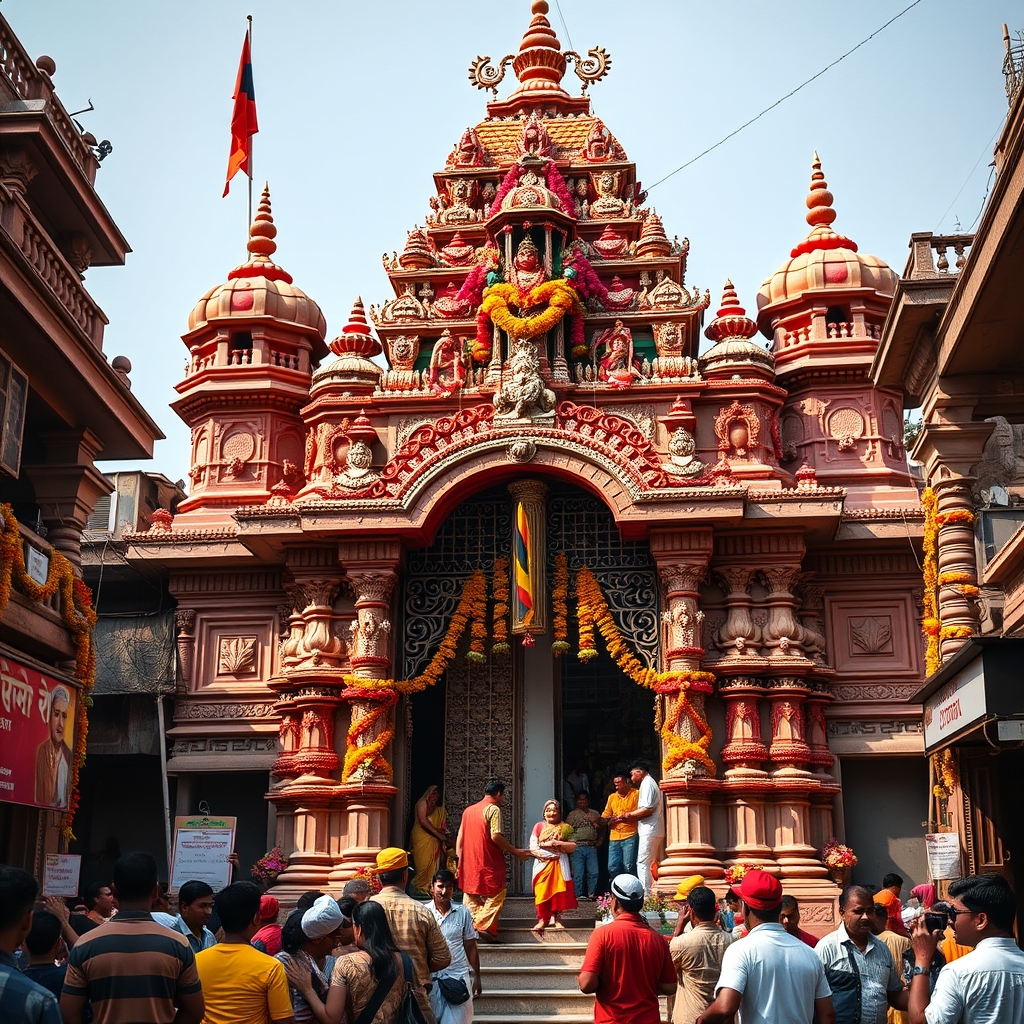
Photo: Magiceye · CC BY-SA 2.0 · via Wikimedia Commons
Most people walk straight past her. Tucked into a knot of jewellers’ lanes in Bhuleshwar, behind a modest saffron gateway, sits the small shrine that gave this city of twenty-odd million its name. Mumbai is, quite literally, the place of Mumba Aai — the mother goddess Mumba. If you have ever wondered why the city dropped “Bombay” and returned to “Mumbai,” the answer is a black-stone idol with a silver crown, worshipped here for centuries by the fisherfolk who lived on these islands long before the docks, the Fort or the trains.
This is not a grand temple in the way of Siddhivinayak or Mahalaxmi. It is a working neighbourhood shrine wrapped inside one of the busiest wholesale markets in India, and that is exactly what makes it worth an hour of your time. You come for the story, and you stay for the lanes.
Quick reference: the temple and its surroundings
| Place | Area | Cost | Best time | Nearest station |
|---|---|---|---|---|
| Shree Mumbadevi Mandir | Bhuleshwar | Free darshan | Weekday morning | Kalbadevi (Metro 3) |
| Zaveri Bazaar (gold) | Around the temple | Free to browse | Daytime, not lunch | Charni Road (WR) |
| Mangaldas Market (cloth) | Short walk | Free to browse | Daytime | Marine Lines (WR) |
| Shree Thaker Bhojanalay | Kalbadevi | ~₹400–700/head | Lunch, go early | Charni Road (WR) |
| Badshah (falooda) | Opp. Crawford Market | Falooda ~₹135 | Afternoon | CSMT (CR) |
The goddess who named a city
The name is not folklore invented for tourists. “Mumbai” comes from Mumbā — a local form of the mother goddess Parvati, worshipped in her fisherwoman aspect — joined with aai, the Marathi word for mother. Some scholars trace it further to Maha-Amba, “the Great Mother.” Either way, the goddess came first and the city took her name.
Mumbā was the patron deity of the Koli people, the fishing community who were the original inhabitants of the seven islands later stitched together into Bombay. For them she was not an abstraction but the presence that watched over the catch and the coast. When you stand in the sanctum today, you are standing in a line of devotion that predates almost everything else in the city around you.
There is a legend attached, told with local relish. A demon named Mumbaraka is said to have terrorised the islanders until an eight-armed goddess was sent to destroy him. Beaten and repentant, the demon begged her to take his name and stay among the people. She agreed — and so the goddess, and eventually the city, became Mumba’s.
Shree Mumbadevi Mandir, Bhuleshwar
Area: Mumbadevi Road, Zaveri Bazaar, Bhuleshwar. Why it is worth it: the idol and its symbolism reward a slow look rather than a quick bow. The central image of the goddess is carved in black stone and dressed in cloth, crowned in silver, with a gold nath (nose stud) and a gold necklace, and heaped each day with marigolds. Look closely and you will notice the idol is said to have no mouth — devotees read this as the mark of the silent, all-giving Mother Earth. To the left sits a stone figure of Annapurna, goddess of nourishment, riding a peacock; in front of the shrine stands a small tiger, the goddess’s vahana or mount. Practical tip: the sanctum is compact and the queue moves quickly on ordinary weekdays, so take a moment before you join it to actually read the icons rather than being swept past them.
From Bori Bunder to Bhuleshwar: a short history
The Mumbadevi you visit is not on its original site. The first shrine is believed to be some six centuries old and stood near Bori Bunder — the very ground where Chhatrapati Shivaji Maharaj Terminus (the old Victoria Terminus) now rises. It was built and tended by Koli fishermen.
As the British expanded their fortified town in the 1730s, the old temple was pulled down, and the goddess was moved inland to her present spot at Bhuleshwar. The structure you see today took shape over the following decades, with a local goldsmith among the patrons who paid for its rebuilding — a small but telling detail, given that the temple now sits at the heart of India’s gold trade. Rebuilt, relocated and repeatedly renovated, the shrine has effectively kept pace with the city it named.
Darshan: timings and what to expect
The temple is open every day and keeps long hours — the gates open early, well before six in the morning for the first mangal aarti, and darshan carries on through the day into the evening, with the final aarti late at night. Timings shift on festival days, so treat any published schedule as a guide rather than gospel.
A few things worth knowing before you go:
- Best days and worst crowds. Tuesday is the most auspicious day for the goddess and draws the biggest queues; Fridays are also busy. For a calm visit, come on a weekday morning outside those days.
- Navratri (the nine nights of the goddess, usually falling in September–October) is when the temple is at its most alive — flowers, lights, long lines and continuous ritual. Wonderful if you enjoy crowds and energy, and one to avoid if you do not.
- Offerings. Devotees bring coconuts, flowers, sweets and incense; stalls right outside sell ready-made puja thalis. Entry is free.
- Etiquette. Remove your footwear before entering, dress modestly, and keep phones away in the sanctum — photography of the idol is generally not encouraged.
The market that wraps around the temple
Half the pleasure of Mumbadevi is that you cannot separate the shrine from its surroundings. The lane leading up to it, Mumbadevi Road, is lined with stalls selling everything a household altar needs — idols, framed prints, garlands, bells, vermilion, incense.
Zaveri Bazaar
Area: immediately around the temple, spilling north from Crawford Market. Why it is worth it: this is the beating heart of India’s gold and jewellery trade — a roughly 150-year-old market of thousands of shops, some over three centuries old, packed into lanes barely wide enough for two people to pass. A very large share of the country’s gold changes hands here. Even if you are not buying, the sheer density of glittering windows, hand-carts, tea-sellers and darting couriers is a spectacle. Practical tip: keep your bag in front of you and your wits about you in the crush, carry some cash, and do not expect to move quickly — this is a place to drift, not to march through.
Fan out a little and the specialisations change street by street. Mangaldas Market, a short walk away, is one of Asia’s great textile bazaars — bolts of cotton, silk, chiffon and block-print stacked to the ceiling, ideal if you want cloth for un-stitched garments. Crawford Market (officially Mahatma Jyotiba Phule Mandai), just to the south, is the old colonial-era hall for fruit, imported goods and general oddments. Push on towards C.P. Tank (Cawasji Patel Tank) and you reach the lanes known for bangles.
Other shrines in the Bhuleshwar cluster
Bhuleshwar is one of the densest concentrations of old temples in Mumbai, so Mumbadevi rewards being combined with a short temple walk. Within a few minutes on foot you can reach the Bhuleshwar Mahadev temple the area is named for, the ornate Godiji Parshwanath Jain temple, and the striking Kabutar Khana pigeon-feeding plaza nearby. The lanes are also studded with smaller Devi and Hanuman shrines tucked between shopfronts. It is a genuinely layered quarter — gold traders, temple bells, cloth wholesalers and street kitchens all packed into the same few blocks — and an hour of unhurried wandering shows you an older, denser Mumbai than the postcard sights ever do.
Where to eat nearby
Shree Thaker Bhojanalay (Fanaswadi, Kalbadevi) is the classic pairing with a Mumbadevi visit — an unlimited Gujarati thali served since 1945, with waiters circling to refill bowls of vegetables, farsan, rotli, rice, chutneys and, at weekends, sweets like shrikhand and gulab jamun. It is a proper sit-down feast; expect to pay a few hundred rupees a head and to leave defeated. Come hungry and go early to dodge the queue on the stairs.
Badshah Cold Drinks (opposite Crawford Market, on Lokmanya Tilak Road) has been pulling in crowds for over a century for its falooda — the royal falooda, a tall glass of milk, sev, sabja, rose syrup and vanilla ice cream, runs around ₹135. Pure vegetarian and largely cash-only, so carry notes.
Vinay Health Home (Thakurdwar, near Charni Road in Girgaon) is the spot for a Maharashtrian breakfast — a fiery misal pav, batata vada, poha and sabudana vada, at a plain, clean, decades-old eating house that opens by seven in the morning. A short taxi or brisk walk from the temple, and a good way to bookend the outing.
Getting there
The single biggest change in recent years is the metro. Mumbai Metro Line 3 (the Aqua Line), the city’s first underground line, opened its final stretch in October 2025, and Kalbadevi station now sits only a five-to-seven-minute walk from the temple — comfortably the easiest way in.
On the suburban rail, Charni Road (Western line) is roughly 1.5 km away and Marine Lines is about a 13-minute walk; Chhatrapati Shivaji Maharaj Terminus on the Central line is around 2 km. From CSMT or Crawford Market it is a pleasant, if chaotic, ten-to-fifteen-minute walk through the bazaar.
If you drive or take a taxi, expect to crawl: the lanes are narrow and permanently congested. Avoid the roughly 8–10am and 5–9pm windows, and honestly, once you are near, walking beats sitting in a jam.
A few practical notes for the visit itself: wear slip-on footwear, since you will remove it at the shrine and again if you step into the Jain temple nearby; carry small cash for offerings, the puja stalls and the falooda afterwards; and give the bazaar a wide berth on major gold-buying festival days like Akshaya Tritiya and Dhanteras, when Zaveri Bazaar becomes almost impassable. Mornings on an ordinary weekday remain the sweet spot — the shrine is calm, the market is waking up, and the light in the narrow lanes is at its best.
Plan your visit
Mumbadevi rewards curiosity more than piety. It is small, unshowy and hemmed in by commerce — but it is the origin point of the city’s name and one of the last living links to the Koli fishing world that existed here before the metropolis. Take Metro Line 3 to Kalbadevi on a weekday morning, read the icons before you join the quick-moving queue, then give yourself an hour to drift through Zaveri Bazaar and Mangaldas Market before a Gujarati thali at Shree Thaker or a falooda at Badshah. You come away understanding something the skyline cannot tell you: that before Mumbai was a financial capital, it was a fishing coast that belonged to a mother goddess.
Frequently Asked Questions
Why is Mumbai named after Mumbadevi Temple?
The city takes its name from the goddess Mumbā (Mumba Aai), the patron deity of the Koli fishing community who first lived on these islands. 'Mumbai' is her name plus aai, the Marathi word for mother. The goddess and her shrine long predate the modern city.
What are the Mumbadevi Temple darshan timings?
The temple is open daily and keeps long hours — the gates open early, before six in the morning for the first mangal aarti, and darshan runs through the day into the evening, with a final aarti late at night. Timings shift on festival days, so treat any published schedule as a guide rather than gospel.
Which day is best to visit Mumbadevi Temple?
Any day works as the temple is open daily, but Tuesday is the most auspicious for the goddess and draws the biggest crowds, with Fridays also busy. For a calm visit, come on a weekday morning outside Tuesday and Friday. Navratri (September–October) is the most vibrant but most crowded time.
How do I reach Mumbadevi Temple without a car?
Take Metro Line 3 (the Aqua Line) to Kalbadevi station, about a five-to-seven-minute walk away. On suburban rail, Charni Road and Marine Lines on the Western line are within walking distance, and CSMT on the Central line is about 2 km. Walking in from Crawford Market through the bazaar is quick and interesting.
Is there an entry fee for Mumbadevi Temple?
No. Darshan is free. You only pay for offerings or specific pujas, and small stalls right outside sell ready-made puja thalis of coconuts, flowers and sweets. Remove your footwear, dress modestly, and be discreet with cameras near the idol.