
'%3E%3Crect%20width%3D'96'%20height%3D'96'%20fill%3D'%236A1B9A'%2F%3E%3Ccircle%20cx%3D'30'%20cy%3D'24'%20r%3D'44'%20fill%3D'%23fff'%20opacity%3D'.12'%2F%3E%3Ccircle%20cx%3D'60'%20cy%3D'74'%20r%3D'40'%20fill%3D'%23000'%20opacity%3D'.10'%2F%3E%3C%2Fg%3E%3Cg%20fill%3D'%23fff'%3E%3Cpath%20d%3D'M56%2033%20a16%2016%200%201%200%201%2030%20a12.5%2012.5%200%201%201%20-1%20-30%20z'%2F%3E%3Cpath%20d%3D'M39%2040%20l1.1%202.4%202.6%20.2%20-2%201.8%20.6%202.6%20-2.3%20-1.3%20-2.3%201.3%20.6%20-2.6%20-2%20-1.8%202.6%20-.2%20z'%2F%3E%3C%2Fg%3E%3C%2Fsvg%3E)
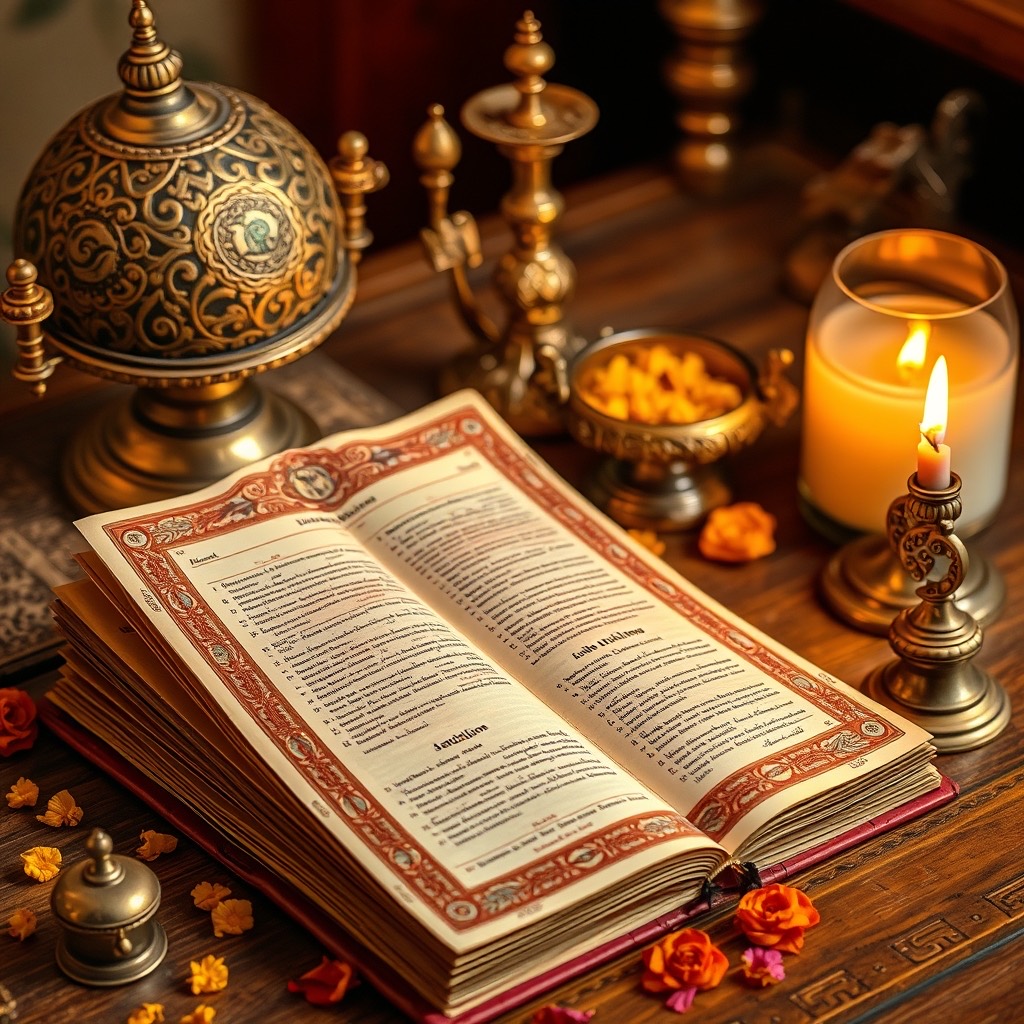
Ask when Diwali falls, when to begin a new venture, or which hour is best for a wedding, and the answer comes from one book: the Panchang, the Hindu almanac. It is the timekeeping backbone of Indian tradition — part calendar, part astronomical table, part guide to auspicious hours. This is what it contains, how each part is worked out, and how to read one yourself.
What the Panchang is
The word breaks into pancha (five) and anga (limb): the five limbs. For every single day, a Panchang records five quantities — tithi, vaara, nakshatra, yoga and karana — each computed for a specific place and date, because the sky over Mumbai at sunrise is not the sky over Delhi or Chennai. Four of the five limbs are drawn from the shifting angle between the Sun and the Moon; only the weekday stands apart. Together they turn the raw motion of the heavens into a practical guide for daily life, ritual and celebration.
Why the Sun and Moon are the engine
The Vedic calendar is luni-solar: it tracks the Moon’s phases for the month and the Sun’s path for the year, then reconciles the two. The Moon circles the zodiac in about 27.3 days; the Sun takes a year. The difference between their positions — how far the Moon has pulled ahead of the Sun — generates the tithi, the yoga and the karana. The Moon’s own position against the fixed stars gives the nakshatra. Only the weekday runs on its own seven-day cycle. Grasp that the Sun–Moon relationship drives almost everything, and the rest of the Panchang falls into place.
The five limbs, one by one
1. Tithi — the lunar day
A tithi is the time the Moon takes to gain 12° on the Sun. Thirty tithis make a lunar month, split into two fortnights (paksha):
- Shukla Paksha — the bright, waxing fortnight, Pratipada to Purnima (full moon).
- Krishna Paksha — the dark, waning fortnight, Pratipada to Amavasya (new moon).
Because the Moon’s speed varies, a tithi is rarely exactly one solar day — it can start and end at any clock time, and occasionally a tithi is skipped (kshaya) or repeated (adhika). Tithis are grouped by character, which is why some are preferred for beginnings and others avoided:
| Group | Tithis (in each paksha) | Character |
|---|---|---|
| Nanda (joyful) | Pratipada, Shashthi, Ekadashi | Prosperity, celebrations |
| Bhadra (healthy) | Dwitiya, Saptami, Dwadashi | Steady, everyday work |
| Jaya (victorious) | Tritiya, Ashtami, Trayodashi | Courage, competition |
| Rikta (empty) | Chaturthi, Navami, Chaturdashi | Generally avoided for auspicious starts |
| Purna (full) | Panchami, Dashami, Purnima/Amavasya | Completion, fulfilment |
The tithi is the single most important limb — it dates almost every festival and anchors most muhurats.
2. Vaara — the weekday and its planet
The seven vaaras are the ordinary weekdays, each ruled by a planet whose nature colours the day:
| Vaara | Day | Ruling planet | Suited to |
|---|---|---|---|
| Ravivara | Sunday | Sun (Surya) | Authority, health, government work |
| Somavara | Monday | Moon (Chandra) | Home, water, gentle beginnings |
| Mangalavara | Tuesday | Mars (Mangala) | Energy, property, disputes; often avoided for calm starts |
| Budhavara | Wednesday | Mercury (Budha) | Study, trade, communication |
| Guruvara | Thursday | Jupiter (Guru) | Weddings, education, spiritual acts — highly auspicious |
| Shukravara | Friday | Venus (Shukra) | Love, art, luxury, vehicles |
| Shanivara | Saturday | Saturn (Shani) | Labour, iron, service; slow and serious |
3. Nakshatra — the lunar mansion
The zodiac is divided into 27 nakshatras (lunar mansions), each about 13°20′ wide. The nakshatra is simply which mansion the Moon occupies that day, and it carries a strong flavour — some nakshatras favour travel, others learning, marriage, or healing. The Moon passes roughly one nakshatra per day, so this limb changes daily and is central to choosing a muhurat. (For the full set, see The 27 Nakshatras.)
4. Yoga — the Sun–Moon sum
A yoga is formed by adding the longitudes of the Sun and Moon and dividing the zodiac into 27 equal parts. There are 27 yogas, from Vishkambha to Vaidhriti. Most are benign; a few — such as Vyatipata and Vaidhriti — are treated as inauspicious and avoided for important beginnings. The yoga is easy to overlook but valued in careful muhurat work.
5. Karana — the half-tithi
A karana is half a tithi (the Moon gaining 6° on the Sun), so there are two karanas per tithi and 60 per lunar month. There are 11 karanas in all: four fixed (Shakuni, Chatushpada, Naga, Kimstughna) that occur once a month, and seven movable that repeat. The one to know is Vishti, better known as Bhadra — a karana traditionally shunned for auspicious acts. A good Panchang always flags when Bhadra is active.
Amanta and Purnimanta — the two month systems
A lunar month can be bracketed two ways, and this is the commonest source of regional confusion:
- Amanta (used in south and west India, including Maharashtra) — the month ends at the new moon (amavasya).
- Purnimanta (used across much of north India) — the month ends at the full moon (purnima).
The tithis themselves are identical; only the month label shifts. This is why the same festival can be assigned to different month names in different regions, even though everyone celebrates on the same night.
The inauspicious windows — and one good one
Beyond the five limbs, a daily Panchang marks the kaal periods to avoid, all of which move with your local sunrise and sunset:
- Rahu Kaal — a ~90-minute window ruled by Rahu, avoided for starting important work.
- Yamaganda — ruled by Yama; likewise avoided for beginnings.
- Gulika Kaal (Kuligai) — the segment of Saturn’s shadow, considered unfavourable.
- Bhadra (Vishti karana) — avoided for auspicious acts while it lasts.
And the reliably favourable one: Abhijit Muhurta, a short ~48-minute slot around local solar noon, generally auspicious for beginnings when a fuller muhurat has not been calculated.
Muhurat — choosing an auspicious time
Muhurat (or muhurta) is the art of picking the right moment to begin something — a wedding, a housewarming (griha pravesh), a new business, a journey, or a child’s first lessons. Rather than a single lucky time, it is an alignment: a supportive tithi, an auspicious weekday, a favourable nakshatra and yoga, a karana clear of Bhadra, all sitting outside Rahu Kaal, Yamaganda and Gulika Kaal. When those line up, the window is your muhurat. Everyday choices can lean on the daily Panchang; a wedding or a chart-linked decision is best set by an astrologer who reads the day’s Panchang against your birth chart.
How the Panchang dates the festivals
Because Hindu festivals are pinned to tithis and nakshatras, their Western dates move each year — the Panchang is what tells you when they land:
- Diwali — Kartik Amavasya (the new moon of Kartik).
- Holi — Phalguna Purnima (the full moon of Phalguna).
- Ganesh Chaturthi — Shukla Chaturthi of Bhadrapada.
- Krishna Janmashtami — Krishna Ashtami of Bhadrapada.
- Maha Shivaratri — the Chaturdashi of Krishna Paksha in Phalguna.
- Makar Sankranti — an exception, fixed by the solar calendar (the Sun’s entry into Capricorn), so it falls on nearly the same date each year.
Drik and Vakya — how it is calculated
Two traditions compute the Panchang. Drik (Drika) Panchang works from observed, astronomical positions and is what nearly all modern almanacs and apps use. Vakya Panchang follows older mnemonic tables passed down in tradition, still used in parts of Tamil Nadu and Kerala. The two usually agree closely, but can differ by a small margin that occasionally shifts a tithi’s ending time — and, rarely, a festival’s date by a day. When two calendars disagree, this is often why.
Reading it in daily life
You do not need to be a scholar to get value from a Panchang. Millions check it to:
- find festival and fasting days (Ekadashi, Pradosh, Sankashti);
- pick a weekday that suits a task (Thursday for study, Friday for a purchase);
- avoid Rahu Kaal when signing, launching or travelling;
- grab Abhijit Muhurta for a quick auspicious start;
- and simply stay in step with the rhythm of the traditional year.
In short
The Panchang compresses the whole moving sky into five daily numbers — tithi, vaara, nakshatra, yoga, karana — plus the kaal windows around them. Learn to read those, and you hold the same tool that dates every festival, sets every muhurat and has kept Indian ritual life synchronised with the heavens for well over two thousand years. Start with today’s tithi; the rest follows.