India's First Language Museum Opens in Kolkata
Shabdalok museum showcases India's linguistic diversity, tracing evolution of languages and scripts.
'%3E%3Crect%20width%3D'96'%20height%3D'96'%20fill%3D'%23B3261E'%2F%3E%3Ccircle%20cx%3D'30'%20cy%3D'24'%20r%3D'44'%20fill%3D'%23fff'%20opacity%3D'.12'%2F%3E%3Ccircle%20cx%3D'60'%20cy%3D'74'%20r%3D'40'%20fill%3D'%23000'%20opacity%3D'.10'%2F%3E%3C%2Fg%3E%3Cg%20fill%3D'%23fff'%3E%3Crect%20x%3D'29'%20y%3D'49'%20width%3D'8'%20height%3D'19'%20rx%3D'1'%2F%3E%3Crect%20x%3D'39'%20y%3D'40'%20width%3D'9'%20height%3D'28'%20rx%3D'1'%2F%3E%3Crect%20x%3D'50'%20y%3D'45'%20width%3D'8'%20height%3D'23'%20rx%3D'1'%2F%3E%3Crect%20x%3D'60'%20y%3D'53'%20width%3D'7'%20height%3D'15'%20rx%3D'1'%2F%3E%3Crect%20x%3D'41'%20y%3D'34'%20width%3D'5'%20height%3D'6'%2F%3E%3C%2Fg%3E%3C%2Fsvg%3E)
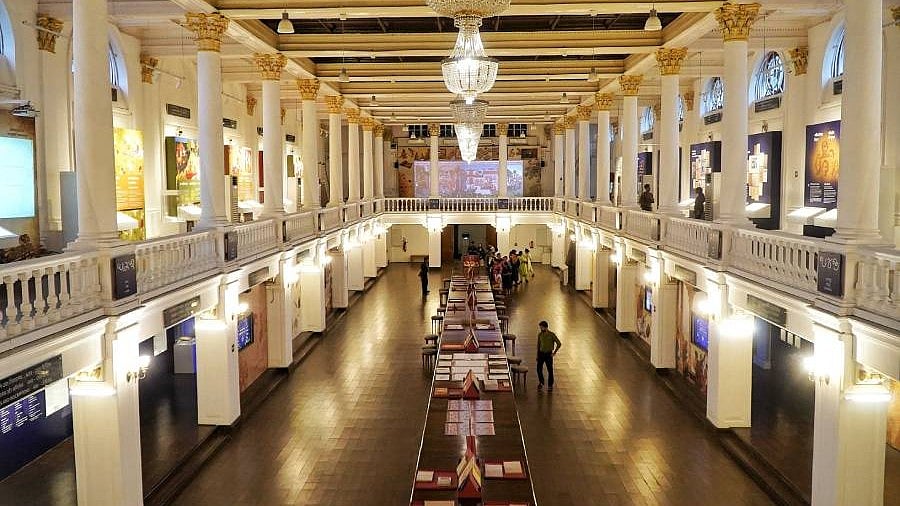
India's first language museum, Shabdalok, has opened its doors to the public on the National Library campus in Kolkata. The museum, which formally launched on July 19, aims to provide an immersive experience, exploring the diversity of Indian languages, scripts, and literature through digital displays, holograms, and audio-visual walls.
The nine galleries of Shabdalok take visitors on a journey from the origin of words and mother tongues to the evolution of language, oral traditions, and performing arts. The museum also delves into the contributions of individual writers and thinkers, public dialogue, and the history of public libraries.
With over 19,500 languages and dialects spoken in India, according to the 2011 Census, the museum's first phase focuses on tracing the diversity of Indian languages and scripts. The exhibits cover the constitutionally recognized languages, following their movement from oral traditions and manuscripts into print and electronic text.
One of the notable installations allows visitors to pick a single word and watch its meaning change over centuries, demonstrating how language can drift over generations. This interactive exhibit has already sparked curiosity among visitors, with one college student admitting that it made her rethink something she says every day without noticing.
While some visitors, like Iftekhar Ahsan, Founder of Calcutta Walks, have commended the initiative for providing public access to the previously closed National Library, others have expressed concerns about the museum's impact. Ahsan feels that the museum could have been made more immersive and detailed, but acknowledges that it dedicates a great space to the linguistic heritage of the country.
The National Library, where the museum is located, has a rich history dating back to 1836. The library has spent nearly two centuries collecting and preserving India's literary heritage, making it the perfect location for a museum that celebrates the country's linguistic diversity.
Shabdalok's opening marks a significant milestone in India's cultural landscape, providing a unique platform for people to engage with and appreciate the country's rich linguistic heritage. As visitors explore the museum, they will be encouraged to think about their mother tongue and the evolution of language in a new and immersive way.
The museum's launch is also expected to boost tourism in Kolkata, with visitors from across the country and abroad flocking to experience the city's newest cultural attraction. With its unique blend of technology and tradition, Shabdalok is set to become a must-visit destination for anyone interested in language, culture, and history.
In the coming months, the museum is expected to attract scholars, researchers, and language enthusiasts, who will be able to explore the vast collections and exhibits on offer. As India's first language museum, Shabdalok has the potential to change the way people see and interact with their mother tongue, and its impact is likely to be felt for years to come.
In conclusion, Shabdalok's opening is a significant event that celebrates India's linguistic diversity and provides a unique platform for people to engage with and appreciate the country's rich cultural heritage. As the museum continues to evolve and grow, it is likely to become an important cultural institution in India, promoting a deeper understanding and appreciation of the country's languages and scripts.
Frequently asked questions
What is the name of India's first language museum?
Shabdalok, located on the National Library campus in Kolkata.
What is the focus of the museum's first phase?
The first phase of the museum focuses on tracing the diversity of Indian languages and scripts.