EIL, CSIR-IMMT Partner for Indigenous Mineral Technologies
EIL and CSIR-IMMT sign MoU to advance mineral processing and critical minerals. Collaboration to facilitate research and development initiatives.
'%3E%3Crect%20width%3D'96'%20height%3D'96'%20fill%3D'%23B3261E'%2F%3E%3Ccircle%20cx%3D'30'%20cy%3D'24'%20r%3D'44'%20fill%3D'%23fff'%20opacity%3D'.12'%2F%3E%3Ccircle%20cx%3D'60'%20cy%3D'74'%20r%3D'40'%20fill%3D'%23000'%20opacity%3D'.10'%2F%3E%3C%2Fg%3E%3Cg%20fill%3D'%23fff'%3E%3Crect%20x%3D'29'%20y%3D'49'%20width%3D'8'%20height%3D'19'%20rx%3D'1'%2F%3E%3Crect%20x%3D'39'%20y%3D'40'%20width%3D'9'%20height%3D'28'%20rx%3D'1'%2F%3E%3Crect%20x%3D'50'%20y%3D'45'%20width%3D'8'%20height%3D'23'%20rx%3D'1'%2F%3E%3Crect%20x%3D'60'%20y%3D'53'%20width%3D'7'%20height%3D'15'%20rx%3D'1'%2F%3E%3Crect%20x%3D'41'%20y%3D'34'%20width%3D'5'%20height%3D'6'%2F%3E%3C%2Fg%3E%3C%2Fsvg%3E)
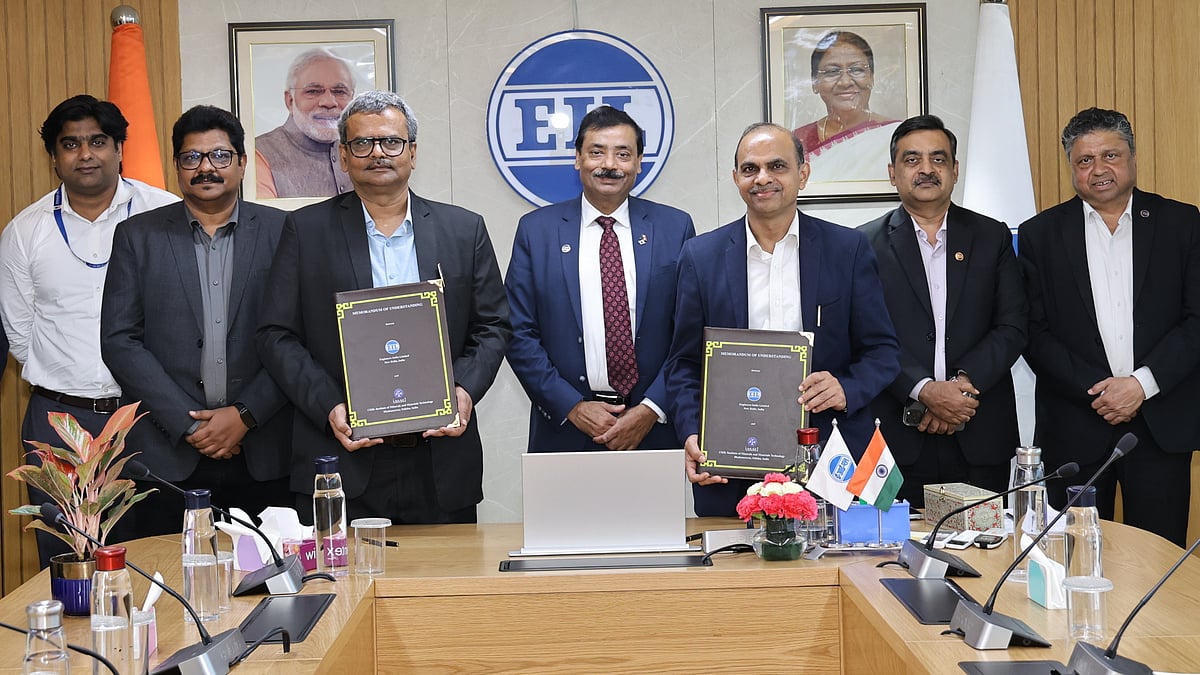
Engineers India Limited (EIL) and the CSIR-Institute of Minerals and Materials Technology (CSIR-IMMT) have signed a Memorandum of Understanding (MoU) to strengthen collaboration in mineral processing, extractive metallurgy, and the critical and strategic minerals value chain.
The MoU was signed on 23 July 2026 at EIL's Head Office in New Delhi by Rajiv Agarwal, Director (Technical), EIL, and Dr Ramanuj Narayan, Director, CSIR-IMMT. The signing ceremony was attended by Atul Gupta, Chairman and Managing Director, EIL, and Dr Kali Sanjay, Head, Business Development & CoE, CSIR-IMMT, along with senior officials from both organizations.
Under the agreement, EIL and CSIR-IMMT will jointly identify, evaluate, and undertake research and development initiatives in critical and strategic minerals. The collaboration will facilitate the exchange of technical expertise, capacity-building programs, technology scale-up, and the execution of pilot-scale and commercial deployment projects.
EIL is a public sector undertaking under the administrative control of the Ministry of Petroleum & Natural Gas (MoPNG), Govt. of India. It is a premier engineering consultancy agency providing concept to commissioning services across various sectors, including oil & gas, petroleum, refining, ferrous & non-ferrous, fertilizers, infrastructure, and renewable energy.
CSIR-IMMT, a constituent laboratory of CSIR, is engaged in research and technology development in mineral processing, extractive metallurgy, and materials engineering. It is recognized as a Centre of Excellence for Critical Minerals under the National Critical Mineral Mission.
The partnership between EIL and CSIR-IMMT is expected to advance indigenous technologies for critical and strategic minerals, contributing to the country's self-reliance in the mineral sector. The collaboration will also facilitate the development of new technologies and processes, creating opportunities for growth and employment in the sector.
The National Critical Mineral Mission aims to make India self-reliant in critical minerals, which are essential for various industries, including electronics, renewable energy, and defense. The mission focuses on developing domestic capabilities in mineral exploration, mining, and processing, as well as promoting research and development in critical mineral technologies.
The partnership between EIL and CSIR-IMMT is a significant step towards achieving the objectives of the National Critical Mineral Mission. By leveraging their expertise and resources, the two organizations can develop innovative solutions for the mineral sector, contributing to the country's economic growth and development.
In conclusion, the MoU between EIL and CSIR-IMMT marks a significant milestone in the development of indigenous technologies for critical and strategic minerals. The collaboration is expected to have a positive impact on the mineral sector, contributing to the country's self-reliance and economic growth.
The partnership is also expected to create new opportunities for research and development in critical mineral technologies, promoting innovation and entrepreneurship in the sector. As India continues to grow and develop, the demand for critical minerals is expected to increase, making it essential to develop domestic capabilities in mineral exploration, mining, and processing.
Overall, the MoU between EIL and CSIR-IMMT is a significant step towards advancing indigenous technologies for critical and strategic minerals, contributing to the country's economic growth and development.
Frequently asked questions
What is the purpose of the MoU between EIL and CSIR-IMMT?
The MoU aims to strengthen collaboration in mineral processing, extractive metallurgy, and the critical and strategic minerals value chain.
What are the expected outcomes of the partnership between EIL and CSIR-IMMT?
The partnership is expected to advance indigenous technologies for critical and strategic minerals, contributing to the country's self-reliance in the mineral sector.